
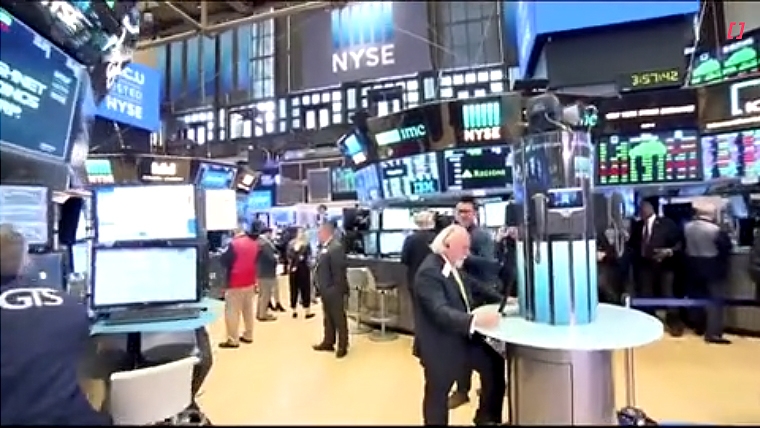
Risk sentiment improved overnight despite the lack of positive news coming out of the Middle East. We await President Trump’s next move in the region to break the deadlock. US equities show strong gains to a fresh record high, buoyed by strong earnings from IT companies and capping off a very strong month. The ECB and BoE have joined other central banks in keeping policy steady despite upside pressure on inflation. Global rates are lower. The USD is broadly weaker, and JPY has outperformed following official intervention. The NZD has recovered strongly, breaking up through 0.59.
Yesterday afternoon, Axios reported that CENTCOM was due to brief Trump on two plans for potential military action in Iran – one involving a short and powerful wave of strikes in the hope of breaking the deadlock and one involving taking over the Strait of Hormuz to reopen for commercial shipping, which could include ground forces.
This saw the market trade with a risk-off tone and sent Brent crude up through USD126 per barrel. Prices have since plunged to USD114, albeit that reflects the expiring of the active futures contract, with little appetite for speculators holding the contract to convert into physical delivery. Brent dated, which measures the price for near-term physical delivery, isn’t affected by the futures roll, and is down only slightly for the day and sits around USD123 per barrel.
In overnight news, we’ve heard from Iran’s Supreme Leader Khamenei. In a written statement, he vowed not to give up the country’s nuclear or missile technologies and to keep control of the Strait of Hormuz. And so the stalemate between the US and Iran continues.
The BoE and ECB policy updates didn’t surprise, with policies on hold and both waiting to see how developments in the Middle East evolve before pulling the trigger on higher rates.
For the BoE, the MPC voted 8-1, with Chief Economist Pill arguing for a 25bps hike. Rather than set out a central forecast, the BoE offered three scenarios conditioned on different paths for oil prices and the strength of second round effects. All three scenarios led to higher rates. Each MPC member expressed views on which scenarios they saw as more likely. Governor Bailey suggested rates may need to rise and “it would be a mistake to wait to see second round effects before acting because then it would be too late”. The market viewed the one dissent as a dovish surprise and rates fell, albeit this was against a backdrop of lower global rates. The market is pricing a June hike at about a 60% chance, with a July hike more than fully priced.
The ECB said that the upside risks to inflation and the downside risks to growth have intensified. President Lagarde said they debated in depth a decision to hike today and the debate must be revisited at the next policy meeting in six weeks’ time. “…we are not seeing second round effects…we are receiving inconsistent information...there are no intentions to significantly raise wages…financial tightening is happening…for these reasons we want to give ourselves time”. The market attributes a high probability for a June hike and prices nearly three full hikes for this year.
Ahead of the meeting, Euro area GDP rose just 0.1% q/q in Q1, one-tenth weaker than expected even with a stronger than expected 0.3% q/q gain for Germany. CPI inflation figures were in line, with annual headline inflation rising to 3.0%, from 2.6%, and core inflation down a tick to 2.2%.
Better risk sentiment has supported bond markets with falls led by the short end. The US 10-year Treasury yield is down 4bps to 4.39% against a 7bps fall in the 2-year rate. European and UK 2-year rates are down about 10bps while 10-year rates are down 6-7bps.
US GDP rose an annualised 2.0% in Q1, two-tenths weaker than expected. The figure was buoyed by the end of the government shutdown in Q4, which saw government spending jump 4.4%, while the AI boom drove strong gains in investment. Private consumption moderated to 1.6% while net exports detracted. Yesterday, Fed Chair Powell described the US economy as “quite resilient” and that is probably a fair description. Initial jobless claims surprisingly plunged 26k last week to 189k with broad falls across States. Alongside the recent lift in weekly ADP private payrolls data, labour market conditions look to have improved.
The core PCE deflator rose 0.3% m/m and 3.2% yoy in March, as expected while the employment cost was slightly stronger at 0.9% q/q in Q1.
In currency markets, the USD is broadly weaker, reflecting the positive risk backdrop. The yen surged after repeated warnings by Japanese officials, with traders convinced that official intervention occurred. This followed USD/JPY recent break up through 160. Following intervention, the currency has settled below 156.50. However, with the BoJ’s super easy policy stance being a key force behind repeated yen weakness, the stronger yen is only likely a temporary reprieve that shakes out speculative positions. NZD/JPY has fallen to 92.3, back to where it sat a few weeks ago.
After weaker risk appetite made for a soggy NZD during local trading hours, the NZD has steadily risen overnight, driving up through 0.59 for a gain of 1.3% since this time yesterday. The AUD has followed a similar path and is near 0.72. NZD/AUD has nudged back above 0.82 and the NZD is stronger on the crosses apart from against the yen. NZD/EUR has recovered to 0.5030 and NZD/GBP has recovered to 0.4340.
Yesterday, the ANZ business outlook survey showed weaker key activity indicators in April compared to March, albeit not as weak as the late-March figures when fuel prices were rocketing ahead and there was talk of fuel rationing. Year-ahead inflation expectations jumped to 3.81% in April from 3.08% in March, and from 3.70% in late March. Pricing intentions remained high, but eased to 57.5, from 60.3 in March and 67.0 in late-March.
Swap rates fell after the data, following decent gains earlier in the session driven by global forces, but rates still closed higher on the day. The 2-year swap rate rose 6bps to 3.60% while the 10-year rate rose 5bps to 4.38%. The NZGB curve showed more of a flattening bias, with short rates up 5-6bps, the 10-year rate up 3bps to 4.76%, while rates rose by just 1bp for the longest maturity bonds. The Australian 10-year bond future is down 7bps in yield terms since the NZ close, setting the scene for lower NZ rates on the open.
On the calendar today, in NZ consumer confidence and building consents are released, followed by Tokyo CPI data. The key release tonight is the ISM manufacturing survey, with the consensus expecting a small lift to 53.2.
Daily exchange rates
Select chart tabs
Jason Wong is the senior Markets Strategist at BNZ Markets.
We welcome your comments below. If you are not already registered, please register to comment
Remember we welcome robust, respectful and insightful debate. We don't welcome abusive or defamatory comments and will de-register those repeatedly making such comments. Our current comment policy is here.