

Having been pounded down three cents from 0.6800 to 0.6500 over recent weeks against the USD, due to lower interest rates in Australia and New Zealand as well as the China/US trade wars starting up again, the Kiwi dollar is showing some tentative signs of attracting some support in the FX markets.
The NZD/USD exchange rate sat at 0.6500 for most of last week, however a slightly weaker USD in global forex markets later in the week allowed a partial recovery in the Kiwi dollar up to 0.6550.
Profit taking by speculators who short sold the Kiwi dollar in late March when RBNZ Governor Adrian Orr hinted that the next move in NZ interest rates would most likely be downwards, added to the Kiwi bounce back.
The move back upwards has seen the rate break out and above the downtrend line it has remained under since 0.6900 in late March.
Whether further buying interest is enticed into the Kiwi by this technical/chart change remains to be seen.
What can now be stated with some more certainty, in terms of the outlook for the NZD from here, is that the negative sentiment from expectations of lower interest rates is already fully priced into the exchange rate and therefore unlikely to cause further NZD weakness.
GDP growth numbers are the next pointer for NZD direction
Retail sales figures for the March quarter recording a 3.7% increase over the same quarter in 2018 was a timely reminder to the financial markets last week that the NZ economy is not stalling and falling into a hole as some pundits have been confidently predicting.
Manufacturing and service industry surveys have,however, been weaker over recent months as demand eases off somewhat due to global business investment being in a “on-hold” mode pending some settlement of the trade squabbles between China and the US.
Our exports continued to expand at a strong clip in the first part of 2019 with increased volumes and prices.
When overall GDP growth figures for the March quarter are released on 20 June, the growth momentum may surprise on the upside with an increase above 0.6% for the quarter now quite likely.
Back in September 2018, it was a much stronger than expected +1.0% increase in GDP growth in the June 2018 quarter that reversed the Kiwi dollar upwards from rates below 0.6500 at the time.
Global economic and financial markets conditions in late 2018 were arguably much more uncertain than they are today. The share markets were plummeting due to the US Federal Reserve increasing their interest rates and the trade war was fully underway.
In contrast, the international environment today is only clouded by the blow-up in trade talks between the US and China over the last two weeks. Commodity prices are much higher today than in late 2018.
China US trade negotiations remain pivotal
For the Kiwi dollar to make more meaningful gains to 0.6600 and 0.6700, it will require a positive catalyst, such as the China and US trade negotiators getting back around the table again.
There are no signs of that happening in the short-term as the Chinese seem prepared to play the long game in response to President Trump’s taunts, threats and bullying tactics.
Despite the current stand-off and deteriorating relationship between China and the US, both parties know that there is too much at stake for the global economy not to reach some form of agreement on trade.
Trump cannot afford a full-blown trade war that lowers global growth, which in turn is negative for the US economy. He needs a strong US economy going into the 2020 Presidential elections to get re-elected.
A global economy heading into recession due to trade wars is bad news for the Chinese economy as well. Any signs of the trade talks being re-ignited over coming weeks will be reflected in rising equity markets and, in turn, appreciation in the NZD and AUD.
Upcoming interest rate cuts already priced-in to the AUD/USD exchange rate
The Aussie dollar was predicted to recover strongly against the USD on the unexpected Liberal Coalition victory on Saturday 19th May. However, the AUD gains were short-lived as their RBA Governor rather surprisingly lowered their official interest rates in a speech in Brisbane last week.
Identical to the NZ dollar situation with interest rate changes, the AUD/USD forex market has now fully priced-in (in advance) any future interest rate reductions, therefore AUD selling is not anticipated when the interest rates cuts are formally announced.
Inflation dissected?
Both RBNZ economists and private sector economists have highlighted the fact in recent years that New Zealand’s annual inflation rate has consistently tracked below the 2% target and thus lower interest rates are justified and required to boost the economy to generate higher inflation.
The persistent low inflation has only come about due to a global phenomenon that has occurred over the last decade, being the technology revolution. Technological advances in manufacturing and ways of doing stuff has consistently lowered prices for electronic equipment/devices, communications and household appliances.
Analysis of the component parts of the New Zealand Consumer Price Index over the last 10 years confirms that many other price increases households have been paying have been disguised by the massive price reductions (due to the technology revolution) in a small number of items: -
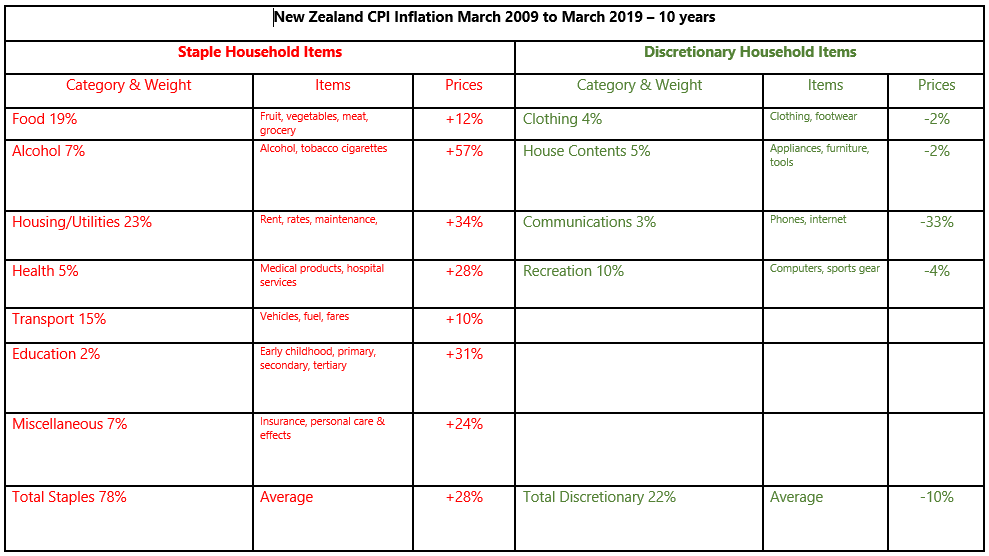
Unfortunately, the technology revolution has not stopped price increases in the 78% staples part, maybe due to a lack of competition and/or inefficient state provision.
Lower socio-economic groups in our community who do not have the discretionary spending cash to buy the latest whizz-bang electronic stuff are not experiencing any benefits of the so-called low inflation. Their household staple expenses have been increasing at 2.8% per annum on average.
The dangers of continually slashing interest rates in response to the very low inflation is that speculative asset bubbles are created in property and equity markets as it is very cheap to borrow.
Under this scenario the gap between rich and poor will continue to widen.
Other losers are elderly investors who are now receiving less than 3.00% return in bank deposits and are being forced into dividend stocks (with attached equity market risks) to earn enough money to live on.
Running a super-loose monetary policy, due to the low inflation the technology revolution has created, is producing a few risks and adverse consequences that do not seem to be well understood.
Daily exchange rates
Select chart tabs
*Roger J Kerr is Executive Chairman of Barrington Treasury Services NZ Limited. He has written commentaries on the NZ dollar since 1981.
We welcome your comments below. If you are not already registered, please register to comment
Remember we welcome robust, respectful and insightful debate. We don't welcome abusive or defamatory comments and will de-register those repeatedly making such comments. Our current comment policy is here.