

This week's Quarterly Survey of Business Opinion (QSBO) from the New Zealand Institute of Economic Research made for sober reading.
The bit that really jumped out at me was this;
A net 25% of firms reduced their headcount during the quarter, the highest proportion since the Global Financial Crisis in 2007, and another 10% expect to lay off staff next quarter.
The volume of companies saying they're laying off staff suggests unemployment's rising, possibly significantly. The last official Statistics NZ reading showed an unemployment rate of 4.3%, or 134,000 people, as of March. The June quarter data will be out on August 7.
The QSBO has been running since 1961 and is described as New Zealand’s longest-running business opinion survey, querying about 4,300 firms quarterly.
Here's a cross section of other indicators suggesting the economy's in a tailspin.
Credit bureau Centrix says company liquidations in May were the highest for a May month in a decade. The value of new residential building construction work consented fell $3.3 billion in the year to May as the average asking price of homes listed for sale falls and the volume of properties listed for sale rises. And retail spending fell for a fourth consecutive month in May.
Meanwhile, the Reserve Bank (RBNZ) next reviews monetary policy next week, July 10. So what chance it lowers the Official Cash Rate (OCR) from 5.50% where it has been since May 2023? Or even hints a reduction is coming soon?
Not great.
Since inflation surged from 2021, with Consumers Price Index (CPI) inflation peaking at 7.3% - its highest level in 30+ years - in June 2022, the inflation fighting RBNZ has been under siege.
That's because its monetary policy mandate tasks the RBNZ with keeping annual CPI inflation between 1% and 3% over the medium term, with a focus on keeping future inflation near the 2% mid-point.
For the March year Statistics NZ had the CPI at 4%, down from 4.7% in December. The June year CPI will be out on July 17, which the RBNZ expects to weigh in at 3.6%. The CPI measures changes in the prices paid by households for goods and services.
This trend of falling inflation and a starkly weakening economy might suggest the RBNZ can take its foot off the monetary policy pedal. BNZ Head of Research Stephen Toplis, is certainly of this view. Following the QSBO he published a note headlined; ‘QSBO says inflation beaten,’ adding;
“In our humble opinion, today's NZIER Quarterly Survey of Business Opinion screams: cut rates sooner rather than later.”
However, taking the RBNZ's musings on inflation literally, it wants to see the whites of 2% inflation's eyes before any OCR cut is made. The RBNZ hierarchy has also been striving hard to avoid signalling an OCR cut is around the corner, to avoid precipitating a pick-up in economic activity, potentially adding petrol to the inflation flame. The RBNZ doesn't want egg on its face.
Witness the recent speech from RBNZ Chief Economist Paul Conway. Its title was The road back to 2% inflation. That follows one from Governor Adrian Orr in February with the title The Monetary Policy Remit and 2% inflation. Orr said;
The Reserve Bank believes that the current 2% mid-point inflation target remains appropriate for New Zealand.
“2% continues to strike the right balance between the costs and benefits of inflation,” Mr Orr says. “A focus on 2% appears to be consistent with an ‘optimal’ level of inflation.”
“In the long-term, an inflation target centred on 2% is more likely to mean continued growth and steady jobs, supporting the prosperity and wellbeing of everyone,” he says.
The non-tradable dilemma
The big CPI inflation challenge for some time now has been what's known as non-tradable inflation. This is the changes in prices for goods and services less exposed to international competition and more influenced by domestic factors. Think insurance costs, local government rates, rents, construction costs, and cigarette and tobacco inflation.
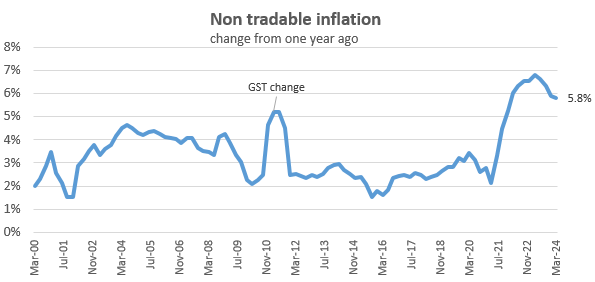
March year CPI inflation had tradable inflation, featuring imported goods such as petrol, down to 1.6%, with non-tradeable inflation at 5.8%.
But to what extent can the RBNZ even influence the prices of insurance, council rates and rents? Toplis is a sceptic, saying in January;
...non-tradables inflation is almost always higher than 2.0%. Since 2000 non-tradables inflation has averaged 3.3%. In the 95 quarters across this period annual non-tradables inflation has been 2.0% or below just six times. Four of those six quarters ended up sub 2.0% because of a big reduction in ACC levies that 'artificially' depressed the reading by around 0.6%."
"Given what is currently driving non-tradables inflation, it is highly unlikely monetary policy will be able to get it anywhere near 2.0% in the foreseeable future."
So what does the RBNZ itself say?
In a press conference after the RBNZ's February Monetary Policy Statement Orr said;
The Consumer Price Index is made up of many, many components. Once you start climbing down into the components monetary policy really doesn't impact any of them. It impacts indirectly the components of the CPI via spending, demand and supply. That's how it impacts on it...we do not set local authority rates, we do not set prices. We set the price of money which then determines over time willingness for people to hold it or not, spend or save, so it's that second round indirect impact.
As we get to the lower inflation parts there are some really persistent and challenging parts of that inflation picture and it just means that we may have to work harder to achieve the same outcome. But I would say it's no different to any other period.
The hardest component for us to manage is productivity. Low productivity means low nominal GDP growth before you get inflation pressures rising so if we had a higher productivity economy we would be able to deal with these relative prices much easier. But again that's in the hands of businesspeople, consumers, investors, government policy. We just control the price of money.
The chart below shows the rise and fall of non-tradable inflation since the start of this century.
'Inflation in these components will not peak until the third quarter'
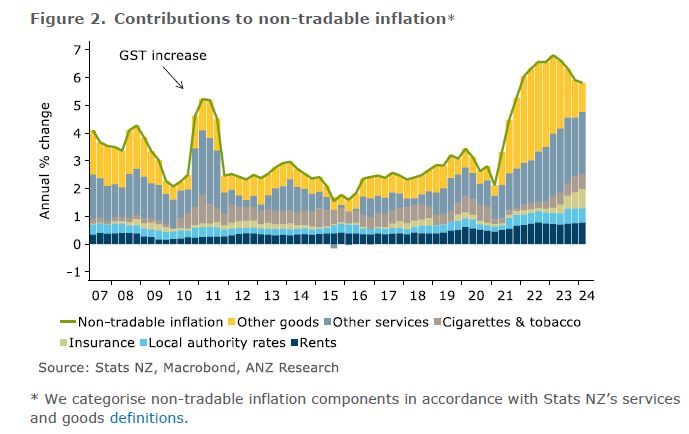
ANZ New Zealand economists Henry Russell and Sharon Zollner last month issued a helpful note, Non-tradable disinflation: a waiting game. They dig into insurance costs, local authority rates, cigarettes and tobacco inflation and rent inflation. Russell and Zollner note collectively the four account for 2.5 percentage points, or 44%, of the current annual non-tradable inflation of 5.8%. That has them punching well above their collective weight of less than a third of the non-tradable basket.
Russell and Zollner say;
"And on our forecasts, while other sources of non-tradable inflation retreat, inflation in these components will not peak until the third quarter. At that point it will be responsible for around 2.7 percentage points, or 54%, of total non-tradable inflation."
They add another recently emerged example of inflation persistence stems from the Commerce Commission announcing its draft decision to increase revenue limits for Transpower and local electricity distributors from the March quarter next year.
"The new revenue limits would result in an average annual increase of $180, +GST, to household power bills, adding roughly 0.25 percentage points to annual headline inflation and 0.45 percentage points to non-tradable inflation, all else equal."
The ANZ economists also note;
Since the initial inflation surge from March 2021, the cost of building a new home as measured in the CPI has increased around 36%. Dwelling insurance as measured in the CPI has increase by around 40% over the same period.
How about vehicle insurance? Since March 2021, vehicle insurance costs are up nearly 31%. Over the same period, vehicle prices have risen 7.3%, vehicle parts and accessories have risen 26%, and vehicle servicing and repairs have risen 18.8%.
The chart below, showing the contributors to non-tradable inflation, comes from ANZ.
'King Canute'
Russell and Zollner say, in a glass-half-full view;
"This baked-in persistence (the impact of which is exacerbated by the unusual highs seen in CPI inflation), is very likely one of the reasons why monetary policy lags are proving longer this cycle."
"That’s preferable to the alternative explanation: that monetary policy isn’t working, either because of a change in the transmission mechanism or because the speed limit for the economy is lower than previously envisaged, as the RBNZ concluded in the May Monetary Policy Statement. That implies more pain is required, whereas this explanation implies that we just have to be patient."
The extent to which monetary policy impacts the likes of insurance, rates, rent and household power bills is highly debatable. In the words of Orr above it has an indirect impact. Insurance premiums are set by insurers facing rising costs from extreme weather and reinsurers, and whose shareholders want good returns. Rates are set by financially challenged councils, rents are determined within a broken housing market, and the Commerce Commission is allowing power bill increases to help fund needed network investment.
Speaking to Auckland University's Tim Hazledine last year, he questioned whether "King Canute in the Reserve Bank" had anything to do with falling inflation. Hazledine also offered a series of suggestions to help the RBNZ tackle inflation including; expanding the Commerce Commission's mandate so it becomes a price watch commission, holding tripartite pay talks between the Government, unions and employer groups, exploring an extension of the Pharmac model to source other products and services at lower prices from international suppliers, and reducing GST to 10% from 15%.
Meanwhile, Kiwibank's Jarrod Kerr has queried the ongoing feasibility of the 2% target. Kerr notes more extreme weather events, moves to decarbonise the economy, improving struggling or failing infrastructure, wars and geo-political tensions are all inflationary.
One thing is for sure. Debate will continue over the RBNZ's wielding of monetary policy and the impact of the central bank's blunt OCR tool. Especially if the economy continues weakening, the OCR is held at its current level, and non-tradable inflation remains stubbornly high.
In this scenario questions need to be asked as to whether current monetary policy settings, dating from the 1980s, are fit to serve New Zealanders today and their 21st century challenges.
*This article was first published in our email for paying subscribers early on Friday morning. See here for more details and how to subscribe.
We welcome your comments below. If you are not already registered, please register to comment
Remember we welcome robust, respectful and insightful debate. We don't welcome abusive or defamatory comments and will de-register those repeatedly making such comments. Our current comment policy is here.