
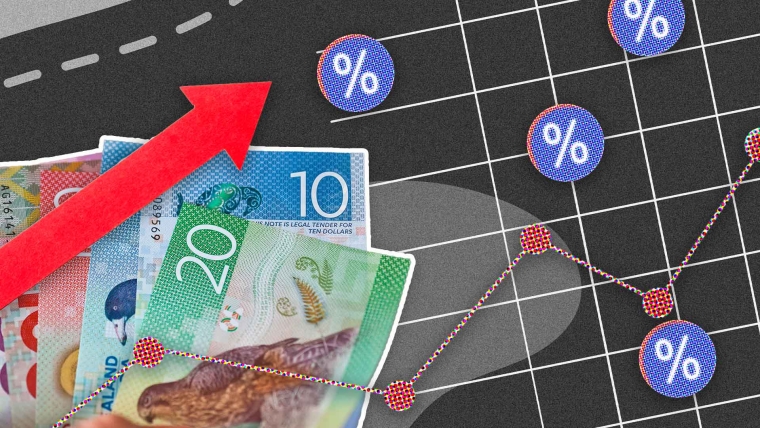
Bank economists were either crowing or shaking their heads at the Reserve Bank (RBNZ) following its decision to hike the Official Cash Rate (OCR) for the first time in three years.
However, all are in agreement that more OCR increases are on the horizon before the end of 2026.
The RBNZ’s Monetary Policy Committee (MPC) agreed to raise the OCR by 25 basis points, to 2.50% from 2.25%, at its July Monetary Policy Review (MPR) on Wednesday.
The MPC said New Zealand’s economic recovery was underway before the Middle East conflict, but lost momentum in the June quarter as the oil shock weighed on economic activity. And although oil prices have fallen, the effects of the oil shock will linger for some time, according to the MPC, leading the six-member committee to reach consensus and raise the OCR to 2.50%.
'The central bank shouldn’t take the General Election into consideration'
Following the announcement BNZ’s head of research Stephen Toplis said the Reserve Bank needs to get the OCR “progressively up to neutral.”
“Where neutral is exactly is open to conjecture. But we can say with some certainty that it is not 2.5%. This is why the RBNZ states that ‘with inflation still above target and economic activity expected to strengthen, some further reduction in monetary policy is likely to be required. Given this, we feel that a further 25 [basis] point increase in September is very close to a done deal,” he said.
“We also continue to believe there will need to be follow-through in at least one of the October and November meetings. The central bank shouldn’t take the General Election into consideration in making its decision, but you wouldn’t rule out an October pause.”
RBNZ Governor Anna Breman told reporters at a media conference that the neutral OCR rate is the policy rate the RBNZ sees as neither stimulative nor restrictive for the economy and inflation.
“And our assessment is that 2.25% was somewhat below neutral, so stimulative,” she said. “So we are removing some of that stimulatory monetary policy and gradually moving towards neutral.”
ANZ NZ chief economist Sharon Zollner said there was “little urgency” in the RBNZ’s forward guidance at the July MPR. This was consistent with ANZ’s view that there was little to be gained from providing very strong guidance in such uncertain times, according to Zollner.
“We think the RBNZ will continue to hike the OCR because the economy doesn’t need stimulatory monetary policy any longer. That’s a lot more palatable than the previous scenario, of the RBNZ having to hike despite a weak economy because of an external cost shock that demands extra short-term pain to achieve the long-term gain of low and stable inflation,” she said.
“We continue to expect hikes at the next two meetings, in early September and late October, taking the OCR to 3%, as the economic upswing becomes more established.”
The rear vision mirror
Westpac NZ chief economist Kelly Eckhold said the July review showed the MPC is pointing toward follow-on tightening in upcoming OCR reviews.
“The MPC seemed concerned that not raising the OCR today would prompt further easing in financial conditions and hence it seems the RBNZ continues to see an end-of-year OCR of 2.75-3% as being reasonable,” he said.
Although Eckhold had anticipated the RBNZ would hold the OCR at 2.25%, he still expects two more OCR hikes out of the RBNZ this year – one in the September MPS and one in the December MPS. Like ANZ NZ, Westpac NZ is forecasting that the OCR will end 2026 at 3%.
“In the current uncertain environment, it goes without saying that the evolution of monetary policy will depend on how both global events and key data evolve,” he said.
“Therefore, as the RBNZ noted itself today, the exact timing of the tightening profile is highly uncertain and even the tightening we forecast at the September 2026 meeting should not be regarded as a ‘done deal’.”
Kiwibank economists Jarrod Kerr and Alexandra Turcu are also expecting two more OCR hikes out of the RBNZ before the end of the year.
“While we agree that a move up in interest rates was going to happen eventually, we disagree on the timing,” they said.
The pair noted that while the RBNZ’s July MPR statement had emphasised the threat to medium-term inflation, they would argue that the medium-term inflation outlook is “already tame” with a weak labour market and uneven recovery.
The OCR is the RBNZ’s main tool for keeping inflation between 1% and 3%, with a target point of 2% and the RBNZ said on Wednesday it still anticipates headline inflation to ease close to 2% in 2027.
However, the RBNZ has lowered its forecast for near-term inflation because current oil futures pricing is now significantly lower than was assumed in the May MPS. Annual inflation is now expected to have peaked at 3.9% in the June 2026 quarter and to decline to 3.3% in the September 2026 quarter.
This is lower than the Reserve Bank had previously forecast in the May MPS when it forecast inflation would reach 4.2% in the June 2026 quarter and peak at 4.3% in the September 2026 quarter.
“The lower forecast relative to the May Statement largely reflects smaller direct price effects due to lower oil prices, as well as reduced pass-through to other consumer prices,” the RBNZ said.
Annual consumers price index (CPI) inflation was 3.1% in the March quarter. Statistics NZ is set to release June quarter CPI on July 21.
“The RBNZ anticipates that the rear-vision mirror data will show the economy was weak over the third quarter, when the bulk of the oil price shock impacts hit home on consumer budgets, business costs, and confidence in general,” ASB chief economist Nick Tuffley said.
He noted that the RBNZ “has and will” continue to act swiftly enough to ensure medium-term inflation will return close to the 2% midpoint of the target band over time.
“In other words, that the OCR will increase to around the ‘goldilocks’ neutral level, which we estimate is around 3.25%, without overshooting,” he said.
“For one, the last OCR decision of 2026 will have been made before we even see in the rear vision mirror just how strong the economic pickup has been. We do see, though, an immediate follow-up OCR increase in September as having a very low threshold.”
Prior to the July MPR, bank economists had been divided over whether the Reserve Bank’s MPC would choose to hike or hold the cash rate. While ANZ NZ and BNZ economists expected the committee to raise the OCR by 25 basis points, ASB, Westpac NZ and Kiwibank had forecast the committee would continue to keep the OCR on hold at 2.25%
We welcome your comments below. If you are not already registered, please register to comment
Remember we welcome robust, respectful and insightful debate. We don't welcome abusive or defamatory comments and will de-register those repeatedly making such comments. Our current comment policy is here.