

The Reserve Bank (RBNZ) has kept the Official Cash Rate (OCR) on hold at 1.75% as expected, but decisively moved to an easing bias.
Governor Adrian Orr has ditched his line the direction of the next OCR move "could be up or down," saying the "more likely direction" is down "given the weaker global economic outlook and reduced momentum in domestic spending".
Where he previously noted "upside and downside risks," he now says the balance of risks "has shifted to the downside".
With gross domestic product (GDP) growth undershooting the RBNZ's forecasts in the December quarter, Orr acknowledges: "Domestic growth slowed in 2018, with softness in the housing market and weak business investment contributing."
While he at the last OCR review in February said trading partner growth was expected to "moderate," he now says the global economic outlook has "continued to weaken".
Orr also notes this weaker outlook has "prompted central banks to ease their expected monetary policy stances, placing upward pressure on the New Zealand dollar".
He has removed the line from his previous statement: "We expect to keep the OCR at this level [1.75%] through 2019 and 2020."
However his concluding remark remains the same: "We will keep the OCR at an expansionary level for a considerable period to contribute to maximising sustainable employment, and maintaining low and stable inflation."
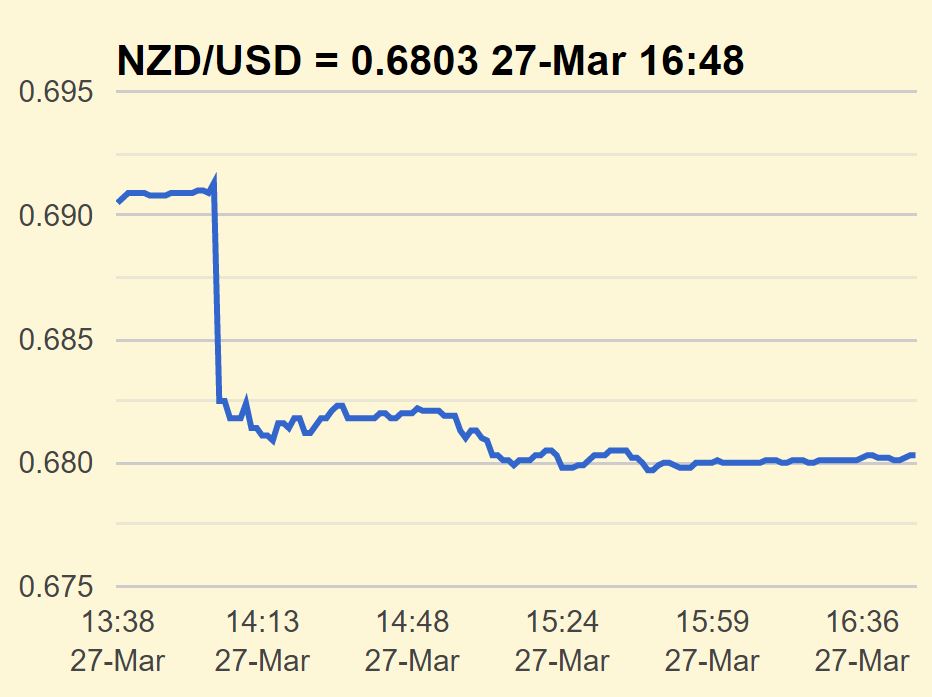
The New Zealand dollar plummeted on the news, and then fell a bit more, settling just over a cent lower at 68.0 US cents by mid-Wednesday afternoon.
Orr throws the cat among the pigeons; economists see cuts (plural) on the horizon
As shown by the shift in the dollar, Orr's tone is considerably more dovish than the market expected.
Some bank economists can now conceivably see a cut happening as soon as May 8 – when the decision will for the first time be in the hands of the soon to-be-announced Monetary Policy Committee.
Kiwibank economists have drastically changed their outlook, saying there’s a 60% chance the RBNZ will cut the OCR in May.
They go further to say: “One cut wouldn’t touch the sides, so we expect another follow up move to 1.25% in either August or November.”
ANZ economists – previously the outliers among their peers for forecasting three cuts to bring the OCR down to 1.00% by next year – continue to see the RBNZ making its move in November. But they acknowledge the “risks have now shifted in the direction of an earlier move”.
While ASB economists had believed the RBNZ could afford to sit tight for a bit longer to gauge the state of the economy, they now expect the OCR to fall to 1.25%.
They see the RBNZ making its first move in August, but haven't ruled out earlier action.
BNZ economists say: "While the door to a May rate cut may have been opened, we do not believe the evidence will be sufficient at that time to actually take the plunge.
"Unless we see weakness in the labour market or falling inflation we will rail against a May cut view, albeit ever mindful that we do not see justification for the Bank’s current stance either."
Westpac economists are “very surprised,” because in their eyes the economic situation has not changed much since February.
They raise the point: “Perhaps the main reason for the change of stance was the actions of other central banks.
“The RBNZ said that a weakening global economic outlook had "prompted central banks to ease their expected monetary policy stances, placing upward pressure on the New Zealand dollar".
“In other words, the RBNZ might have tailored this statement to meet the expectations of financial markets, who are pricing OCR cuts, thereby avoiding a lift in the exchange rate.”
Orr's full statement
The Official Cash Rate (OCR) remains at 1.75 percent. Given the weaker global economic outlook and reduced momentum in domestic spending, the more likely direction of our next OCR move is down.
Employment is near its maximum sustainable level. However, core consumer price inflation remains below our 2 percent target mid-point, necessitating continued supportive monetary policy.
The global economic outlook has continued to weaken, in particular amongst some of our key trading partners including Australia, Europe, and China. This weaker outlook has prompted central banks to ease their expected monetary policy stances, placing upward pressure on the New Zealand dollar.
Domestic growth slowed in 2018, with softness in the housing market and weak business investment contributing.
We expect ongoing low interest rates, and increased government spending and investment, to support economic growth over 2019. Low interest rates, and continued employment growth, should support household spending and business investment. Government spending on infrastructure, housing, and transfer payments also supports domestic demand.
As capacity pressures build, consumer price inflation is expected to rise to around the mid-point of our target range at 2 percent.
The balance of risks to this outlook has shifted to the downside. The risk of a more pronounced global downturn has increased and low business sentiment continues to weigh on domestic spending. On the upside, inflation could rise faster if firms pass on cost increases to prices to a greater extent.
We will keep the OCR at an expansionary level for a considerable period to contribute to maximising sustainable employment, and maintaining low and stable inflation.
We welcome your comments below. If you are not already registered, please register to comment
Remember we welcome robust, respectful and insightful debate. We don't welcome abusive or defamatory comments and will de-register those repeatedly making such comments. Our current comment policy is here.