
Westpac's economists are picking that Auckland will have dealt to its housing shortfall by next year.
But despite that, they don't see a "housing oversupply situation" arising.
The comments are in Westpac's latest Economic Overview penned by the Westpac economists - acting chief economist Michael Gordon, senior economist Satish Ranchhod, senior agri economist Nathan Penny, industry economist Paul Clark and economist Gregorius Steven.
In terms of the immediate future of the housing market, the economists are picking a 5% fall in prices this year as mortgage rates rise.
They believe, however that term mortgage rates - "particularly for two years and beyond" - are already nearing their highs for this cycle.
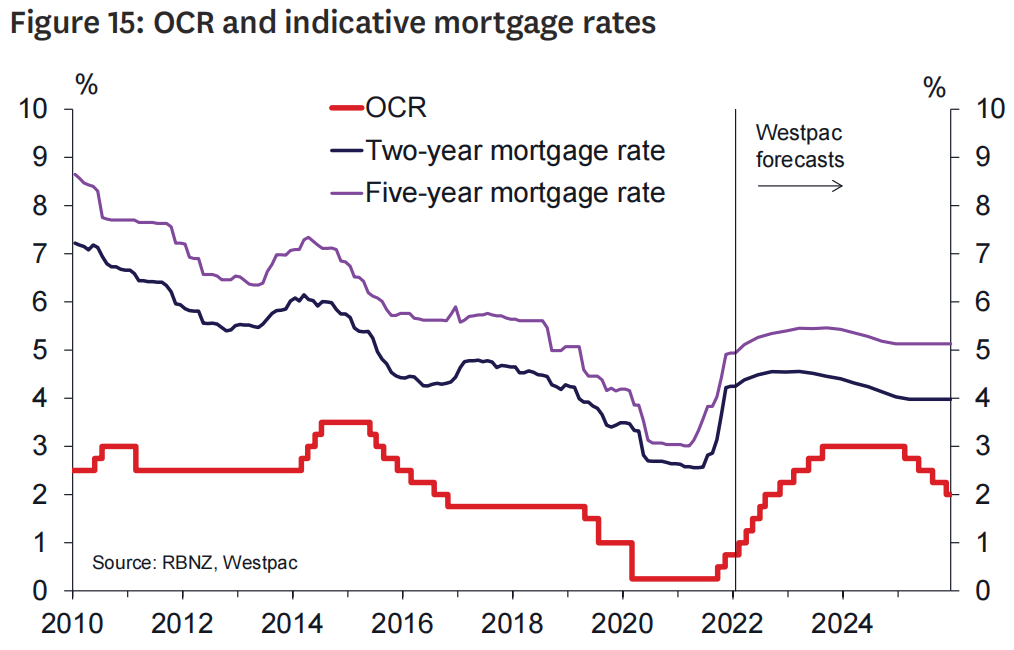
"That in turn is having the intended effect on the housing market: prices have slowed and even started to turn lower in December and January. Falling house values will dampen households’ willingness to spend over the next couple of years."
They note that the closure of our borders has seen population growth plummet "at the same time as home building is hitting record levels".
"As a result, the shortages that built up in recent years are now being rapidly eroded. But even with a strong outlook for home building, this doesn’t signal that a period of ‘oversupply’ is on the cards," they say.
In explaining, they say that between 2015 and 2020 New Zealand’s population grew by around 11%. Over that same period our housing stock only increased by 7%.
"That left us with around 59,000 too few homes. Shortages of housing have been most pronounced in Auckland. However, they have become increasingly widespread across the country."
But the "huge imbalance" between population pressures and housing supply that developed over the past decade is now undergoing a rapid transformation in the wake of Covid-19.
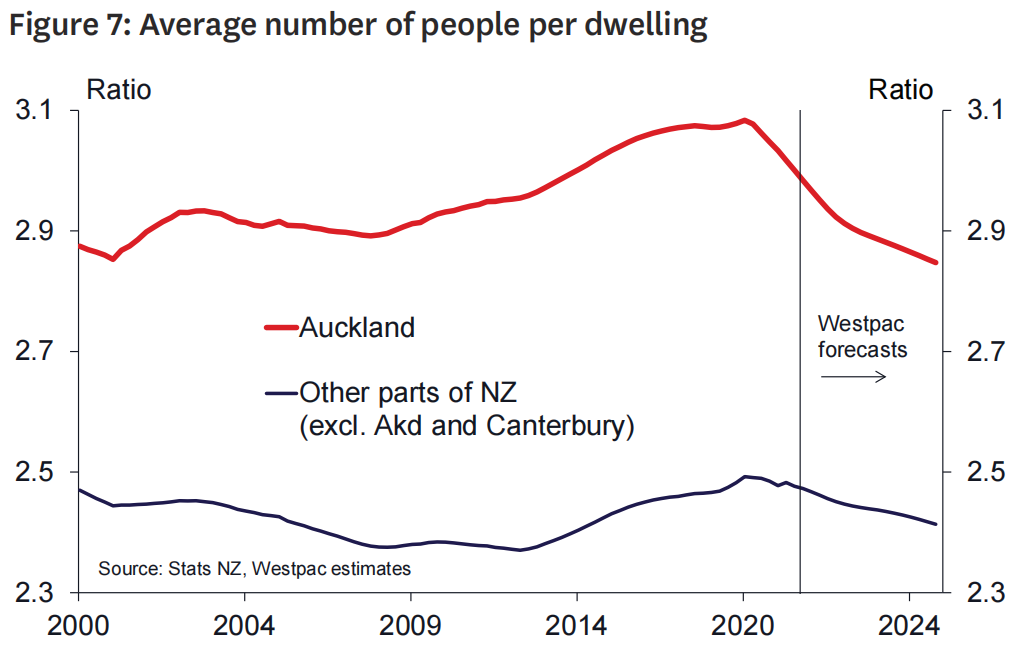
"In fact, over the past year alone, the shortfall of housing has fallen by around 29,000 homes. And looking to the next few years, further big changes in both housing demand and supply are on the cards. Home building activity is booming. Over the past year, a record 48,500 new dwellings were consented. That’s more than twice the pace needed to keep up with population growth and address the existing shortages."
At the same time, population growth has plummeted. In the year to September 2021, New Zealand’s population grew by just 0.5% - well down on the rates of around 2% that we saw in the years leading up to the Covid outbreak. This downturn in population growth is primarily due to the closure of our borders and the resulting fall in net migration.
The closure of the borders has had "a particularly stark impact on Auckland", with the region’s population actually falling slightly over the past year.
Auckland had been grappling with a growing shortage of housing for the better part of a decade.
"But with building activity in our largest city now charging ahead, that shortage of homes is on track to be eliminated by the end of next year."
In other parts of the country, population growth has not fallen to the same extent. As a result, housing shortages in areas outside of Auckland are being eroded more gradually.
"Even so, elevated levels of home building mean housing shortages are on track to be largely eliminated by the middle part of this decade."
The Westpac economists expect that home building activity "will remain elevated for some time".
"That’s because of the strong financial incentives for developers to bring new projects to market: while residential building costs have increased by around 50% since 2015, average house prices have more than doubled over the same period.
"Even so, we don’t expect an oversupply situation will emerge, even with the slowdown in population growth. In most parts of the country, the current high levels of home building are what is needed to take the number of homes per head of population back to the sorts of levels we saw in the middle of last decade (just before the start of the recent period of very strong net migration)."
They describe the situation in Auckland as "more nuanced".
"Housing pressures in the city mean that we typically see an outflow of its residents to other parts of the country – something that’s been exposed recently as the tap of incoming migrants has been turned off. With the number of completed homes set to rise sharply, that raises the risk that the city could tip into oversupply within the next few years.
"However, we don’t think that would be the case for long: an abundant supply of housing would help to stem the exodus of its residents, bringing demand and supply back towards balance. Ultimately, the risk of oversupply is more relevant at the national level, rather than regional."
On the economy more generally, the Westpac economists see headline inflation reaching a peak of 6.3% in the March quarter this year. It hit 5.9% as of December 2021.
"However, what’s more important is not the peak in inflation, but its persistence. Our forecasts see inflation remaining above 3% through to the end of this year, then dropping below that mark from 2023 onward – but remaining in the upper half of the Reserve Bank’s 1-3% target range over the medium term. That would be a distinct change from the decade prior to Covid, when inflation was stubbornly in, or below, the lower half of the target range."
We welcome your comments below. If you are not already registered, please register to comment
Remember we welcome robust, respectful and insightful debate. We don't welcome abusive or defamatory comments and will de-register those repeatedly making such comments. Our current comment policy is here.