
The Kiwi dollar appears to be holding its own just above 0.6400 against the US dollar since the surprise 0.50% cut to the OCR interest rate by the Reserve Bank of New Zealand on 7th August 2018.
The RBNZ has come under some criticism since from local business groups for not only startling the markets, but also potentially causing further unnecessary loss of confidence as they seemed to be signalling that there was extreme danger ahead for the NZ economy.
The reduction in interest rates was designed to stimulate business investment through a lower cost of debt funding.
Unfortunately, it is solely the uncertainty caused by the global trade wars that is holding back business investment over the last 12 months, not interest costs.
The New Zealand economy in expanding at an annual 2.5% growth rate has performed admirably in the face of the disruption and uncertainty brought about by the China/US trade and tariff stand-off.
How the NZ economy (and thus the NZ dollar value) performs over the next 12 months is totally dependent on whether the US and China can reach an agreement on trade.
The global economy is really on a knife-edge as already the UK and Germany are on the verge of economic recession and a prolonged continuation of the trade wars will cause further contraction in economic activity around the world.
The NZD/USD exchange rate was halted from rebounding above 0.6500 last week as a weak NZ manufacturing PMI survey result and a stronger USD against the Euro (to $1.1100) pulled the Kiwi back down.
Global economy on a knife-edge adds to pressure on the Fed and Trump
Instructively for the NZ dollar’s future fortunes, there are early signs that the penny may have dropped for Donald Trump that his instigated import tariffs and tit-for-tat trade war with China is not benefiting the US economy, in fact it is doing severe damage.
He has postponed the latest tariff increase from 1 September to mid-December and called banking leaders when the US equity market was plummeting last week to get their view on how household consumers were doing.
The reply was that they would be doing much better if there were not massive uncertainties in the productive part of the economy due to the trade wars.
The chances are now improving that President Trump will finally start to heed the advice of his Treasury Secretary Steve Mnuchin and Trade Representative Robert Lighthizer who view the escalation in the trade wars as counter-productive and hurting the US economy and thus Trump’s re-election chances next year.
To date, Trump has followed the direction of hard-line White House trade advisor Peter Navarro and taken a confrontational and provocative trade stance against the Chinese.
It was only a matter of time before Trump realised that his bullyboy negotiating tactics would not work against the Chinese, who are very happy to play the “long-game”. There is no question that any news that signals progress on achieving a trade agreement between the US and China will be positive for the Kiwi dollar and Aussie dollar from current lower levels.
It was expected that generally weaker US economic data would cause the US dollar to weaken back against all major currencies as the chances of further interest rate cuts by the Federal Reserve increase.
That expectation received a knock-back last week with stronger than anticipated retail sales data in the US for the month of July. It will require much weaker US employment numbers to convince the Fed to be more aggressive on interest rate reductions.
Focus over this next week will be on the annual jamboree of central bankers in Jackson Hole, Wyoming wherein Fed boss Jerome Powell has a tricky communication challenge as to how they (the Fed) will react to deteriorating global economic conditions.
NZD/AUD cross-rate at pivotal point
The under-performance of the AUD against the USD vis-à-vis the NZD against the USD over the last 12 months has driven the NZD/AUD cross-rate up from 0.9000 to 0.9700.
Until recently, almost unanimous negative forecasts on the outlook for the Australian economy and the AUD were behind the performance difference.
However, over recent months higher Aussie export commodity prices, a turn in their residential property market, income tax cuts, strong employment growth and government infrastructural spending are all behind a significant improvement in Australian economic data.
Massive monthly overseas trade surpluses will deliver Australia its first Balance of Payments Current A/c surplus since 1975 (data release for the year to 30 June is on 3 September). Both currencies have been under downward pressure from the China/US trade wars. However, looking ahead, the Australian economy is set to out-perform the NZ economy, resulting in the AUD out-performing the NZD against the USD, thus a lower NZD/AUD cross-rate.
A resolution of the trade wars would see the AUD appreciate further and faster than the NZD against the USD. Trans-Tasman currency speculators who have been long NZD/short AUD over the last year will now be seeking to close and reverse their profitable exchange rate bets i.e. selling the NZD/buying AUD.
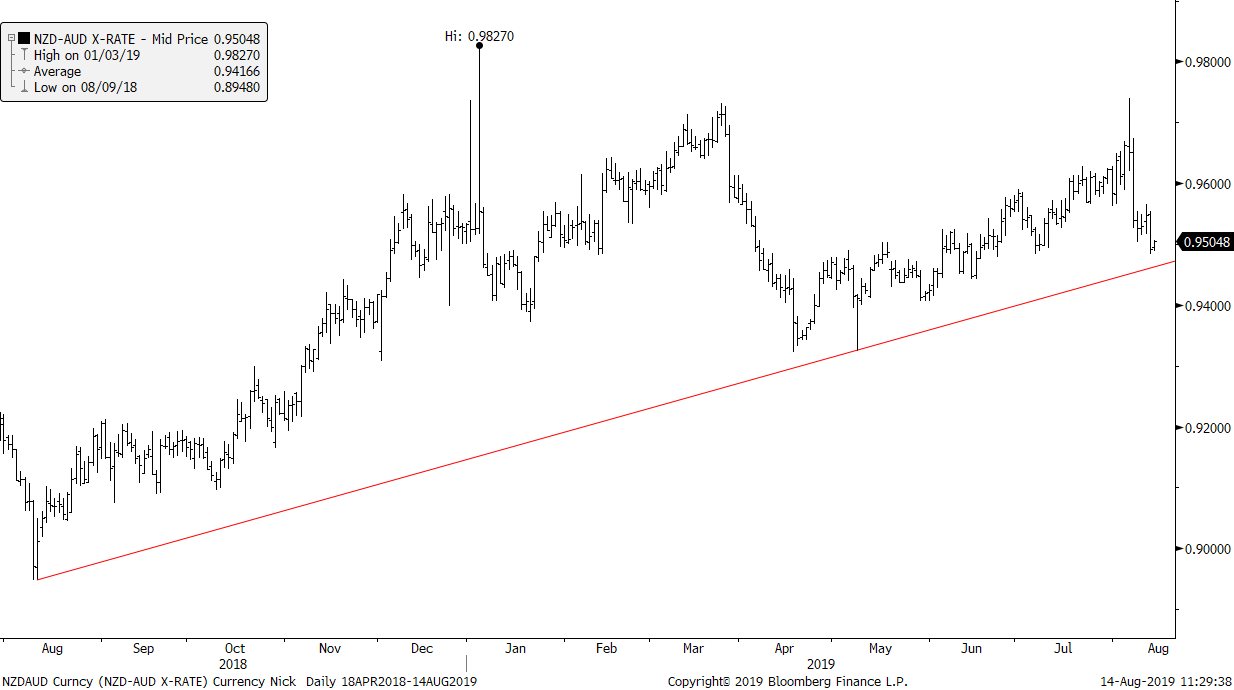
From a technical/chart perspective, any NZD/AUD movement below 0.9470 breaks the uptrend line that has held for the last 12 months (refer chart below).
The NZD/AUD cross-rate has already pulled back to 0.9480 from above 0.9700 on the 6th of August. Movements lower to 0.9200/0.9300 are expected, with the wider 0.9000 to 0.9700 trading range of the last five years yet again holding firm. AUD exporters who are running out of hedging may finally have relief in sight, whereas AUD importers have had ample opportunity to load up on hedging above 0.9600.
Daily exchange rates
Select chart tabs
*Roger J Kerr is Executive Chairman of Barrington Treasury Services NZ Limited. He has written commentaries on the NZ dollar since 1981.
We welcome your comments below. If you are not already registered, please register to comment
Remember we welcome robust, respectful and insightful debate. We don't welcome abusive or defamatory comments and will de-register those repeatedly making such comments. Our current comment policy is here.