

Summary of key points: -
- Anticipated correction down in the Kiwi dollar proving to be illusive – so far
- RBNZ not expected to disappoint with actions to force the NZ dollar down
- US economy (and thus the US dollar) goes from bad to worse
Anticipated correction down in the Kiwi dollar proving to be illusive – so far
The preferred view on the short-term NZD/USD exchange rate direction from this column over recent weeks has been that a downward correction from the 0.6600 level was likely, due to: -
- The FX markets would be anticipating an increase in the amount of QE monetary policy loosening from the RBNZ in the lead-up to the next statement on 12th August. One of the reasons for the RBNZ to increase the money printing being that they would be unhappy at recent NZD gains.
- The strong gains in the NZD/USD rate from 0.6100 to 0.6600 had been “too far, too fast” and a correction back would be inevitable.
- Continuing advances by US equities could not last forever and a corrective move downwards appeared well overdue. A change to an investment market “risk-off” mode is always negative for the Kiwi dollar.
What has occurred in the forex markets over the last few weeks is that the weakening momentum in the US dollar itself (for a host of good reasons) has outweighed all of the above variables that were expected to produce a pullback in the NZD/USD rate to the 0.6400 area.
The Kiwi traded to a high of 0.6685 on 23 July on the back of concerted selling of the US dollar against all currencies.
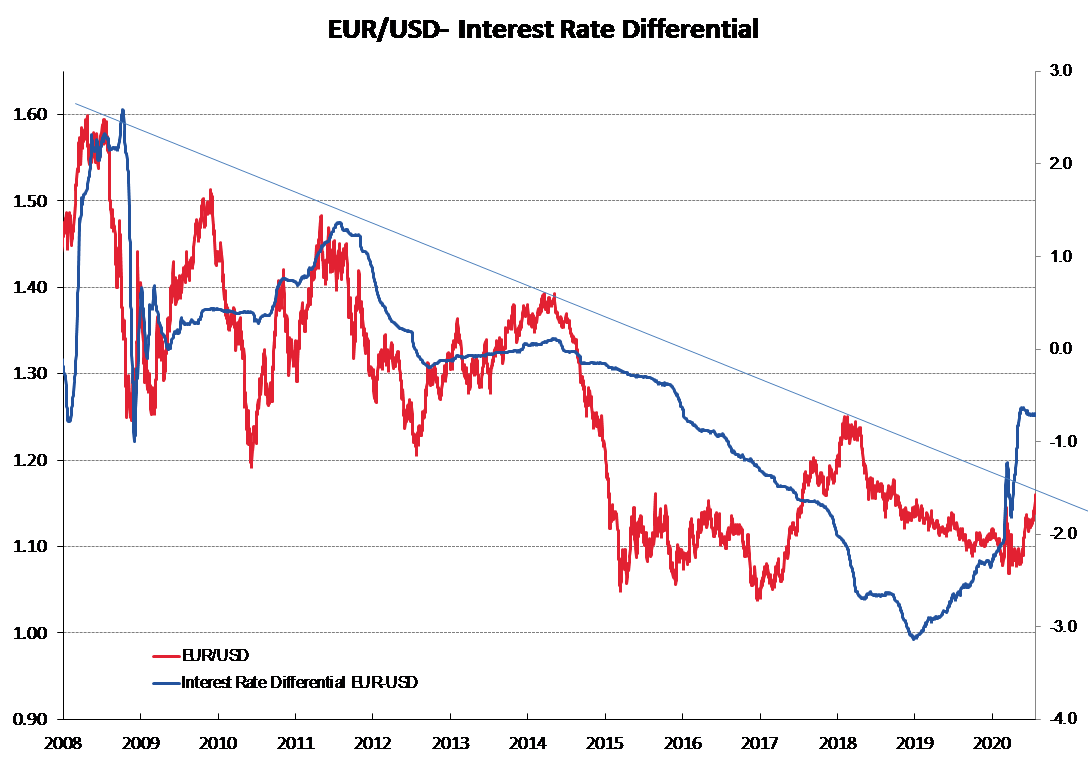
The USD sell-off against the Euro commenced from the $1.0800 point in early May and has intensified in recent weeks as investors around the world shift out of the USD on the basis that the US economy has been hit the hardest by Covid-19 and is struggling to recover.
Over the last two weeks the USD has weakened 4% from $1.1200 to the current $1.1650 level.
Therefore, a sharply higher NZD/USD rate is all about the depreciation of the USD, nothing much to do with the New Zealand side of the currency pair.
RBNZ not expected to disappoint with actions to force the NZ dollar down
Whilst the New Zealand economy is recovering earlier and stronger (as this column expected) from the pandemic shutdown, the RBNZ will (being true to their past form) still be very cautious and suspicious about the economic outlook when they deliver their Monetary Policy Statement on 12th of August.
Global economic conditions will be challenging, and they will have concerns about job cuts and company failures impacting on consumer spending once the Government’s wage subsidy ends on 1 September.
For these reasons the RBNZ is likely to continue their pre-emptive monetary policy management and increase the LSAP amount from the current $63 billion to over $90 billion. In all likelihood they will not have to actually use any of the increased amount to support the economy, however they see less risk with that occurring than finding out later they should have moved earlier with the increased QE.
The RBNZ have been very consistent over the last two years in both jawboning and taking action to force the Kiwi dollar lower as they see a weaker currency as being more helpful for the economic recovery. As we have stated previously that approach ignores the fact that USD exporters hedge forward their currency risk for multiple years and thus have their profits protected.
On the day of the RBNZ statement, the NZD/USD rate will likely be sold off one or two cents as the markets react to the increased monetary loosening.
However, it is futile for the RBNZ to even attempt to control the NZD/USD value when it is the USD side of the currency pair that is causing the higher exchange rate.
Apart from dairy commodity prices increasing over recent weeks, there has been no other positive NZD factors to cause the sharply higher NZD/USD exchange rate. It is all about USD weakness.
Surprisingly, FX market reports on the Kiwi dollar produced by local banks and brokers rarely includes analysis of likely future USD movements against all currencies, yet it represents half of the exchange rate and cannot be ignored.
US economy (and thus the US dollar) goes from bad to worse
No-one is calling it a second wave of Covid-19 smashing the US economy, however that appears to be what is happening as the US pay the price for underestimating the voracity of the infectious disease, were not cautious enough and re-opened too early.
Latest weekly employment numbers in the US indicate that the previous improving trend with jobs has started to turn the other way.
The full July jobs report (Non-Farm Payrolls) is due for release on Friday 7th August and the increase in jobs may well prove to be somewhat less than the current consensus forecast of +2.2 million.
The Trump administration continues to blame China for all their problems, however their cycle of confrontation with China is all about attracting votes in the upcoming Presidential election and nothing much to do with the economy.
The largest risk for local US dollar exporters was always about a paradigm shift in the value of the US dollar itself and that is now happening.
The US dollar no longer has an interest rate advantage over the Euro and the internal Government budget deficit has blown out to 14% of GDP.
The US economy requires a lower currency value to attract in foreign capital to finance their massive deficits.
The rationale for a short-term pullback in the Kiwi dollar to 0.6400 still holds, however the medium to longer term outlook of a much weaker USD propelling the NZD/USD rate to 0.7000 and above remains as our central view.
Daily exchange rates
Select chart tabs
*Roger J Kerr is Executive Chairman of Barrington Treasury Services NZ Limited. He has written commentaries on the NZ dollar since 1981.
We welcome your comments below. If you are not already registered, please register to comment
Remember we welcome robust, respectful and insightful debate. We don't welcome abusive or defamatory comments and will de-register those repeatedly making such comments. Our current comment policy is here.