

Summary of key points: -
- The Kiwi dollar jumps four cents over the last month, can it fly higher still?
- Why New Zealand has stagflation and why we will struggle to get out of the rut
The Kiwi dollar jumps four cents over the last month, can it fly higher still?
A combination of a weaker US dollar (due to weaker economic data and tumbling US interest rates) and a stronger Australian dollar (due to additional interest rate hikes from the RBA coming in February) has propelled the NZD/USD exchange sharply higher from 0.5800 to 0.6200 over November.
Investor “risk-on” sentiment pushing US equities higher has also been good news for the Kiwi dollar as it is widely regarded as a risk-on, growth and commodity currency. The USD Index has only dropped by 3.00% over the last month, whereas the NZD/USD exchange rate is up nearly 7.00% from 0.5800. The Kiwi following the Aussie dollar higher has added to the additional upward momentum.
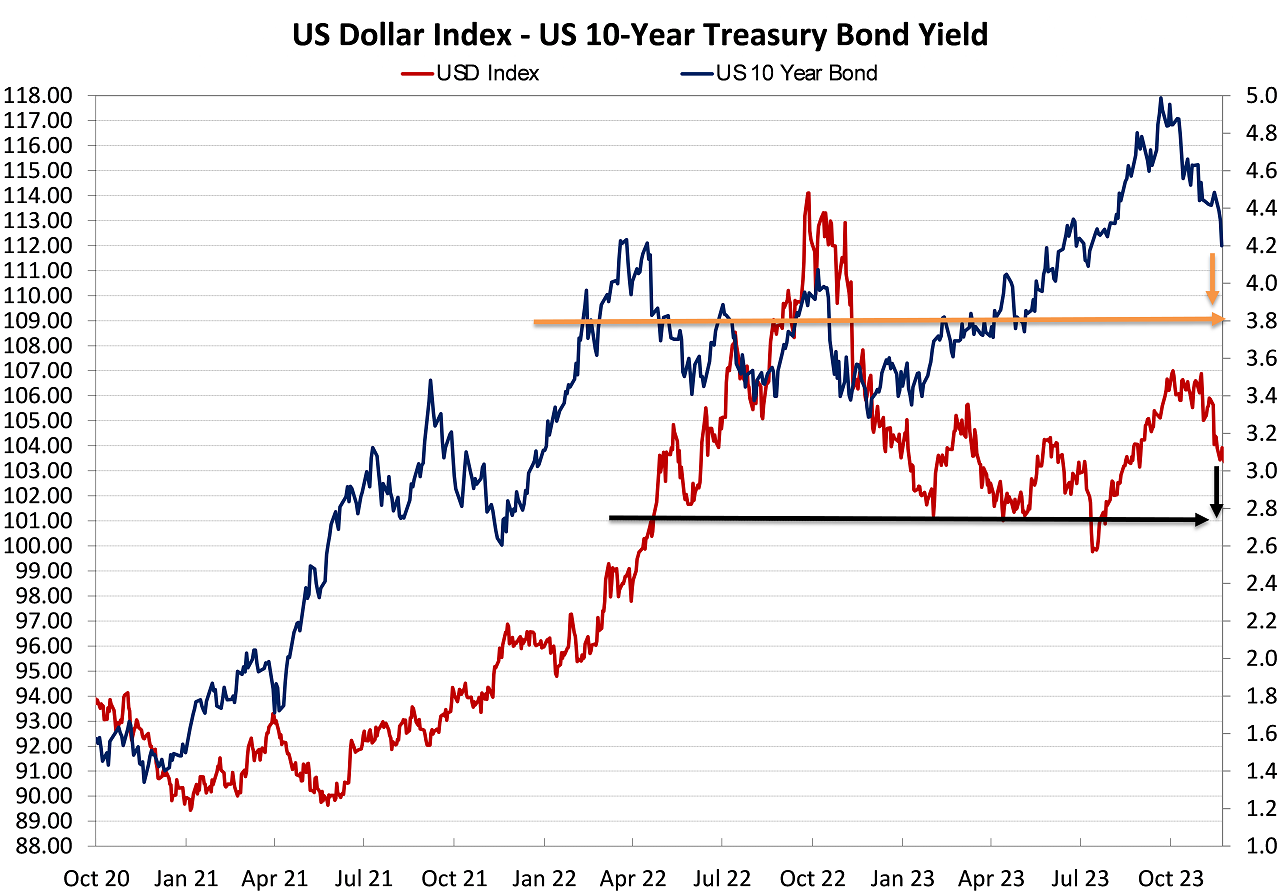
The USD Index followed US 10-year Treasury Bond yields higher through July to September. Both of those gains have reversed very quickly indeed over recent weeks. Bond yields are back sharply from 5.00% to 4.20% and look set to continue to slide back to the 3.80% average level they traded at earlier this year. As a consequence of further reductions in bond yields, the USD Index is likely headed back to the 101.00 level (currently 103.12). The NZD/USD equivalent rate to a 101.00 USD Index point is 0.6500. So, yes, further NZD gains of another three cents are very much on the cards over coming weeks.
The USD was sold by the markets following yet another lower than forecast US inflation result, the PCE measure coming in flat at 0.00% for the month of October. The markets also interpreted Fed Chair Jerome Powell’s latest speech as inching towards the “dovish” side, even though he warned that it would be premature for the markets to be pricing in interest rate cuts in 2024.
Why New Zealand has stagflation and why we will struggle to get out of the rut
What drove the RBNZ to deliver a “more hawkish than anticipated” monetary policy statement last week in the face of slumbering economic growth has a few economists and financial market veterans scratching their heads. We thought he would push-back on the interest rate market’s pricing-in of OCR cuts by May next year, however the message and tone were far more stringent than our expectation. Even more perplexing was the RBNZ reducing their “neutral interest rate” to 2.25% from 2.50% previously. With the OCR projected/required to stay well above 5.00% for at least another 12 months, New Zealand is living with the tightest monetary conditions in the world with interest rates more than 3.00% above the “neutral rate”. Such severely restrictive monetary settings would be justified if the domestic economy was booming with rampant consumer demand and/or inflation was increasing globally. Neither of those two conditions are the case right now. In fact, the opposite is the economic reality.
None of it makes any sense and the only explanation is that Governor Adrian Orr seems to take some mystifying pleasure in “wrong footing” the financial markets at almost every opportunity. The end-purpose of such tactics is also difficult to comprehend. However, what Adrian says today is not that relevant and is quickly dismissed as efficient and liquid interest rate markets will always price-in probabilities of future economic conditions, despite what central bankers may say currently. Still expect interest rate cuts here in NZ towards the end of 2024 (earlier than the current RBNZ signalling). However, that will be some time after the US are cutting their interest rates in mid-2024, therefore US dollar negative and NZ dollar positive from a change in interest rate differentials perspective.
Whilst there was a ton of analysis on New Zealand’s current economic conditions contained within the 58-page Monetary Policy Statement document, some straightforward explanations of how New Zealand got itself into a stagflation environment with high/sticky wage-push inflation, was conspicuous by its absence. The RBNZ always seem very reluctant to point the finger at the culprits who are the root causes of our inflation problem. As the guardians of preserving the value of our savings and spending power of our dollar (i.e. maintaining low inflation) they should have a responsibility to flush-out the root causes of constant price increases and make recommendations as to changes. Currently, they do not do that, they merely shove interest rates up and down and hide behind the fact that it is the only tool they have at their disposal to control inflation. However, the markets and the wider general public deserve an independent and succinct explanation as to how we got ourselves into this stagflation predicament and why the economic/financial pain has to be so harsh to get us out of it.
Perhaps we can help with that explanation by the summary below of the three main causes of the persistent high inflation in 2023: -
- Government policy blunder number 1: The decision by the Ardern Labour Government to keep New Zealand’s borders closed for far too long after the Covid pandemic caused a debilitating and chronic labour shortage across the economy in 2021 and 2022. The unsurprising outcome from that ill-judged immigration policy was a massive spiral up in wage levels to retain/attract workers and therefore wage-push inflation that is very difficult to reverse.
- Government policy blunder number 2: Another poorly thought-through economic policy change by Ardern/Robertson was to end interest cost deductibility on rental properties. The economic and human consequences of this decision was swift and severe. Owners of investment/rental properties sold the houses to owner-occupiers and the evicted tenants in many cases were forced into motels. The reduced supply of rental properties sent rents skyrocketing, which contributed to the higher inflation. “Own goals” scored by the previous Labour Government on both housing and inflation.
- Government/RBNZ joint policy blunder number 3: Both monetary and fiscal policy stimulus was significantly “over-done” in New Zealand compared to other countries in the 2020 and 2021 Covid period. The inevitable consequence of the over-stimulation with too much money printing and willy-nilly Government spending was higher inflation.
The Government and the RBNZ do not have to look too far across the road at each other in Wellington to see the major contributors to our stagflation problem. We now have concentrated high immigration which is continuing to push up housing demand and rents.
Reducing inflation when it is the “wage-push” variety is hard work and takes a long time. It does appear that the RBNZ have finally woken up to that reality. However, that does not necessarily mean that the OCR has to remain above 5.00% until 2025.
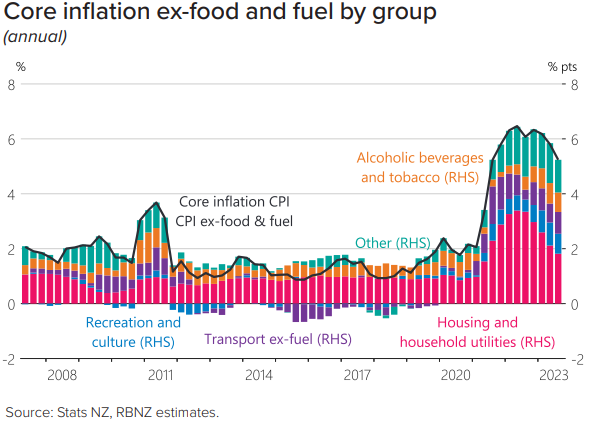
To understand what needs to change in the New Zealand economy to address the permanently high domestic/non-tradable core inflation, the RBNZ chart below confirms the prime culprit – continuous price increases in Housing and Household Utilities (red bars in chart). The RBNZ’s MPS last week contained inflation forecasts out to 2026 that indicates that domestic/non-tradable inflation remains at its normal 3.00% annual increase. Therefore, tradable inflation (oil and imported goods) will need to be zero or negative for the RBNZ to achieve its 2.00% target (mid-point of the 1.00% to 3.00% band). Everyone should now see why the RBNZ needs a higher NZ dollar value (lower prices on imported items) to get inflation down to target.
Solving the perma-inflation increases in housing and household utilities is a topic for another day. Competition, regulation, economies of scale, efficiency and city zoning are issues a smart guy like Minister of the Crown, David Seymour can put his mind to.
Daily exchange rates
Select chart tabs
*Roger J Kerr is Executive Chairman of Barrington Treasury Services NZ Limited. He has written commentaries on the NZ dollar since 1981.
We welcome your comments below. If you are not already registered, please register to comment
Remember we welcome robust, respectful and insightful debate. We don't welcome abusive or defamatory comments and will de-register those repeatedly making such comments. Our current comment policy is here.