
Risk sentiment catapulted after the announcement of a two-week ceasefire in the Middle East, that paves the way for a reopening of the Strait of Hormuz. Oil prices plunged, global equities showed strong gains, global rates fell and the USD was broadly weaker. The NZD got some added support from an RBNZ policy update that tilted in a more hawkish direction. Overnight, there has been no follow-through price action, with the ceasefire deal on shaky grounds, signs of attacks still taking place, and the Strait of Hormuz remaining effectively closed.
An hour and a half ahead of the noon (NZT) deadline for Iran to reopen the Strait of Hormuz, President Trump announced on social media he agreed to suspend the bombing of Iran for a period of two weeks, subject to Iran agreeing to the complete, immediate and safe opening of the Strait of Hormuz. He talked up the chances of long-term peace, saying the two parties were very far along with a definitive agreement as almost all of the various points of past contention have been agreed. Iran responded that based on Trump’s acceptance of the general framework of Iran’s 10-point proposal, safe passage through the Strait of Hormuz would be possible for two weeks. Israel also agreed to the ceasefire.
These headlines triggered a strong market reaction, with oil prices plunging and risk assets recovering, but there remain more questions than answers.
For one, the US and Israel believe that the ceasefire deal excludes Israel’s attacks on Hezbollah targets in Lebanon, while Iran and mediator Pakistan believe Lebanon was part of the deal. Israel has continued with extensive strikes in Lebanon, carrying out its largest operation there since the conflict began. Iran has threatened to withdraw from the ceasefire deal if these attacks continue, and Iran’s parliament speaker said that three clauses in the ceasefire deal have been violated so far. Iranian media reported that passage of oil tankers through the Strait of Hormuz were halted after Israel’s attacks. Earlier, two tankers were granted permission to pass through the strait.
There has also been reports of ongoing strikes in the Gulf region and Iran state media noted Tehran being attacked. Saudi Arabia’s east-west pipeline was hit by a drone strike, albeit with limited damage.
Furthermore, while the 10-point plan has not been released in full publicly, Iranian state media have previously reported key elements, the more contentious ones being acceptance of Iran’s uranium enrichment for its nuclear programme and withdrawal of the US military from the Gulf region. It is hard to see these points being agreed by the US.
Overnight, Trump “clarified”, noting many of the 15 points have already been agreed (these are the US 15-points, no mention of Iran’s 10-point plan) and that there will be no enrichment of uranium and the US will be working with Iran to remove the material. Needless to say, there is conflicting information by both sides and it is not clear what has actually been agreed. The White House announced that VP Vance would hold direct talks with Iran in Pakistan this weekend, supported by Witkoff and Kushner.
Turning to the markets, oil prices have sustained much of the fall seen during the NZ trading session, with Brent crude currently just below USD95, down about 13%.
Europe’s key gas benchmark fell 14.9%. The US S&P500 is up close to 2½% in mid-afternoon trading, as guided by the futures market yesterday. Gains have been greater elsewhere, given Europe and Asia are more economically exposed to the conflict than the US. The Euro Stoxx 600 index closed up 3.9%, Japan’s Nikkei rose 5.4% and China’s CSI 300 rose 3.5%.
European rates have seen much greater falls compared to the US, with steeper curves as markets pare back expected rate hikes in Europe and increase the chance of a rate cut in the US. Germany and UK 2-year bonds yields fell 23-24bps, while 10-year rates fell 14bps and 19bps respectively. The net daily reaction in US rates has been minimal, with earlier falls reversed. The US 10-year rate fell as low as 4.23% overnight, before trading up to just under 4.3%, up 5bps from the NZ close.
The USD is broadly weaker with some big moves seen since this time yesterday, with much of the move seen during NZ trading hours, with only modest movements overnight. The NZD has been one of the best performing, up 2% since this time yesterday, with an additional boost coming after the RBNZ’s policy update (see below). The NZD traded a high just below 0.5860 and currently sits near 0.5820. The AUD is at 0.7035. After trading below 0.82 yesterday, NZD/AUD has recovered to 0.8265, with the more hawkish RBNZ update seeing a closing of some short NZD/AUD positions. The NZD has made strong gains on other crosses.
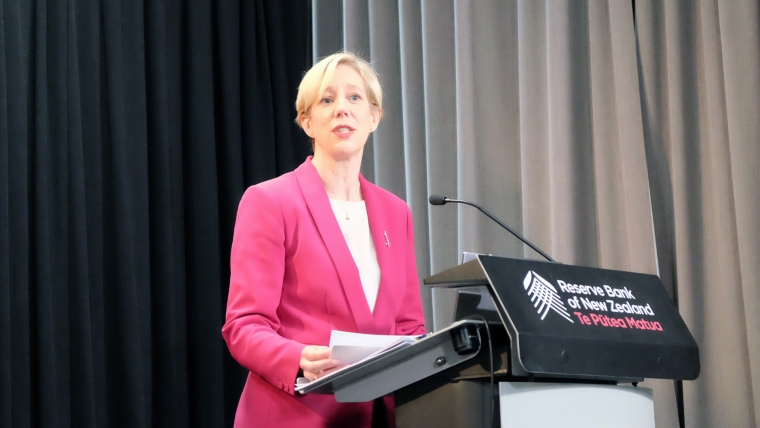
The RBNZ left the OCR unchanged at 2.25%, which surprised nobody, but there was a notable shift in rhetoric in a more hawkish direction regarding the policy outlook, even compared to Governor Breman’s speech a couple of weeks ago. Language used included talk of possible “decisive and timely” increases in the OCR, the Committee “vigilant” to any generalised inflationary pressure and it “stands ready to act” to return inflation to its medium term target.
The more hawkish language triggered higher rates and added to earlier NZD strength, while two other major trading banks joined BNZ’s long-standing view that the first rate hike would likely come in September. The 2-year swap rate closed down “only” 3bps to 3.38%, after being down 10bps just ahead of the policy update on global forces. The curve flattened, with the 10-year swap rate closing down 9bps to 4.25%, little changed from the pre-RBNZ level. NZGBs saw similar moves, with the 2-year rate down 4bps and the 10-year rate down 9bps to 4.63%.
On the economic calendar, US personal income, personal spending, PCE deflators and jobless claims data are due tonight. The consensus sees the core PCE deflator up 0.4% m/m in February, the same as for January, highlighting strong underlying inflation pressure at the beginning of the year. March CPI data due at the end of this week will be of more interest.
Daily exchange rates
Select chart tabs
Jason Wong is the senior Markets Strategist at BNZ Markets.
We welcome your comments below. If you are not already registered, please register to comment
Remember we welcome robust, respectful and insightful debate. We don't welcome abusive or defamatory comments and will de-register those repeatedly making such comments. Our current comment policy is here.