

Summary of key points: -
- Recent increases in US interest rates and the US dollar set to reverse
- New Zealand’s productivity record will surprise you
- Strong jobs growth in Australia defies talk of an economic slowdown
The re-escalation of the Iran/US war over the last 13 days has predictably sent oil prices sharply higher and with that comes higher US interest rates and a stronger US dollar on the currency markets. The USD Index has returned to its late June high of 101.30 when Kevin Warsh’s first Fed meeting was interpretated by the markets as hawkish for interest rate hikes. On this occasion, the Kiwi dollar and the Aussie dollar have displayed more resiliency in the face of increased geo-political risks and USD appreciation against the major currencies of the Euro, Yen and Pound. The NZD/USD exchange rate reached a high of 0.5870 on 12 July and has only pulled back less than a cent to 0.5790 at the market close on Friday. The speculative FX market is already at extreme “short-sold” NZD positions and now with the RBNZ back-flipping to a more hawkish monetary stance, there is clearly a reluctance by the currency punters to sell the Kiwi further and add to those already large positions.
On the NZD side of the NZD/USD currency pair, the sentiment and outlook for the Kiwi dollar is now much more positive with the RBNZ increasing interest rates and the economic picture certainly improving. Through the March to June period the majority of local economic forecasters predicted with confidence that the economy would be stalled by the energy crisis as household consumers faced with higher fuel costs would spend less elsewhere. However, it is now becoming evident that the June quarter GDP growth will not be negative or zero as many had originally expected. The RBNZ GDP Nowcast Predictor Model, at this point in time, is showing a strong bounce back to something near +1.00% GDP growth for the September quarter we are now in. The New Zealand economy seems very well placed to continue to expand at a 3.00% annual clip for GDP growth should the tariff and Middle East war disruptions imposed on the global economy by Trump come to an end. Even with those disruptions over the last 18 months, the export-led recovery in the NZ economy has been impressive. Unfortunately, the positive economic picture has not been reflected in a higher NZ dollar exchange rate as our interest rates, for the meantime, remain below those of the US.
On the USD side of the currency pair, the current environment and outlook is much more uncertain. We are witnessing another bout of US dollar appreciation as the higher oil prices, in the short-term, stoke the market bets that the Fed will hike interest rates as the higher US inflation from oil becomes more embedded. Whether the US dollar can sustain its recent gains to 101.30 on the DXY Index comes down to what happens from here with the two big determinants of USD currency direction: -
- Geo-political risk with the Iran/Iraq war: The question in front of the markets is whether President Donald Trump will once again be under pressure to return to the peace talks table, sooner rather than later, to get oil prices back down. Gasoline pump prices back above US$4.00/gallon in the US really damage the Republican’s chances of holding power in the Congress at the November mid-term elections. Trump will always bower to the political risk at home, therefore for this reason alone, he needs to extract himself from the mess of his own making in the Middle East. Latest reports are that the intermediary, Pakistan, with the backing of China, is making moves to get an early ceasefire from the latest flare-up. The financial players in the oil market have switched to long-oil positions over the last fortnight, however a stopping of the air attacks will see the punters rapidly switch the other way and send oil prices lower. The pressure comes off US interest rates if oil prices again pullback downwards as rapidly as they went up.
- In late-breaking news, the US has paused air strikes on Iran and is once again seeking a diplomatic solution. WTI oil prices have plummeted over the weekend from above US$90.00/barrel to US$85.00/barrel as a result.
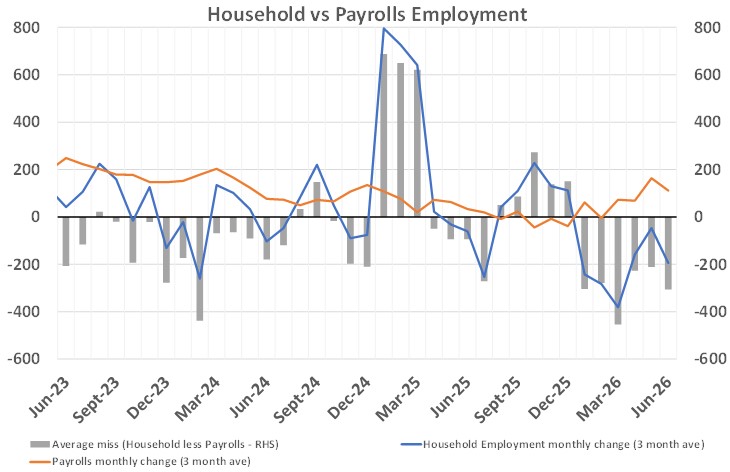
- Evolving US economic data: In selling bond yields much higher over the last two weeks, the US interest rate markets have adopted an extreme position that oil prices will remain elevated for a prolonged period and that will feed into second-round price increases and that will, in turn, force the Fed to raise official interest rates. The US tw0-year Treasury Bond yield has increased from 4.10% to 4.33% since 17thJuly, and the 10-year Treasury Bond yield has similarly lifted from 4.50% to 4.68%. There is a much better than even probability that oil prices headed back south again will reverse these interest rate increases very quickly. The US dollar will struggle to holds its latest gains above 101.00 when the interest rates reverse downwards. Outside of the oil price impact on the US economy, interest rates and the USD, other core inflation and employment trends continue to soften. Further confirmation of lower core inflation (energy and food prices excluded) should come with the PCE Inflation data being released on 30th July. A 0.00% - no change PCE result for the month of June would not surprise. GDP growth numbers for the June quarter are also released on 30th July, The market consensus forecasts are for an annual GDP growth rate 0f 2.20%, however the risk would appear to be for a softer than anticipated outcome. These two key economic indicators are released a day after the next Fed meeting on 29th July. The Fed are not expected to say anything too different to their June meeting. The next US employment update is the Non-Farm payrolls report for June on Friday 7th August. Another low monthly increase following the much lower than forecast +57,000 in May will cause the interest rate markets to reassess their positioning for Fed rate hikes. The chart below shows just how much weaker the household survey of employment (blue line) has been over the last six months to the reported Non-Fram Payroll results (survey of business firms - orange line). History tells us that the Non-Farm Payrolls survey does eventually follow the more volatile household survey lower.
New Zealand’s productivity record – a chart that will surprise you
New Zealand’s woefully poor productivity performance is often cited as to why we have a low-wage economy that struggles to get ahead. The reasons for our lower productivity are well canvassed, being a lack of “economies of scale”, a shortage of capital and low adoption of technology. Everyone knows what causes the so-called productivity problem, however very few come up with solutions to improve our performance. The author’s long-held view on productivity is that New Zealand’s high number of jobs in the low-productive retail sector disguises and drags down the extremely high productivity levels in the agriculture and horticulture sectors. The general consensus amongst local economists, businesspeople and politicians is that New Zealand is a serial under-performer when it comes to productivity and the solutions to improve are not easy or obvious.
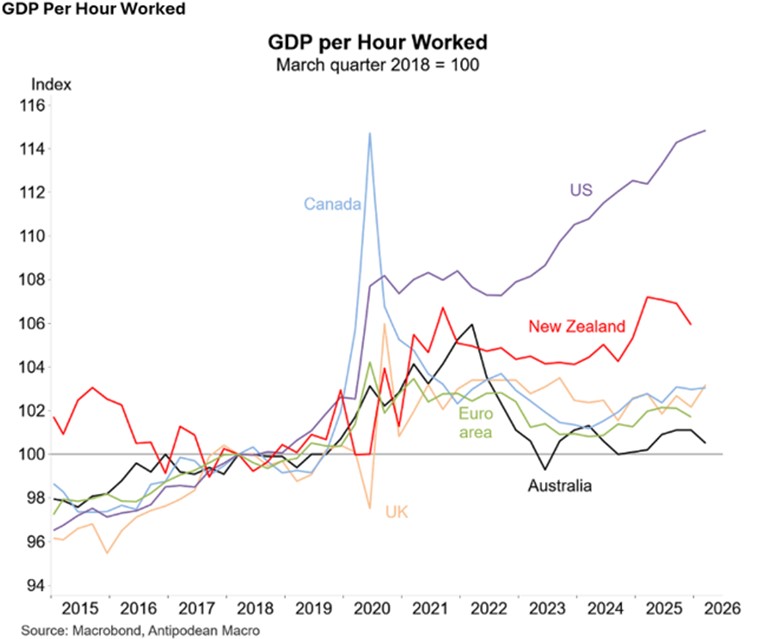
The chart below from Macquarie Bank may surprise you, as it destroys the myth that we are at the bottom of the leagues table when it comes to productivity.
The spectacular gains in US productivity, as they are rapid adopters of technology from the AI revolution, will not surprise anyone. However, the fact that New Zealand is so far above Europe, the UK, Canada and Australia on GDP per hour worked basis will come as a major surprise to the doomsayers who like to run down the NZ economy at every opportunity. One explanation for New Zealand’s superior performance is that staffing levels in our retail sector are changing with big-box retailers such as Cosco and Ikea coming into the market, as well as the demise of the high street strip retailers who just cannot compete, unless they are uniquely specialised. On the other side, agriculture technology and scientific advancements are producing higher output per worker hours. It will also surprise many that local niche-product manufacturers are automating rapidly with robotics.
Strong jobs growth in Australia defies talk of an economic slowdown
A faltering residential property market and lower migration inflows have been seen as evidence of the Australian economy slowing down under the weight of a tighter monetary policy from the Reserve Bank of Australia (“RBA”). Forward pricing in the interest rate markets had shifted from expectations of further rate hikes from the RBA to no change or cuts being needed to interest rates before the end of the year. Weaker consumer and business confidence surveys supported the softer outlook for the Australian economy.
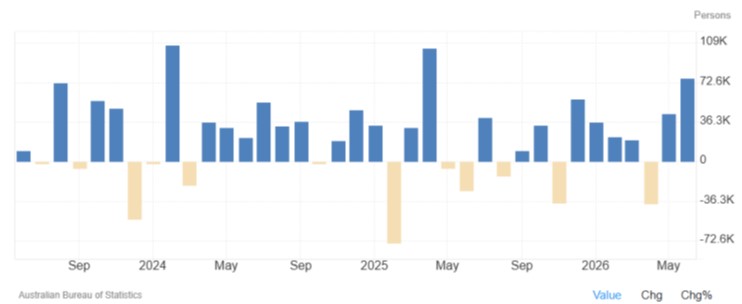
Last Thursday’s employment data for the month of June smashed those expectations of no more interest rate increases. The interest rate markets reacted quickly to the stunning 76,300 increase in jobs in June, well above prior consensus forecast of just +15,000. The May jobs number was also revised upwards to +44,000. Interest rate markets are now pricing-in another full 0.25% OCR increase from the current 4.35% level before the end of the year, with a 36% chance of a hike next month. The RBA operates under a dual mandate, maximising employment and targeting a 2.50% inflation rate. The economy is clearly expanding if the strong monthly employment numbers are to be believed. However, a word of caution, the monthly employment data in Australia is notoriously volatile (as the bar chart below confirms). Do not be surprised to see a sudden decrease in jobs sometime over coming months, which could swing the sentiment the other way.
The implications for the Aussie dollar are clearly positive, with the interest rate differential to US interest rates widening out again. Whether the RBA increase their interest rates further may well come down to the next inflation report being released this week on Wednesday 29th July. Forecasts are for a 0.20% increase for the month of June, increasing the annual rate of inflation from 4.00% to 4.10%. The RBA focus on the quarterly inflation data, especially the “trimmed-mean” measure that strips out more volatile price movements. An increase in the annual trimmed mean number from 3.50% to 3.80% may well be sufficient evidence for the RBA to increase interest rates next month.
On the expectations that WTI oil prices will now quickly unwind the recent increase from US$70.00/barrel to US$90.00/barrel on the back of fresh diplomatic initiatives to end the Iran/US war, the US dollar will reverse direction back downwards. The combinations of a weaker USD and the stronger Australian jobs data should propel the AUD/USD exchange rate well above 0.7000 this week. Higher than expected inflation results will add to the AUD gains.
Australian Monthly Employment Change – 2023 to 2026
Daily exchange rates
Select chart tabs
*Roger J Kerr is Executive Chairman of Barrington Treasury Services NZ Limited. He has written commentaries on the NZ dollar since 1981.
We welcome your comments below. If you are not already registered, please register to comment
Remember we welcome robust, respectful and insightful debate. We don't welcome abusive or defamatory comments and will de-register those repeatedly making such comments. Our current comment policy is here.