
Summary of key points: -
- What to make of the US bond market rout
- US dollar slides on weaker economic data
- NZ business confidence defies global uncertainty and bounces back strongly
The big story in the world of financial and investment markets over the last fortnight has been the concerted and consistent sell-off in US Treasury Bonds. The 10-year bond yield has jumped from 4.53% in mid-July to 4.75% today. The simplistic and obvious explanation for the increase in bond yields (decrease in bond prices) is that there are more sellers of bonds than there are buyers! More supply from sellers against less demand from buyers drives lower bond prices (i.e. increased bond yields).
So, who are these very aggressive sellers of US treasury bonds and why are they selling at this time?
Generally, bond market participants fall into two camps. The first being domestic and offshore fund managers and sovereign wealth funds who hold large, fixed interest investment portfolios that will always have a sizeable component of US treasury bonds, the largest and most liquid bond market in the world. The Chinese have been large investors in US treasury bonds in the past; however, over recent years they have significantly reduced their holdings. The Chinese now rank the third largest foreign holder of US bonds, behind Japan and the UK. Foreign holders make up 31% of US treasury bonds on issue (US$9.2 trillion out of US$30 trillion of total US Government debt). However, they are important players and permanent investors in the market as the US economy does not have sufficient domestic savings themselves to fund all their own Government debt. They need the foreign investors more than ever with US Government debt growing at an exponential rate with continuing large fiscal/budget deficits each year under the Trump regime.
The reasons why local fund managers and offshore bonds holders might be actively selling bonds at this time is either: -
- Worries about US Government debt issuance volumes far exceeding investor demand, therefore they are reducing US bond weightings now before prices fall even further (yields increase). These sellers must also be worried about weaker growth in the US economy, resulting in the large fiscal deficits continuing. Effectively a vote of no confidence in the US economy.
- Worries about US inflation increasing and the US Federal Reserve under new Chair Kevin Warsh being slow to stop the increase. If the investors are selling on this premise, they must be convinced that the Middle East war continues for many months yet, oil prices go to US$100/barrel and US inflation increases as a result.
There is now real evidence yet that foreign holders of US treasury bonds are suddenly exiting, however the US dollar has depreciated in recent days on weaker US economic data. Perhaps some of the USD selling is related to foreign investors pulling out of bonds and taking their funds home. We have previously indicated that the large Japanese investment houses are likely to sell out of US treasury bonds and repatriate their money home as the yield gap between Japanese and US 10-year treasury bonds is now less than 1.50%. The Japanese investors might also be returning funds home before the Yen strengthen any further, as the Japanese and US authorities intervene directly in the FX markets to stop further Yen depreciation.
The second major participant in the US bond markets are the hedge funds, investment bank proprietary traders and speculators who trade the market on sophisticated momentum, algorithmic and technical models. Once key resistance levels are broken in the rise of bond yields; more speculative selling automatically emerges. In some ways, these short-term bond traders are sending a signal to the Federal Reserve that the Fed Funds interest rate needs to be increased by up to 1.00% to control and bring inflation down. In other words, cause a recession in the US economy to slow demand to reduce inflation as interest rates cannot influence the supply side of the economy that is pushing up inflation. Bond yields at 4.75% are more than 1.00% above the current Fed Funds interest rate at 3.65%.
The unanswered question is whether the investors and traders who are selling bonds are actually correct about higher US inflation from here. We think not!
Our recent FX reports have highlighted the component goods and services parts of the US CPI inflation index. Outside of the volatile gasoline prices, most prices are now trending downwards, not upwards. If US inflation is not increasing, then the bond sellers must be worried about other negatives such as increased bond supply (debt levels and fiscal deficits), the US economy, the risk of a credit rating downgrade and political risk. All those concerns add up to foreign investors exiting the US markets and selling the US dollar as they depart.
As we have seen with oil price movements, the financial/speculative players are quick to unwind their speculative positions and take profits. It will only take another set of softer economic data releases in the US economy to trigger the bond traders to buy bonds to take profits. As US bond yields potentially reverse downwards as fast as they went up, the US dollar will likely follow the yields lower.
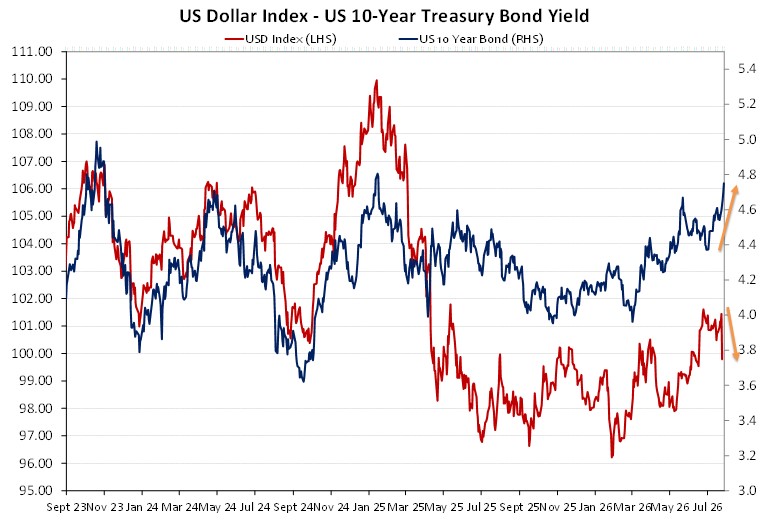
The chart below shows the historical close correlation between the USD Dixy Currency Index and the 10-year US Treasury Bond yield. What has occurred over the last week is that bond yields have been sold higher, however the US dollar has not followed. To the contrary, the US dollar has depreciated from 101.30 on the USD Dixy Index to currently 99.79. The divergence tells us that the sharply higher interest rates now available in the US are not sufficient to attract new US dollar buyers.
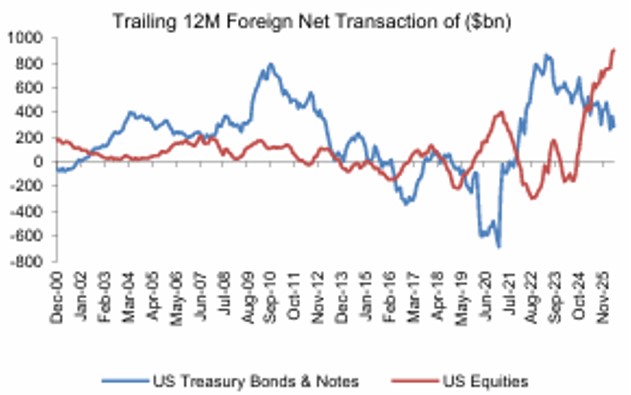
One reason why the US dollar has been stronger (up until a few days ago) was foreign capital inflows into US equity markets as the offshore investors chased the booming AI stocks. The chart below displays net FX transactions into US bonds and equities. Bonds (blue line) have been declining over recent years, whilst foreign inflow into equities (red line) has skyrocketed in 2025 and 2026.
The failure in the last few days of the previous high-flying AI investment hedge fund, Situational Awareness, uncovers the extreme-leveraged and over-hyped equity market values in this space. A major correction downwards in the AI stocks over the coming period would seem set to reverse the FX inflows into the US equity market. Upcoming potential capital outflows from the US markets is yet another negative for the US dollar value.
Foreign Net Transactions into US Equities and Bonds (US$ billions)
Source: Bloomberg and Macquarie Global Strategy
US dollar slides on weaker economic data
US financial markets and the economic commentators are being forced to make their own analysis and decisions on evolving US economic data, as the Fed are no longer providing any “forward guidance” on their intentions with monetary policy and interest rates. It seems both the markets and the commentators are not that happy about the change as their job for a very long time has been to analyse and follow the Fed’s rhetoric and inferences. New Fed Chair, Kevin Warsh’s mantra is “less is more” when it comes to information and guidance. The media conferences after the Fed’s statement, where the Chair takes questions from the journalists, is now quite different to the Jerome Powell era where Powell would pontificate about various trends/changes in the economy. Warsh wants the markets to reflect the economic data, and he will watch the markets as one of his signposts as to the appropriate monetary policy setting. The commentators are supposedly baffled and confused by the new approach by Mr Warsh. To us, it is very clear, if all the economic indicators point to less risk of inflation increasing, the Fed will not be increasing interest rates anytime soon. If the data is soft enough, they will be forced to cut interest rates to fulfil their dual mandate.
Therefore, the Fed are saying nothing, apart from waiting for the recommendation reports of the five task forces looking to reform their operations. The views of the three named Fed committee member dissenters who wanted an interest rate hike at the last meeting should be ignored. All three are known “hawks” who do not have a balanced and considered view on the US economy and the direction of inflation. To them, inflation is always going higher, no matter what the economic evidence in front of them.
So, what is the US economic data currently telling us?
- PCE inflation for the month of June was a decrease of 0.10%, leaving the annual rate of inflation at 3.70%. Core PCE prices increased 0.10%.
- GDP growth for the June quarter at +1.50% was much weaker than prior forecasts of a 2.20% expansion.
The US dollar was sold down on the softer GDP growth news. It was hardly a surprise as many leading indicators for manufacturing and production have been pointing to a slow down (despite the massive business investment going into data centra builds for the AI revolution). In our FX report last week, we stated: -
“GDP growth numbers for the June quarter are also released on 30th July, The market consensus forecasts are for an annual GDP growth rate 0f 2.20%, however the risk would appear to be for a softer than anticipated outcome”.
The reasons for further US dollar depreciation from the current 99.79 level are listed as follows: -
- Continuing weaker US economic data forces a change in current interest rate market pricing, lower market interest rates being negative for the USD. Non-Farm payrolls jobs data for July on Friday 7th August is likely to be lower than the 80,000 to 90,000 increase forecasted.
- The latest US$59 billion joint intervention by the Americans and Japanese on the Japanese Yen to stop its depreciation looks like it has a better chance of working this time. Japanese investment houses stand to follow each other like sheep in repatriating investment funds home (buying Yen to do so). The USD/JPY exchange rate has already reversed from 164.00 to 157.60 in two days on the intervention Yen buying. Further Yen gains to well below 150.00 would be negative for the USD Dixy Index and also drive the NZD/USD rate higher.
- President Trump is under increasing political pressure at home to end the Iran war sooner rather than later as the November mid-term elections loom ahead. A reduction in geo-political risk and oil prices both being US dollar negatives.
The New Zealand dollar has posted solid gains against the weaker US dollar over the last week, from 0.5760 to 0.5880. Further gains to above 0.5920 would see the Kiwi dollar break above key technical levels and once again return to 0.6000.
NZ business confidence defies global uncertainty and bounces back strongly
Local business confidence, as measured in the monthly ANZ survey, reversed back up in July. The main index jumping from 36.6 in June to 56.1 in July. It appears that there is a diminishing negative influence of the energy crisis/Middle East war and business firms are now just getting on with it. The business “own activity” outlook also reversing higher to 49.3 from 36.9. In fact, all the sub-indices of the survey bounced back up strongly, being investment intentions, employment intentions, residential construction and profit expectations. Only pricing intentions, cost expectations and therefore inflation expectations were lower. The increase in the OCR by the RBNZ had no impact as businesses just see that adjustment as the RBNZ catching up to where the interest rate market is already priced.
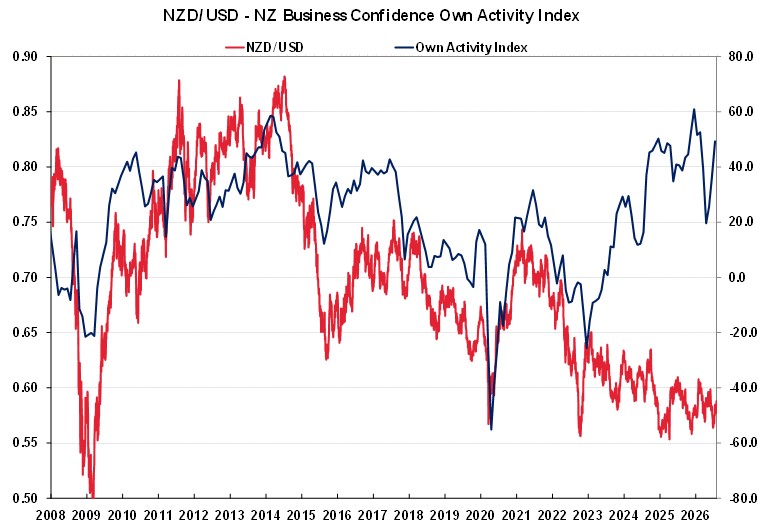
The export-led recovery in the NZ economy now has business confidence returning to the elevated levels of the 2010 to 2017 period (refer to the chart below).
From 2010 to 2022 the NZ dollar exchange rate followed the fortunes of the NZ economy (as measured by business confidence). The Kiwi dollar diverged from rising business confidence through 2023, 2024, 2025 and 2026 as offshore investor interest in the NZD waned as NZ interest rates went below those in the US. In fact, there was a very large incentive to short sell the NZD for the forward points benefit, with no regard to what was going on in the NZ economy. Interest rate changes in New Zealand and the US since 2023 have destroyed the previous close correlation between the NZD/USD exchange rate and NZ business confidence.
The questions ahead of us is whether the correlation is permanently broken down, or just temporary as it is highly unusual for NZ interest rates to be below the US? On the scenario that NZ and US official short-term interest rates both end up at the same 3.50% level over the next six months, there is some probability that the FX markets will return to pricing the Kiwi dollar on its economic merits (i.e. business confidence levels). In which case, the NZ dollar is currently extremely undervalued.
Daily exchange rates
Select chart tabs
*Roger J Kerr is Executive Chairman of Barrington Treasury Services NZ Limited. He has written commentaries on the NZ dollar since 1981.
We welcome your comments below. If you are not already registered, please register to comment
Remember we welcome robust, respectful and insightful debate. We don't welcome abusive or defamatory comments and will de-register those repeatedly making such comments. Our current comment policy is here.