

Summary of key points: -
- Stock take of New Zealand’s economic fundamentals
- US economic results now consistently below overly optimistic forecasts
While interest rate differentials have dominated the fortunes of the NZ dollar against the US dollar over recent years, there is no getting away from the fact that any currency value will ultimately be determined by its underlying economic fundamentals compared to the currency it is being quoted against.
It was a rocky road for the New Zealand economy from the Covid years in 2020/2021 up until 12 months ago, dominated by lockdowns, excessive monetary/fiscal stimulus and then excessive monetary tightening.
More than a year ago we were discussing in this column the strength of the export-led economic recovery long before it was recognised and understood by the mainstream economic commentators. Today, the evidence of the high export commodity prices driving increased economic activity in the regions, outside of Wellington and Auckland, is very plain to see.
Unfortunately, New Zealand’s misplaced fixation and preoccupation with residential property prices as the only gauge of economic success/progression, has led to a current situation (particularly in the Auckland economy) where the general perception is that the economy is still struggling because house prices are static. Nothing could be further from the truth, as the strong export performance to date is now feeding into stronger spending and investment in other parts of the economy.
The banks and the media are also preoccupied with housing and house prices, and they perpetuate the myth that buying and selling existing houses with one another is wealth creation. Wealth creation comes from increasing incomes through building great businesses and industries. We are observing robust wealth creation in the regions and that is leading to rising house prices as demand is boosted by increasing employment and incomes.
The chart below from Westpac confirms the stark divergence between the regions and our two largest cities. The most unrecognised and largely unreported trend in the NZ economy today is the migration of workers out of Auckland to the provincial regions where there are the jobs available.
New Zealand House Prices – By Region
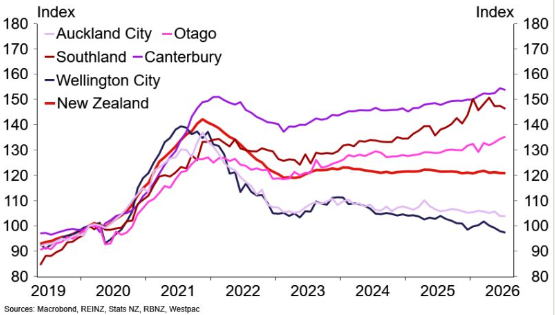
Global credit rating agency, Standard & Poor’s (“S&P”) surprised most media commentators last week with a much more upbeat assessment of the New Zealand economy than the typical downbeat drivel we see from some local forecasters. S&P increased their GDP growth forecasts for 2026 and 2027 by 0.50% to +2.40% and +2.50% respectively, compared to actual GDP growth in 2025 of just +0.70%. S&P correctly observe that latest “high frequency economic indicators point to improving domestic demand, and rising consumer and investor confidence”.
Our view is that S&P are still too pessimistic on New Zealand’s GDP growth outlook for 2026 and 2027. GDP growth for the year to September 2026 will not be released until late December. However, the RBNZ’s Nowcast GDP Predicter Model is estimating an expansion in the economy of +1.00% in the September quarter alone. The close historical correlation of GDP growth in New Zealand to our Terms of Trade Index (export prices over import prices) and the business confidence “own activity” index points to annual GDP growth closer to +3.00% in 2026 and 2027.
A stock take of a raft of other economic measures all point to positive expansion in activity levels: -
- Employment: Increase in jobs of 0.50%, 0.20% and 0.50% over the last three quarters.
- Job adverts: SEEK NZ job adverts in July were up 6.20% compared to a year earlier.
- Balance of overseas trade: Trade surpluses in the export months of February to June have increased markedly in 2025 and 2026 compared to the deficits in those months for 2022, 2023 and 2024. Higher prices and volumes have seen exports increase by 25% year-on-year to 30 June 2026.
- Retail sales: Increased by 0.90% in the March quarter (double consensus forecasts). The June quarter figures are released on 24th August and are forecast to increase by 0.70%. The global shock of the Iran/USD war and energy crisis not having the dire impact expected by most.
- Building permits: New dwellings consented for the year to 30 June 2026 were up 19% from the year ended June 2025. Consented does not mean construction has necessarily commenced, however the signs are positive.
- Concrete production: Our ready-mixed concrete production rose 12% to 1 million cubic metres in the June 2026 quarter compared to June 2025. The multi-year lows of 2024 and 2025 appear to be behind us.
- Visitor arrivals: Increased 8.10% year-on-year to June 2026. We are a cheap destination for the Aussies, and they are coming in droves! Overseas tourist arrivals are now 95% pf pre-pandemic levels.
- Business confidence: The ANZ Business Outlook survey surged to 56.1 in July from 36.6 the previous month.
- Consumer confidence: The ANZ-Roy Morgan Consumer Confidence measure lifted 8 points in July to 99.3, a good recovery from the dip to a low of 80.3 in April after the Iran/US war started.
- Manufacturing: The Business NZ Performance of Manufacturing Index moderated to 54.3 in July following the spectacular spiral higher to 60.1 in June. July was the 21st consecutive month of expansion.
- Government’s budget deficit: The budgeted peak deficit for the financial year to 30 June 2026 was -$11.9 billion, however actual Government revenue and expenditure figures to date are tracking $3 billion less than that.
In summary, house prices in Auckland and Wellington are about the only economic indicators not on the improve in New Zealand today. Despite there being a general election less than three months away, the vast majority of business firms are now just getting on with it, following a brief pause to see what the energy crisis would mean. Thankfully, another heavily reported global shock has had much less adverse impact on the NZ economy than what most expected.
US economic results now consistently below overly optimistic forecasts
“The chickens are coming home to roost” for the US economy as high Government deficits/debt push Treasury Bond interest yields to multi-year highs. The higher market interest rates have automatically tightened monetary conditions in the economy without the Federal Reserve doing anything, and the economic data coming through is confirming that tougher conditions and environment for US households. In many ways, it is an involuntary tightening of monetary policy that is not actually needed by the economy, as inflation is trending downward.
It appears to us that economic forecasters in the US are consistently expecting stronger economic numbers to come through and over recent weeks they are being proven to be totally wrong with that view. Five separate economic measures over the last two weeks have been weaker than consensus forecasts. Whilst the US dollar has weakened on these releases (allowing the NZD/USD exchange rate to return to 0.5900), there has been virtually no reaction by the US interest rate markets with two-year and 10-year Treasury Bond yields remaining st their recent highs.
The five softer economic outcomes are summarised as follows: -
- Non-Farm Payrolls jobs data was much weaker than forecast in both June and July. It is becoming increasingly difficult for Fed members to state that employment supply is being met by demand currently. Supply of labour is now exceeding demand, and many people are exiting the workforce as a result i.e. giving up to even look for a job. The official unemployment rate is therefore not increasing as the labour pool decreases.
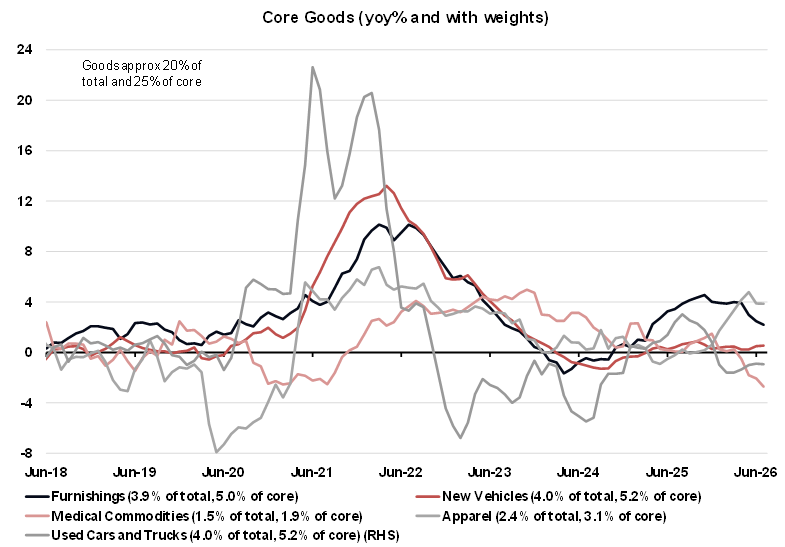
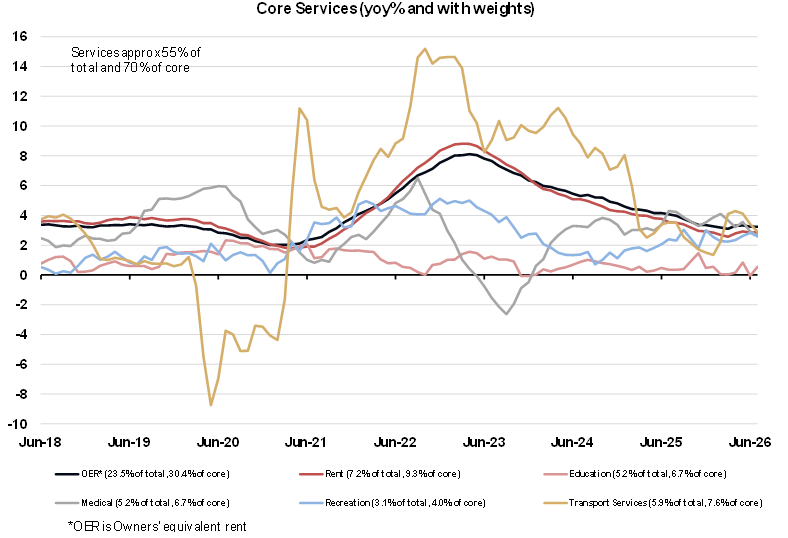
- The CPI inflation rate for July was bang on prior forecasts, leaving the annual headline inflation rate reducing from 3.50% to 3.40%. The annual core inflation rate reducing from 2.60% to 2.50%. The two charts below of the component parts of goods and services inflation in the US confirm the general downtrend in most prices. Warnings of higher inflation in the US are a long way off the mark of what is actually happening in the economy.
- July’s Producers Price Index at 0.00% was below prior forecasts of a 0.20% increase, which augers well for future month’s consumer inflation remaining benign.
- The Michigan Consumer Sentiment index for August was significantly softer at 51.0 than the forecast of 54.6. The deterioration in confidence was across all political and demographic groups, with particular sharp declines among older, lower income, less educated consumers.
- Retail Sales for July were also much weaker than anticipated, coming in at a decrease of 0.60% compared to forecasts of a 0.30% increase. The decline in sales was the first monthly decrease since October 2025.
The only conclusion from the weaker data is that the balance of risk would now favour the Fed cutting interest rates, rather than increasing them as the interest rate markets have been pricing. It seems inevitable to us that the interest rate markets will be forced by the evidence of the poor economic data to re-price to much lower yields going forward. The Fed next meet is on 16th September, and they too will also be forced to adjust their rhetoric away from stating that the economy is “steady” and “stable”. The evidence is accumulating that the US economy is slowing, and the weaker demand lowers inflation risks and trajectory.
The expected environment over coming weeks of decreasing US interest rates will further depreciate the US dollar, allowing the Kiwi dollar to break the shackles to the top side above 0.5920.
The NZD/USD rate was sold off on its own to a low of 0.5830 last week, seemingly unrelated to USD and AUD movements. The NZD selling may have been from local banks buying large amounts of Australian dollars to repatriate dividends to their respective parent banks ahead of their 30 September financial year-ends. The Kiwi dollar dip was transactional related and the NZD immediately recovered back up after the risk was covered through the inter-bank FX market. The NZD/AUD cross-rate also dipped to below 0.8300 on the NZD selling, however it has also since recovered.
Daily exchange rates
Select chart tabs
*Roger J Kerr is Executive Chairman of Barrington Treasury Services NZ Limited. He has written commentaries on the NZ dollar since 1981.
We welcome your comments below. If you are not already registered, please register to comment
Remember we welcome robust, respectful and insightful debate. We don't welcome abusive or defamatory comments and will de-register those repeatedly making such comments. Our current comment policy is here.