

Summary of key points: -
- The US Government shifts market intervention from the Yen currency to their own bond market
- Evidence accumulating that New Zealand has regained its mojo!
The US dollar traded down to a three-month low last week, depreciating in response to the surprising and unexpected intervention by the US Government in their own Treasury Bond market and also in response to continuing weak US economic data that reduces the probability of Fed interest rate hikes. The USD Dixy Currency Index has decreased 2.60% to 98.77 since the high of 101.40 on 27 July when oil prices started to increase again. The weaker US dollar has allowed the NZD/USD exchange rate to lift to three-month highs of 0.5990.
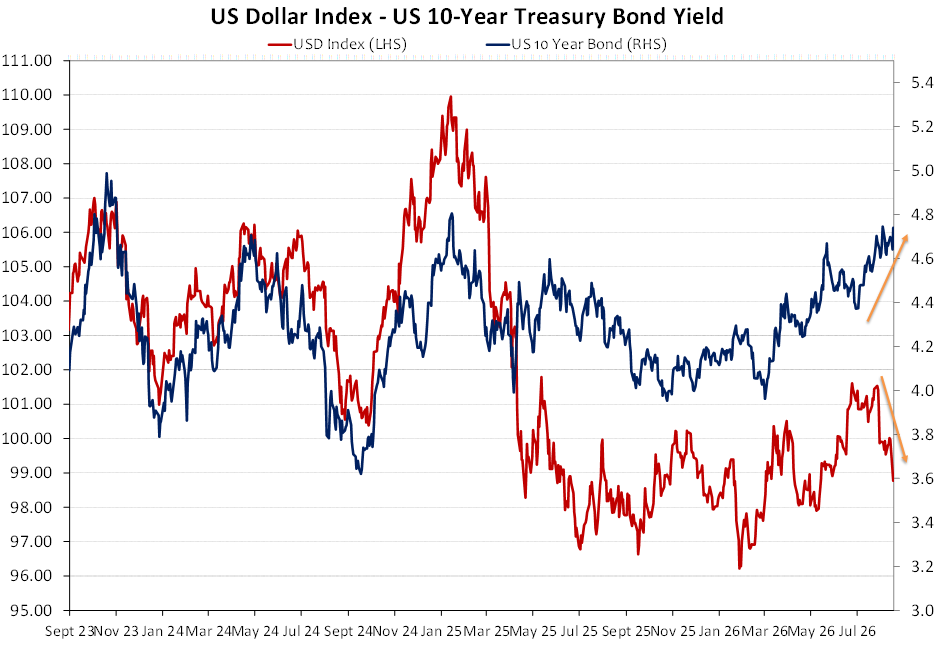
What is unusual about this latest US dollar sell-down is that it has occurred over a period when US long-term Treasury Bond yields have been increasing. Over recent years the USD Dixy Index has been correlated to movements in US interest rates, the USD appreciating when their 10-year Treasury Bond yields increase. The exact opposite has been occurring over recent weeks, the USD has moved lower when bond yields have been rising. One explanation for the change in this important financial market connection is that foreign holders of US bonds have exited the market, selling their bonds and selling the USD as they depart.
It may be recalled that the main reason cited for the US Government assisting the Japanese a month ago with their foreign exchange market intervention to stop the Yen weakening, was that the US was serving their own self-interest as they did not want the Japanese investment funds selling out of their US Treasury Bond holdings to bring money home to shore up the Yen. The Japanese are the largest foreign holders of US Treasury Bonds. US Treasury Secretary, Scott Bessant intervened with the Japanese in the FX markets and last week he announced an intervention by the US Government in their bond market, buying the 30-year bond to bring the yield down. Of course, the US Government is issuing short-term 90-day Treasury Bills to raise the cash to buy the long-dated bonds.
Like the Yen currency intervention, the jury is very much still out as to how successful the bond market intervention has been in achieving the stated objective.
Treasury Secretary Bessant is now displaying all his attributes as a previous hedge fund manager in not being afraid to take on the markets. There are several reasons as to why the US Government wants to lower long-term interest rates:
- Higher 10-year Treasury Bond yields at 4.74% increases the cost of capital equations that are used to value companies on the stock exchange. The last thing the Trump regime wants is a plummeting equities market less than three months away from the mid-term elections for the Senate and House of Representatives.
- Higher 30-year bond yields increases the borrowing costs for new mortgages on new builds in the US housing market. The mortgage borrowing costs are nearing 7.00% and non-one in the US can afford 7.00% interest, therefore the residential real estate market has come to a standstill with building activity collapsing.
- The US Government’s US$40 trillion debt mountain is now costing them US$1.7 trillion in interest cost each year. They are attempting to manipulate the bond market to prevent their own borrowing costs going up on new debt issues.
The US 10-year Treasury Bond yield briefly dipped from 4.74% to 4.63% when Mr Bessant announced the bond buyback plan to commence in early September. However, the markets are highly sceptical about the success of the intervention and yields have reversed back up to 4.74% over the last two trading days.
The bond markets are clearly rattled by growing concerns on the size of the growing US fiscal deficit (Government spending greater than tax revenue coming in each year). President Trump’s musings about tax reductions and the cost of the Iran war add to the fiscal worries.
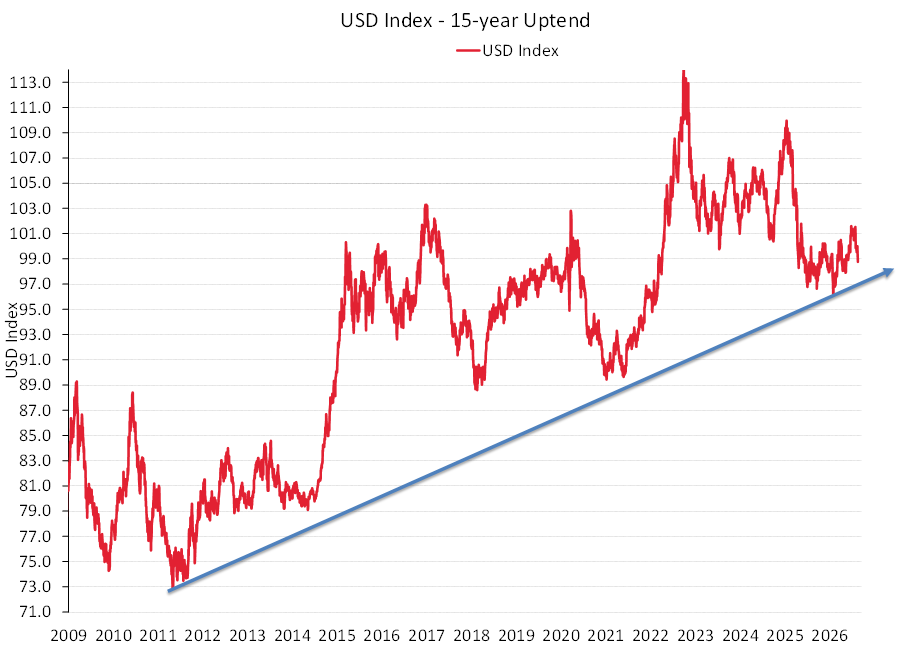
The US dollar weakened on Bessant’s announcement on the bond buyback as investors and traders expressed concern about the worsening fiscal picture and potentially higher inflation. They shifted funds into gold and other currencies. As one FX strategist at Scotiabank summed it up “markets are concluding correctly that if the US Government does not want the bond markets to take the strain from these concerns about fiscal policy sustainability, and Fed policy credibility, then the US dollar will have to”. Any Government or central bank that seeks to artificially lower their interest rates below market pricing, is automatically transferring the economic/financial markets pressure on to their currency value. The Japanese holding their interest rates at 0.00% for many years caused a massive devaluation of the Yen currency. Bessant’s actions are negative for the US dollar and further depreciation has to be expected to test its long-term support level of 97.00 (refer to the second chart below).
Focus is now turning to the world’s central banker’s annual symposium at Jackson Hole, Wyoming on 27th to 29th August, in particular the speech of Federal Reserve Chief, Kevin Warsh. Traditionally, the Fed Governor’s speech at this event lays out their plans for monetary policy management over the next 12 months period. Mr Warsh will not be following tradition and will not discuss such plans. He is waiting on five task forces on the reform of the Fed and their recommendations. Therefore, there is much intrigue as to what Mr Warsh will talk about. He may have to defend the Fed’s authority as the body that controls interest rates, as Treasury Secretary Scott Bessant is now encroaching into this territory. It has all become very messy for the markets to interpret. What we do know is that it is becoming very clear that foreign holders of US Treasury Bonds have lost confidence in both the Fed and the Trump regime and are voting with their feet in exiting the US market.
The sudden dislocation of the previous correlation between 10-year Treasury Bond yields and the USD Dixy Index is telling and confirmed in the chart below:
Evidence accumulating that New Zealand has regained its mojo!
Epitomised by a stunning rugby test win for the All Blacks against the Springboks in the cauldron of Ellis Park in Johannesburg, New Zealand is once again on the front foot economically speaking after years of uncertainty and doubt. The New Zealand economy and business environment today has a positive momentum about it that has been absent through the disruptions of the Covid years, mini-recessions, and Trump’s tariffs and Middle Eastern war. How well the local economy has performed over the last six months since the Iran/US war started in early March has surprised many who were expecting the worst. In many respects, the more positive performance proves once and for all that the New Zealand economy does not need to always rely on rising house prices and strong inwards migration to record strong GDP growth. The growth momentum has come from the export sector, buoyed by fantastic prices, which is now spreading to wider areas of the economy. Prime Minister, Christopher Luxon some time ago talked about New Zealand needing to get is mojo back, it has taken a while, however the evidence is definitely there that we have done just that.
Business investors outside of New Zealand are now recognising the opportunity and potential for our resources and productive capacity. It is no coincidence that the aggressive Australian investment bank, Barrenjoey has recently expanded their footprint into the New Zealand market. They are positioning here as they must see increased cross-border mergers and acquisitions activity levels. As we have commented previously, the low NZD/AUD exchange rate at 0.8300 adds to the attractiveness of the investment opportunity for Australian investors coming into New Zealand at this time.
The runaway success of the Government’s Active Investor Plus visa scheme that offers residency for high-net-worth individuals who invest NZ$5 million to NZ$10 million into local funds or businesses is proof of the attractiveness of New Zealand’s current proposition. The level of the NZ dollar exchange rate at cyclical lows against the US dollar, Euro, Chinese Yuan and Aussie dollar adds to the equation as to why the capital inflows are happening at this time. Total committed funds and the potential pipeline of inflows now stand at NZ$5 billion across 837 active applications. In a time where the old-world order of security, trade and investment has been re-written by President Donald Trump, New Zealand is seen by many as a safe haven that is very much open for business and investment.
The Government’s deliberate strategy to re-engage with the world through Invest NZ and new free trade agreements is starting to pay some dividends.
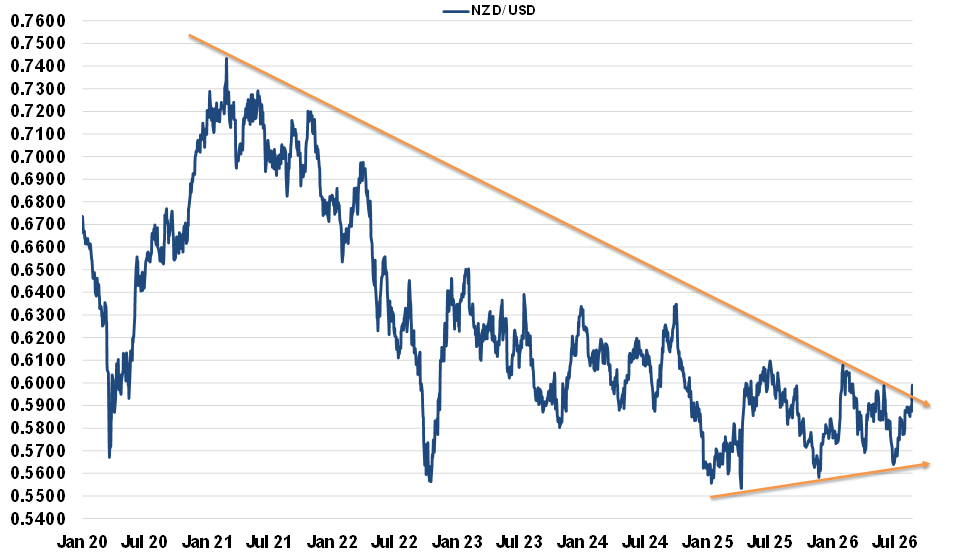
The implications for the NZ dollar value are clearly not negative. The risk of the New Zealand dollar depreciating on its own account has almost disappeared completely, in stark contrast to 12 months ago when the NZ dollar was sold down on the RBNZ slashing interest rates to unjustifiably low levels. Today, the RBNZ are increasing interest rates back to a neutral monetary policy setting, the US dollar itself is weakening, and the NZ economy is producing superior GDP growth to other countries. The recipe of factors for the Kiwi dollar is now very positive and that is why the NZD/USD exchange rate is up more than three cents from 0.5630 over the last two months. In the current environment it would be no surprise to see the Kiwi dollar up another three cents to 0.6300 over coming months, in doing so breaking above the previous highs and resistance levels at 0.6000, 0.6100, and 0.6200.
The chart below confirms that the NZD/USD exchange rate has moved decisively above the 0.5920 resistance level and has broken out of its five-year downtrend pattern. Global currency traders and speculators will now be seeking to buy the Kiwi dollar as its technical/chart picture has turned positive for the first time in several years.
Bank of America currency analysts see the US dollar weakening further with the NZ dollar positioned to outperform G10 currencies. Lower US interest rates and higher NZ interest rates is one factor they cite; however, resilient commodity-driven growth is another positive force for the Kiwi dollar. Bank of Americal also see the NZ dollar as the most effective hedge against the potential global food supply shock from severe El Nino climatic conditions. As global food prices increase on lower supply, New Zealand’s already high terms of trade would increase further. They added “amongst the G10 economies, New Zealand has the highest agricultural exposure, and once markets price favourable trade conditions, the NZ dollar faces substantial upside risk and steep appreciation pressure”.
The risk of further NZ dollar gains well above 0.6000 is certainly outweighing the risk of the NZD/USD exchange rate moving the other way.
Daily exchange rates
Select chart tabs
*Roger J Kerr is Executive Chairman of Barrington Treasury Services NZ Limited. He has written commentaries on the NZ dollar since 1981.
We welcome your comments below. If you are not already registered, please register to comment
Remember we welcome robust, respectful and insightful debate. We don't welcome abusive or defamatory comments and will de-register those repeatedly making such comments. Our current comment policy is here.