

Summary of key points: -
- Competition: What it means for New Zealand’s inflation and interest rates
- Up and Down Kiwi dollar trading pattern continues
- Deciphering Kevin Warsh’s messaging
The push for more competition in the New Zealand economy has been very much in the news over this last week with the National Party announcing a policy to break up the Foodstuffs supermarket cooperative and force two competing brands. Over many years this column has claimed that the most important influence over the level of inflation in the New Zealand economy is the amount of open and free competition that delivers the most efficient method of price discipline. Unfortunately, the lack of strong competition in many of our industries is the main reason why we struggle to adequately control inflation. The lack of competition means that monetary policy has to be used as the blunt stick or the battering ram to drive down inflation and more often than not that leads to volatility of economic performance. The boom/bust housing cycles come about because interest rates are ramped up and down more frequently as the central bank attempts to keep inflation within the 1% to 3% target band.
The composition of inflation in New Zealand is dominated by the lack of competition in the private sector and public sector price setting behaviour that delivers consistently high (over 3.00% annually) non-tradable (domestic) inflation and externally driven non-tradable inflation that fluctuates up and down on events outside of our control (oil, commodity prices, exchange rates). Therefore, you would think that the Reserve Bank of New Zealand (“RBNZ”), as the guardians of inflation, would have a keen interest in promoting competition in the economy. Sadly, the RBNZ do not see that as their role. They “stay in their lane” by not delving into the Government and business area of competition policy. More competition would prevent the root cause of inflation at the top of the cliff; however, the RBNZ’s job is to merely react to events at the bottom of the cliff with inflation control action. Therefore, we endure more volatility in GDP growth, interest rates and the exchange rates than would otherwise be the case in an economy that enjoyed more unfettered competition. Whilst “competition” is the key ingredient for low and stable inflation, the word was not mentioned even once in the 60 pages of the last RBNZ Monetary Policy Statement. They see it as nothing to do with them, but many would argue that it should be.
The reasons why we have low levels of true market competition in many industry sectors such as supermarkets, banks, domestic air travel, electricity, energy, insurance and some building supplies come down to some unique structural features (but not insurmountable features) of the New Zealand economy, being: -
- A relatively small population strung out over two long and narrow islands. Low concentrations of population outside of Auckland.
- The absence of “economies of scale” in nearly every service and product industry.
- High internal freight/transport costs caused by that challenging geography and serviced by multiple and unconnected small/bit players.
- Mixed Government/private sector ownership models in the electricity sector, coupled with generator/wholesaler/retailer vertical integration.
- Multiple electricity/energy network owners/providers (no economies of scale) owned by parochial local trusts.
- Australian domination of banking and insurance markets (Although a listed Kiwibank that rolls up the smaller players might eventually flatten the bloated net interest margins of the big four banks).
- A supermarket duopoly that has adroitly kept out the competition.
- High capital entry cost barriers in the case of domestic air travel.
It is interesting that business folk join in on the complaints about the high cost of food in New Zealand compared to other countries, however, rile against a policy from the National Party to break up the supermarket duopoly as it is Government intervention in the free market. Given New Zealand’s natural disadvantages when it comes to competition, we should entertain pragmatic solutions that may not fully meet the free-market ideology test. There are some very good reasons why global supermarket players such as Aldi and Lidl are not in New Zealand. We do not have the population concentrations and internal freight is highly inefficient. The Warehouse attempted to take on the supermarket duopoly a number of years ago, and even though they already had the network of stores, they could not match the two incumbents on logistics and price.
The National Party is attempting to find some answers in the supermarket industry; they should extend that pragmaticism for solutions to the other non-competitive industry sectors mentioned above. The current Government has addressed the excessive/duplicated cost structures in the local government sector that has been a constant source of inflation on households. There is more work to do with competition policies if we want to address the root causes of inflation and reduce volatility in the economy, exchange rates and interest rates.
Up and Down Kiwi dollar trading pattern continues
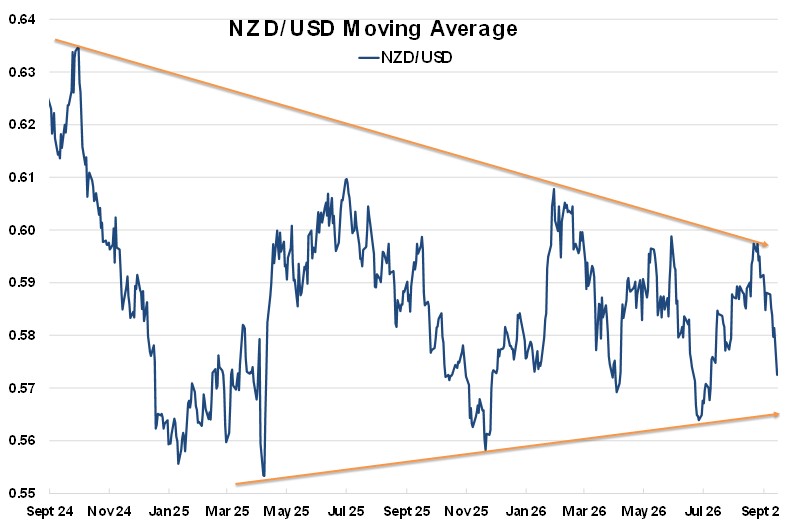
The up and down trading pattern of the NZD/USD exchange rate is becoming increasingly repetitive as it has oscillated continuously between 0.5600 and 0.6100 over the last two years. As the chart below confirms, the Kiwi dollar has suffered five major sell offs since September 2024. After each sell off, the NZ currency (for whatever reason) has bounced back up again quite quickly. The last bout of selling to 0.5725 last week reversing the strong gains to 0.5980 achieved at the end of August. The forces and causes behind the repeating NZD selling and buying patterns are a mixture of global/US dollar currency movements and local RBNZ/NZ economic factors.
What is easily observed from the Kiwi dollar’s movements over the last 24 months is that the “highs” (peaks) are becoming progressively lower and the “lows” (troughs) are becoming progressively higher. The end result is a long running “converging wedge” formation, with the current bottom support line at 0.5650 and the top resistance line at 0.5970. At some point it seems inevitable that the NZD/USD exchange rate will break out of the converging wedge formation and move convincingly higher, or lower, as the case may be.
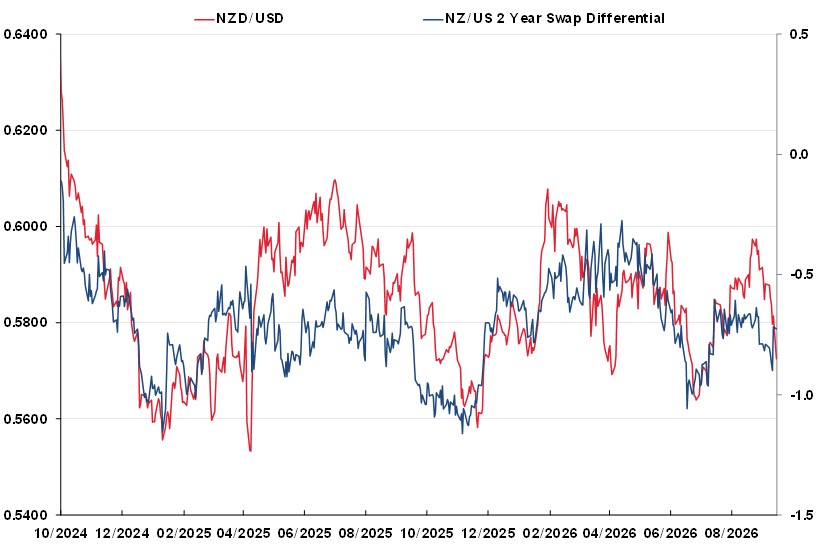
Standing back from the day-to-day FX market events that have caused the NZ dollar to flicker between 0.5600 and 0.6100, the over-arching factor that has maintained the Kiwi dollar’s value within a relatively narrow trading range below 0.6000 has been the fact that US interest rates have been well above New Zealand interest rates for the whole period. The second chart below plots the US:NZ interest rate differential (two-year swap interest rates) movements against the NZD/USD exchange rate over the same two-year period.
When NZ interest rates have moved to be 1.00% below those of the US (blue line in the chart) the NZD/USD exchange rate (red line in the chart) has depreciated to the 0.5600 area: -
- December 2024: Increasing US interest rates = stronger USD
- December 2025: Decreasing NZ interest rates = weaker NZD
- July 2026: Increasing US interest rates = stronger USD
Conversely, when the interest rate differential has contracted, with NZ interest rates being less than 0.50% below US interest rates, the Kiwi dollar has appreciated to near the top of the range at 0.6000. The trading patterns and the strong correlation of the NZD/USD exchange rate to the interest rate differential inform us that the future direction of the Kiwi dollar will continue to be heavily dependent upon changes to the two respective interest rates.
Both NZ and US interest rate markets are currently pricing-in further hikes by the two respective central banks, the Federal Reserve and the RBNZ. Whether New Zealand interest rates can return to their historical position of being above those of the US again comes down how high the RBNZ needs to hike rates to return inflation to 2.00% and whether the current interest rate market pricing in the US of three further 0.25% hikes to above 4.65% is ever actually implemented to return US inflation to the 2.00% target.
Outside the impact of high oil prices on inflation in both economies, the current situation is that most component prices of the CPI Index in the US are trending lower, whereas New Zealand’s domestic inflation remains “sticky high” and our tradable inflation is rising due to the lower NZ dollar value. The end conclusion is that the RBNZ may well have to keep on increasing the OCR interest rate in 2027 to well above 3.50%, whereas the Fed will not have to increase the Fed Funds interest rate to anywhere near the current two-year swap interest rate market pricing in the US of 4.75%. In other words, the greater probability is that NZ two-year swap rates increase from their current 4.00% level, however the US two-year swap interest rate eventually declines to 4.00%. An interest rate differential closer to 0.00% propels to the NZD/USD exchange rate to above 0.6100.
Deciphering Kevin Warsh’s messaging
Whilst the financial markets applauded the unanimous decision by the US Federal Reserve to increase their Fed Funds interest rates from 3.65% to 3.90% last week, there were several aspects of Chairman Warsh’s accompanying messages that were difficult to reconcile.
Firstly, Mr Warsh described the increase in the interest rate as removing some “accommodation” in monetary policy, suggesting that the 3.65% interest rate setting was mildly stimulatory to the economy and that was no longer needed. That viewpoint was a tectonic shift from the stance of the previous Fed Chair, Jerome Powell of just a few short months ago, where Mr Powell viewed the 3.65% interest rate setting as moderately “restrictive” on the economy. Both cannot be right, so the US economy must have changed dramatically over the last three months from low demand/low growth to a much higher level of demand/growth. The economic data does not support such a dramatic change. Therefore, Kevin Warsh has an entirely different lens on how interest rates are influencing investment and spending decisions in the economy. As always, the trends in upcoming economic data will provide the answer. If retail sales and business investment soften over coming months, we will know that the higher interest rates are adversely impacting on the economy. That does necessarily mean inflation will reduce at a faster clip, as most of the inflation comes from the supply side of the economy, not the demand side.
Secondly, Mr Warsh had no concerns that the current GDP growth in the US economy in 2026 was very narrowly based, virtually all of it coming from the AI boom and data centre construction. His comfort with this lop-sided economic growth will be questioned if over-hyped/over leveraged AI equities start to correct down and the data centre capital expenditure comes to an abrupt halt as 5.00% plus interest costs hit home. It was surprising that Mr Warsh was happy with the highly concentrated growth engine and dismissed the risks, before his own AI task force reports back with their thinking and recommendations.
Thirdly, Mr Warsh listed three reasons as to why he believed the bond market had sold off so much over recent months that has sent 10-year Treasury Bond yields to new 19-year highs of 5.00%: -
- Strong growth in the US economy (however that is in only one sector as described above).
- Large debt borrowing demand by the AI/data centre hyperscalers, investors into these corporate bonds demanding higher yield returns to compensate for the risk.
- Elevated global geo-political risk. Presumably, the bond market expecting that the Iran/US war will continue, oil prices remain high and that feeds into second the third-round impacts on other prices in the US economy i.e. US inflation increases.
What was surprising was that Mr Warsh did not see the ballooning US Government fiscal/budget deficit and debt levels as the main reason that investors were exiting US Treasury Bonds. Most market commentators would see the additional supply of bonds currently being issued and the surety that the supply will exceed investor demand in the future as the principal reason for the bond market sell off. Most would see that the direction of long-term interest rates in the US can only turn around and decrease if measures are taken to address the fiscal deficit situation. The Trump regime shows no sign of doing that. If the three causes cited by Warsh all reverse (growth falters, AI busts and oil prices tumble) we would still expect that 10-year bond yields would decline and the US Dollar would follow suit.
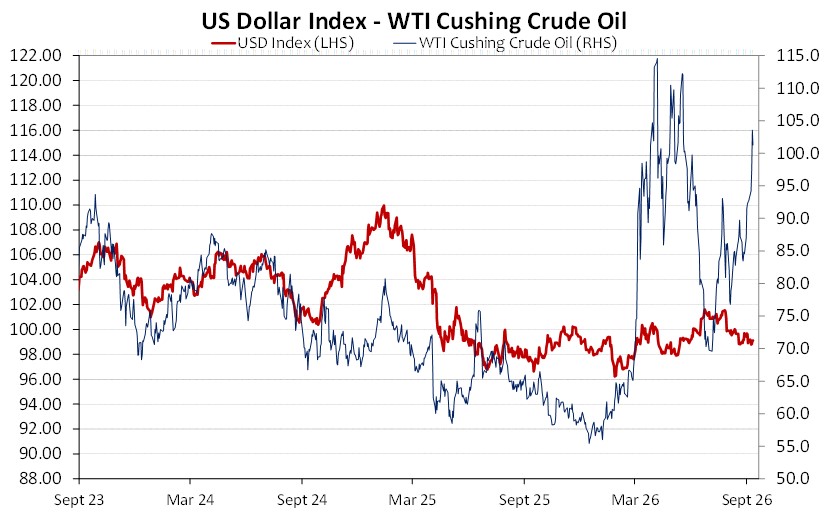
The US dollar has only marginally appreciated in the lead up to the Fed rate hike and subsequent trading. The USD Dixy Index at 99.93 sits towards the upper end of the 96.50 to 100.50 trading range that it has remained within since the tariffs were announced in April 2025. It shows no real signs of making further gains, however future direction will be determined by upcoming US economic data, the mid-term election outcomes and oil price movements. JP Morgan oil market analysts being completely honest this last week when reporting that they “have no idea” as to future oil price movements.
Daily exchange rates
Select chart tabs
*Roger J Kerr is Executive Chairman of Barrington Treasury Services NZ Limited. He has written commentaries on the NZ dollar since 1981.
We welcome your comments below. If you are not already registered, please register to comment
Remember we welcome robust, respectful and insightful debate. We don't welcome abusive or defamatory comments and will de-register those repeatedly making such comments. Our current comment policy is here.