

By Roger J Kerr*

The Kiwi dollar has staged something of minor recovery against the US dollar over this past week, lifting to above 0.6500 from the lows of 0.6440 a week ago.
The Kiwi will only be out of the woods from further depreciation if the selling interest has been exhausted at these levels.
Time will tell on that front, however, as expected the US dollar itself has failed to strengthen below the resistance level of $1.1500 against the Euro.
A marginally weaker USD to $1.1560 against the Euro has been the global currency markets response to the latest meltdown of share markets around the world over recent days.
It tells us something constructive about whether the Kiwi dollar selling has run out of steam when the NZD/USD rate increases in the face of a plunging Dow Jones Index.
Typically, the NZ dollar weakens when there is a “risk-off” sentiment pervading global investment and financial markets.
Should the downward “correction” in equity markets continue over coming weeks and the USD continues to weaken back to $1.1800 against the Euro, the Kiwi will be set to make further recovery upwards to 0.6700 and 0.6800.
It might be a brave person that says it, but in a world of investment market turmoil and uncertainty it would not be too unusual to see some funds flowing into the Kiwi dollar as a safe-haven destination well away from the carnage.
US interest rate potentially going higher than the market previously thought seems to be the prime reason for the equities sell-off.
Federal Reserve boss Jay Powell may have made something of a monetary policy blunder in pontificating that the Fed may have to go above their target 3.00% neutral interest rate next year.
His predecessor, Janet Yellen, would never have scared the horses on Wall Street with such a statement. A Powell retraction would be negative for the USD over coming weeks.
The reasons behind the 10 cents depreciation of the Kiwi dollar from 0.7400 in April to 0.6440 last week are not what you might read about in the popular press. Most of the local commentary on our exchange rate is that the Kiwi is plunging in value due to one or all of the following reasons: -
- Business confidence has collapsed because the Labour Coalition government has created uncertainty in tax, employment and investment. Business people are hardly going to get all positive again with the PM and Government Ministers finding new business targets to attack this last week, being oil companies and supermarket chains. Who’s next?
- US interest rates have increased well above those of New Zealand, leading to foreign capital outflows from NZ.
- The highly indebted housing market is about to collapse, reflecting some upcoming economic demise, thus the currency is depreciating in response.
The real reason why the Kiwi dollar has declined 10 cents is that we follow our big cousin currency across the ditch in lock-step and the AUD/USD exchange rate has dived 10 cents from 0.8100 to 0.7100 against the USD this year (refer chart below). International investors and FX speculators buy and sell the NZD in tandem with their AUD trading activities.
Why has the Australian dollar depreciated so much over a period when their economy has been tracking along rather well? (i.e. above 3% GDP growth and the IMF forecast that to continue).
Many global investors regard the Aussie dollar as a proxy for China and Chinese economic performance. They buy the AUD when the see strong Chinese economic data as the Australian economy is highly dependent on the Chinese buying their mining and energy resources. Stronger infrastructure investment and construction activity in China is always seen as positive for the Aussie dollar.
The AUD weakens when Chinese economic data slows up on previous impressive rates, and this has certainly been the case over recent months with the US trade wars adversely impacting on China.
The Chinese eased their reserve ratios on the banks last week in attempt to restore stronger economic expansion. In response, the AUD/USD rate stopped falling and recovered up from 0.7050 to above 0.7100. Further AUD depreciation is unlikely in the face of the Chinese not wanting their currency, the Yuan, to depreciate much further above 6.92 against the USD as that would weaken their negotiating position with the Americans on any trade talks.
Many investment markets around the world remain under extreme downward pressure on values from US equities, to Hong Kong real estate, to Italian Government bonds, to the US Treasury bond market sell-off, to Emerging Market currencies and the giant scam they call crypto-currencies.
In contrast, New Zealand looks a comparatively safe place to have your money currently. The currency has just depreciated 13.5% over the last six months (i.e. good entry levels), the Government has just recorded a massive budget surplus and agricultural commodity prices remain at 40-year highs. All good reasons for the smart money to start to rate the Kiwi dollar in a different light.
One announcement that could rattle Kiwi dollar buying decisions along this coming Tuesday will be a CPI inflation increase for the September quarter coming out above consensus forecasts of 0.70% and substantially above RBNZ forecasts of +0.40%.
There are already signs that higher fuel prices are pushing up many other prices in the economy, thus the RBNZ should not be ignoring (“looking through”) the oil impact.
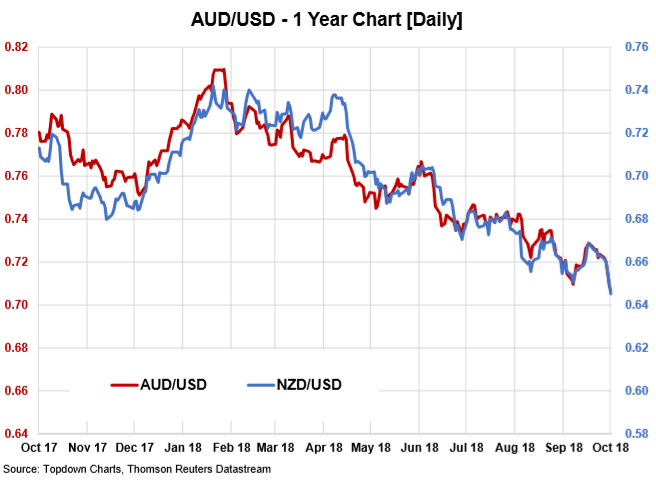
Daily exchange rates
Select chart tabs
*Roger J Kerr is an independent treasury Management advisor. He has written commentaries on the NZ Dollar since 1981.
We welcome your comments below. If you are not already registered, please register to comment
Remember we welcome robust, respectful and insightful debate. We don't welcome abusive or defamatory comments and will de-register those repeatedly making such comments. Our current comment policy is here.