

By Gareth Vaughan
'Too big to fail' is a saying popularised last decade when what became known as the Global Financial Crisis (GFC) swept the world's financial markets.
Basically it refers to a financial institution so important to the economy of a country that a government or central bank must take measures to prevent it from going belly up. Thus too big to fail financial institutions are often referred to as having an implicit government guarantee for their debts.
As a result of the GFC the American and British governments spent trillions of dollars and pounds of taxpayers' money propping up their countries' respective financial systems believing that the alternative, letting big banks and insurers collapse, was worse. Here in New Zealand our big financial service providers survived the GFC, albeit not without assistance. But more on that later.
The too big to fail dilemma has exercised the minds of many a regulator over the past decade. The Financial Stability Board, an international body that monitors and makes recommendations about the global financial system, has published an annual list of global systemically important banks since 2011. This is designed to address the systemic and moral hazard risks associated with systemically important financial institutions, with higher capital buffers required for entities included on the list since 2016.
Closer to home as part of its proposed increase to banks' regulatory capital requirements, the Reserve Bank of New Zealand (RBNZ) has developed a framework for domestic systemically important, or too big to fail, banks. The RBNZ says this will cover ANZ NZ, ASB, BNZ and Westpac NZ who combined hold around 88% of both assets and liabilities in the NZ banking system. Given their size, it's proposed these four Australian owned banks will face an additional capital impost above and beyond what's required of other banks.
'They sailed through because everyone else was paddling like mad'
In a recent RNZ interview RBNZ Governor Adrian Orr attacked the often touted line that NZ's big four banks comfortably survived the GFC.
"I keep hearing this analogy 'oh, the Aussie banks sailed through [the GFC], we're safe.' And that's just wrong. They didn't sail through," Orr said. "They were 100% government guaranteed. New Zealand had about [a] $140 billion underwrite for the banks [the Crown retail deposit guarantee scheme], so we had to step in and have that underwrite."
"The Reserve Bank bought $8 billion of assets off the banks themselves to provide liquidity overnight almost blindfolded having to do it, because of the crisis. [There was] $10 billion of wholesale guarantees for their borrowing offshore, and they [the RBNZ] cut interest rates by 575 basis points. And then the banks say 'we sailed through.' Well, they sailed through because everyone else was paddling like mad," Orr said.
He went on to attack the subsidising of banks by governments/taxpayers/broader society, addressing the old chestnut of big corporations, having enjoyed privatising profits in the good times, then socialising losses when the tide goes out.
"This concept of too big to fail means that I can, as the agent not the owner of the capital, keep pushing and pushing and pushing to maximise the return. And if it [the bank] fails well that's bad. But I'm out. I've made my money, I'm gone. Meanwhile society can pick it [the tab] up. Society too quickly forgets the cost of financial crises and the costs are huge. The costs aren't just the financial price of rebuilding the bank. You have lost often a generation of employment opportunities, you have mental health issues, you have societal exclusion. You look at some of the challenges going [on] around the world globally at the moment. A lot of it is the tail end of the financial crisis," Orr said.
In the post-GFC United States the Occupy Wall Street movement sprang up after the Government bailed out banks rather than homeowners and failed to jail bankers. Arguably this contributed to sections of the population losing faith in authorities and the establishment, thus contributing to the election of Donald Trump as president in 2016. Of course we've also witnessed billions of dollars of quantitative easing, or money printing, from central banks, negative interest rates and a European sovereign debt crisis.
Crisis options & safety nets
One bank failure tool the RBNZ has at its disposal is the Open Bank Resolution Policy (OBR). The RBNZ has argued the OBR could facilitate "a rapid and orderly resolution of a bank failure" without changing the basic legal framework around ranking of creditors in a wind-up or insolvency. Under OBR a troubled bank would be placed into statutory management. The statutory manager would freeze the bank’s liabilities including deposits. The idea would be to release customers' transaction accounts as soon as possible.
The way I've always looked at OBR is it might be used if one of NZ's smaller banks got into isolated trouble. However if one of the country's big banks was in trouble, or there was a systemic issue, it's hard to imagine the Government would allow the RBNZ to use OBR. Rather the Government would probably feel the need for a taxpayer funded bailout. Especially if an Aussie owned bank or banks was/were involved and there was pressure from Canberra.
The Government is also looking to introduce a deposit protection regime as part of phase two of the RBNZ Act Review. The proposal is for the regime to include a limit of between $30,000 and $50,000. NZ is currently an outlier among OECD countries in not having deposit protection.
One of the key arguments behind the RBNZ's bank capital proposals is that through such material increases to regulatory capital the downside from a banking crisis would fall more on bank shareholders and less on taxpayers. Thus despite the existence of the OBR policy and planned introduction of deposit insurance, making banks hold more capital, thereby forcing their owners to have more skin in the game and be less highly leveraged, holds appeal for when the next financial crisis hits. A key part of this is addressing the too big to fail, or implicit guarantee, issue. With breaking up too big to fail banks not on the agenda, I believe this is an aspect of the RBNZ bank capital proposals worth cheering. As is the regulator's plan to reduce the favourable capital position the four Australian owned banks enjoy over all other NZ banks.
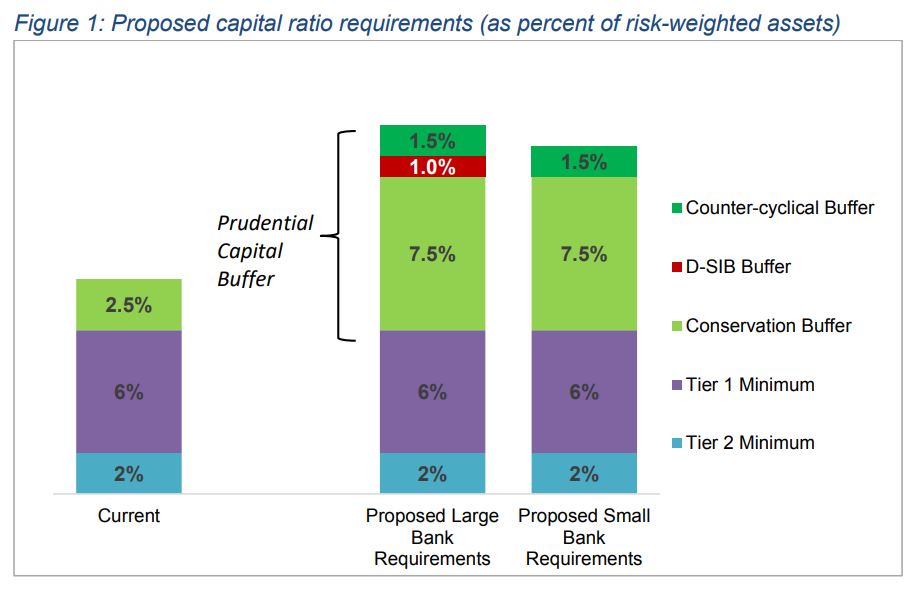
*The RBNZ table below outlines its proposed changes to bank regulatory capital requirements. Note, D-SIB stands for domestic systemically important bank. Kiwibank, The Co-operative Bank, SBS Bank and TSB argue the D-SIB buffer should be 2% not 1%. For background, context and detail on the proposals and bank capital in general, and the nuts and bolts of what's proposed, see our three part series here, here and here. The final RBNZ decisions in its bank capital review are expected in early December.
*This article was first published in our email for paying subscribers early on Friday morning. See here for more details and how to subscribe.
We welcome your comments below. If you are not already registered, please register to comment
Remember we welcome robust, respectful and insightful debate. We don't welcome abusive or defamatory comments and will de-register those repeatedly making such comments. Our current comment policy is here.