
The Reserve Bank (RBNZ) is "hell-bent on hiking [interest] rates to hurt households", Kiwibank economists say.
In their weekly First View publication, Kiwibank's chief economist Jarrod Kerr, senior economist Jeremy Couchman and economist Mary Jo Vergara say they believe the interest rate hikes already delivered "will have a huge impact on households".
Last week the RBNZ hiked the Official Cash Rate by a record 75 basis points to 4.25%, its highest level since 2008. The RBNZ indicated a new peak OCR of 5.5% next year. And it signalled a recession to begin from the middle of next year, with Governor Adrian Orr conceding the central bank was deliberately engineering a recession.
The Kiwibank economists say discretionary income "will evaporate" for many mortgagees, especially those that are relatively new to home ownership, and have entered the housing market in recent years.
"Some households will suffer significant financial stress as relentless rate rises push above the ‘test’ interest rates (around 6%) banks have used in recent years. RBNZ rate rises are testing the limits, and consumption will ease.
"We’re wary the RBNZ may overtighten and cause a sharper correction, or a deeper recession, with a greater pull back in house prices."
The RBNZ is now forecasting a peak to trough fall in house prices of 20%.
"In order to meet its inflation mandate, the RBNZ is hell-bent on hiking rates to hurt households. Demand must be restricted to meet supply. Inflation must return to the 1-to-3% target band," the economists say.
"On top of the current 4.25% cash rate, the RBNZ is signalling a further 125bps of hikes to come. The consequence looks likely to be a shallow but protracted recession from mid next year.
The economists say mortgage rates "will be forced higher" in response to the OCR increases.
"And these rapid-fire rate rises are coming at a time when many indebted households are rolling off fixed rates. Previously fixed 1- and 2-year rates, locked in between 2% and 3%, are rolling off onto much higher rates between 6% and 7%. That’s a huge burden being lumped on top of households. For an $800,000 mortgage, the interest expense will rise from around $20,000 to $50,000."
However, the economists say the impending end (December) to the funding for lending programme (FLP) - through which banks can access relatively cheap funding, at the same rate as the OCR - means "more tightening over and above" that signalled by the RBNZ’s forecast OCR track. (At time of writing the banks have accessed $18.7 billion through the FLP, with the programme being closed off on December 6).
"The total impact could be between 15-50bps above the OCR projection," the economists estimate.
They say early in the pandemic, in 2020, the RBNZ moved "swiftly and aggressively" to keep the financial system afloat.
"The OCR was slashed, billions of dollars of bonds were purchased under the LSAP [large scale asset purchases] programme and the funding for lending programme (FLP) was introduced. The FLP was especially effective in holding down bank funding costs. Both mortgage rates and term deposit rates fell during the introduction of the programme. The announcement of the FLP came in over August and November 2020, with the implementation in December. The success of the FLP was most pertinent when wholesale swap rates rose into 2021, and bank funding costs were held down.
"In the period after the GFC and before the pandemic, the spread between mortgage rates and wholesale swap rates was around 200-250bps. With the FLP, the spread compressed ~50-100bps," the economists say.
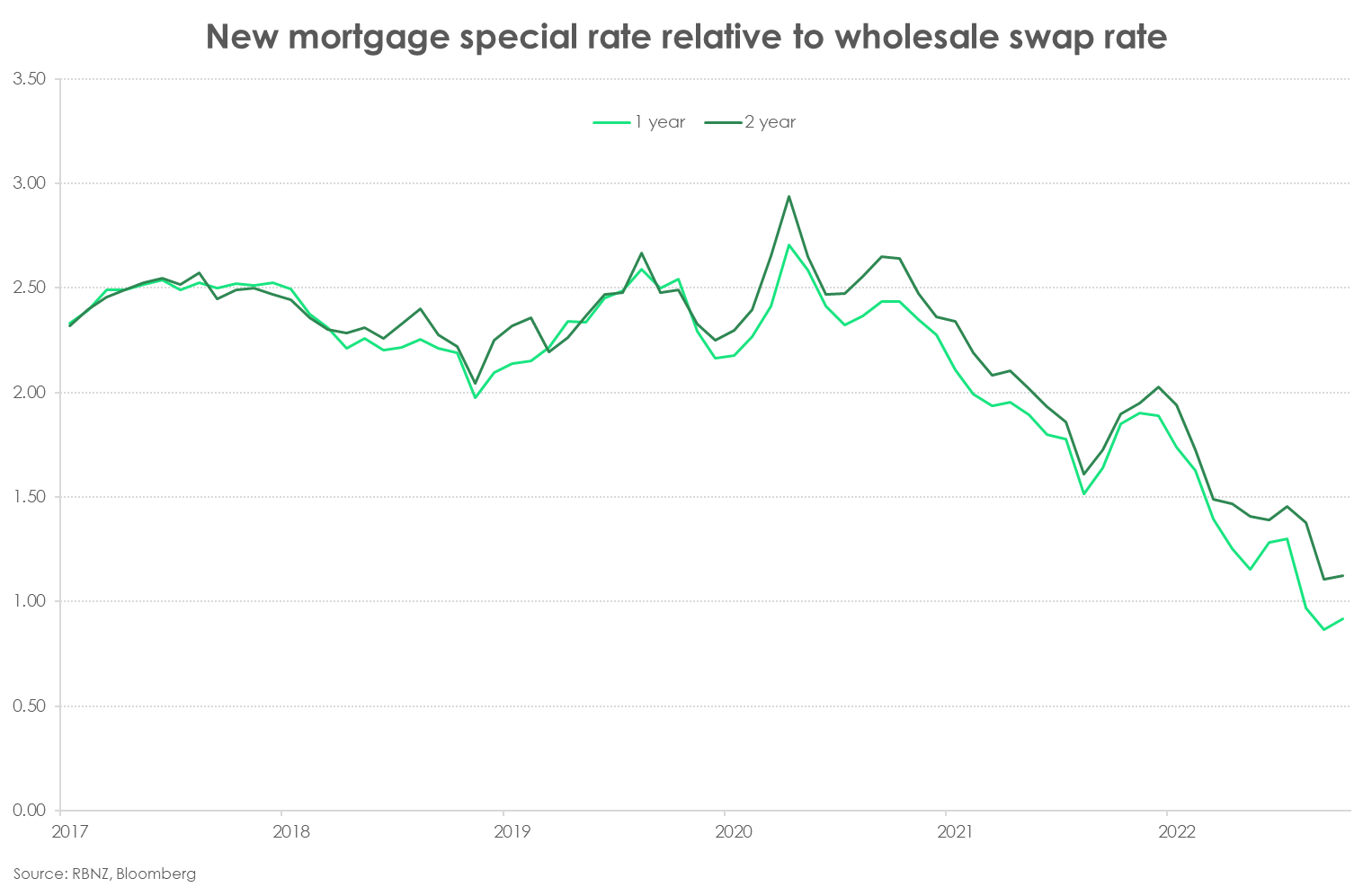
However they say once the programme ends next week, this will put upward pressure on wholesale bank funding rates.
"That is, raising funds will become a relatively more competitive and therefore expensive exercise for banks. Term deposit rates are expected to rise. And that means more tightening above and beyond the projected 125bps of additional hikes to the cash rate.
"The exact impact of the FLP on wholesale funding rates is incredibly difficult to gauge. The total impact could be between 15-50bps. But there’s potentially a lot more to come through if we return to pre-Covid levels.
"If total spreads were to return to pre-Covid levels we would see a lift of around 80-100bps – above the RBNZ’s forecast of 125bps in OCR hikes."
The economists say their focus is now turning to the RBNZ's next OCR meeting on February 22.
"And the RBNZ’s forecasts imply another 75bp hike in the cash rate.
"However, given that other central banks have, or are about to, slow the pace of rate hikes we expect them to moderate their language. We suspect the RBNZ (along with every other inflation fighting bank) will be in a position to ‘pivot’, and slow rate hikes, with weakening growth and improved inflation expectations. We hope…"
We welcome your comments below. If you are not already registered, please register to comment
Remember we welcome robust, respectful and insightful debate. We don't welcome abusive or defamatory comments and will de-register those repeatedly making such comments. Our current comment policy is here.