

Any hopes that we all might be able to ease ourselves slowly into the New Year are likely to be pretty quickly dashed, I feel.
This year already looks like one that's going to get off to a real quick start and then leave us all hanging grimly on trying to keep up with everything.
Therefore, as my first contribution for 2023 I want to do a quick summary of where things finished up before we all disappeared for Christmas, before briefly talking about some of the big stuff that's just around the corner.
This is in fact a cunning strategy on my part with two aims: one to get MYSELF up to speed with what on earth has been going on and secondly, to get you, dear reader, sufficiently girded for the challenges ahead.
Okay, to start with the headline stuff: In keeping with the general trend of economic data again and again blowing all expectations out of the water, the September quarter GDP released in mid-December came in at a much hotter than expected +2% for the quarter. Unemployment's still at a super-tight 3.3%, with hourly wage rises now hitting 8.6%. Annual inflation as of September was at 7.2%, which again was a much stronger figure than expected.
The latter figure appeared to rattle the RBNZ, which had thought it was getting things under control. It reached for the blunderbuss with a 75-basis point blast to the Official Cash Rate in its last rate review of 2022 on November 23. Impressive as this upward shunting of the OCR to 4.25% was, what strangely seemed to get bigger traction with the public was RBNZ Governor Adrian Orr's frank revelation that the central bank's deliberately trying to engineer a recession for us. Well, why not? Christmas was coming, and the spirit of giving and all that.
Well, we might all have been looking forward to the holidays, but apparently we went into them in a pretty dark mood, judging by various confidence surveys (see here and see here) that were released towards the end of the year.
Of course, the housing market hasn't been helping the mood, and the December housing data released to date (see here and see here and see here) is indicating perhaps a slower pace of price falls (these things being relative) but on very low sales volumes. And low sales volumes would tend to indicate continued downward pressure in the short term.
All of this has happened of course as mortgage rates have been rising rapidly. And sure enough, people have not been queuing up to get mortgages in quite the way they were back in the 'good old days' of 2020-21.
The RBNZ released a bunch of crunchy info for November just prior to the holiday break. The sector lending figures showed that the annual rate of growth in the country's stock of mortgages was down to just 4.8% (plummeting from 11% as of November 2021). The 4.8% growth rate was the slowest since February 2015.
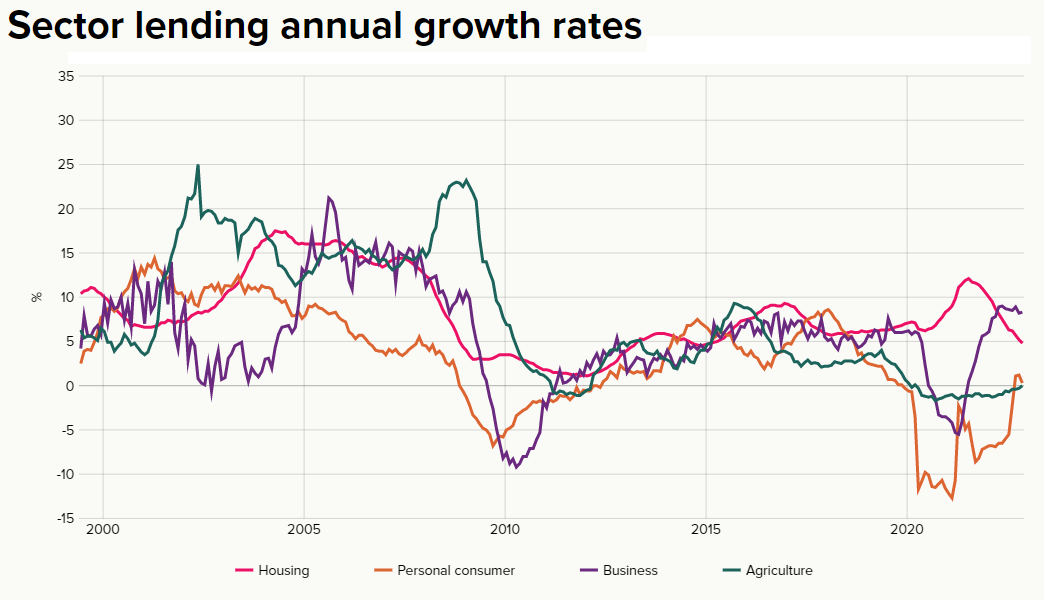
The detail on the monthly mortgage lending available through another RBNZ data release emphasises the picture. The $6 billion borrowed in November was less than two-thirds of the bumper $9 billion-plus advanced in November 2021 as the all night house buying bender of the previous 18 months started to come to its crunching end.
Interestingly though, the plucky first home buyers are not being deterred. They are still in there in very sprightly numbers. The $1.357 billion borrowed by this grouping in November was down by less than $400 million compared with the hothouse figures from the same month a year earlier. And the 22.4% share of total mortgage monies advanced that the FHBs took in November was a new record high for this grouping.
It is to be imagined that the perceived job security of a super tight labour market and an unemployment rate of just 3.3% is proving conducive to keeping the FHBs very interested in the housing market.
As I've said a few times, the job market will be key to everything this year.
Last week's BNZ/SEEK Employment Report then was of very much more than passing interest. This graph is exactly what the RBNZ would want to see:
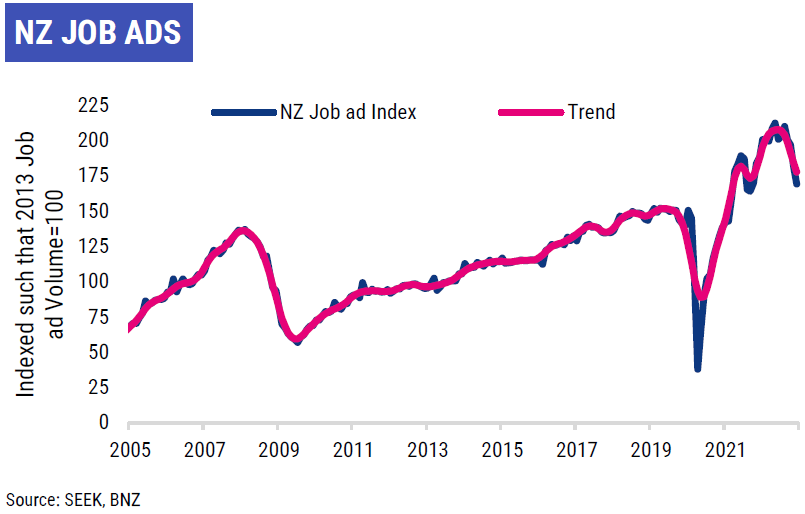
BNZ senior economist Craig Ebert said that "far from being an aberration", the 8.3% drop in November’s job ads proved to be a pretty good pointer to further weakness in December.
"Job ads fell 6.3% in the final month of 2022. This took the cumulative fall over the last four months to around 20%, based on the seasonally adjusted series. It’s been a similar sized drop in trend terms. This measure also marked jobs ads, in December 2022, at about 20% above their 2019 average, whereas in mid-2022 they were running around 40% higher than that pre-Covid point of reference.
"It’s been quite the cooling. Indeed, tracking the trend forward, jobs ads could be back down to pre-Covid levels by the middle of 2023."
As I indicated just above, the RBNZ's looking for the job market to weaken, which will slow spending and take heat out of the economy. The RBNZ was forced to concede towards the end of 2022 that it had seen little impact so far from higher interest rates.
We get further views into the rear vision mirror of the economy during this week with the NZIER releasing its latest Quarterly Survey of Business Opinion. You won't win any prizes for guessing that the results will be similar to the already released gloom and doomfests linked to further up this article. UPDATE: actually it was probably even worse than expected.
Then of course further into the week we'll get the final definitive word on the year in housing with the REINZ December figures and we'll get to see what the decline was in annual terms for the calendar year. As of November REINZ was reporting a 13.7% annual decline in prices nationwide. Gulp. UPDATE, DITTO: This was also everything we expected and more.
Also this week we've got from Stats NZ the December electronic card transactions data, which economists are expecting to be quite weak. Be interesting to see. I have a feeling, a gut feeling, that NZ Inc overspent this Christmas (I know I did) and that could have ramifications down the line. UPDATE: I was completely wrong. The figures give the first real substance to the idea of a slowdown starting.
And then at the back end of this week Stats NZ will help us to work out where all that money was spent with the latest Food Price Index. Remember that food price inflation hit a 14-year high in November. Will we top that again? UPDATE: Oh, we sure did!
All of this stuff is softening us up for the biggies that are just ahead. On January 25 Stats NZ's releasing the December quarter consumers price index inflation figures. I'll have much more to say about these a bit closer to the time, but suffice it to say a lot of people will be hoping the RBNZ's forecast that inflation will actually RISE to 7.5% will be wrong. It's fair to say the 'market' is disinclined to believe that the RBNZ is even close with that pick so will therefore be shaken to its roots if the RBNZ is actually right.
Just a week later, on February 1, we've then got the labour market figures. The key, as I said above, to the whole thing. Expect the figures to be still hot, but also expect any sign of cooling at all to be jumped on by economists as a cue for the RBNZ to ease back on the OCR hike gas. On February 14 the RBNZ releases its much watched (by the RBNZ) Survey of Expectations in which experts give their views on future inflation. Another high set of figures will keep the upward pressure on the RBNZ.
And then on February 22 after digesting all the aforementioned, the RBNZ makes its first OCR call of the year. Another 75 basis point rise was looking like a slam dunk to me as we went into the holiday break, but I see the markets are hedging a bit now, with wholesale interest rates currently pricing a roughly 50-50 chance of either a 50 point rise (to 4.75%) or a 75 point rise (to 5%).
There is much water to go under the bridge before we get to that point.
As I say, it's looking like a fast start to the year. Hold on, and fingers crossed.
We welcome your comments below. If you are not already registered, please register to comment
Remember we welcome robust, respectful and insightful debate. We don't welcome abusive or defamatory comments and will de-register those repeatedly making such comments. Our current comment policy is here.