

As large parts of the New Zealand economy are largely successfully transferred into a “pause” mode, the debate now rightly turns to “how do we get out of this situation?”
If New Zealand business folk are as agile and nimble as we say we are, we will find a way to re-boot ourselves in innovative ways in the changed global economic environment.
There has to be confidence in our capacity to adapt more quickly than other economies. Our economic livelihood from here sort of depends on whether we are smart enough to have a first mover advantage in the industry areas we have a competitive advantage.
It has certainly become apparent in our reaction to this health and economic shock-wave that there is a re-emerging recognition that our economy remains based on the export of trusted and quality natural foods and fibre.
Agricultural science and the rate of grass growth have always been the cornerstone of our economy, and arguably always will be.
The challenge from here is to add more value and brand marketing to the agriculture and horticulture commodities we export to meet the demand of global consumers who will now be even more discerning about the source and safety of what they are buying/eating.
The immediate question to the opportunity to ramp up food production volumes (once we come out of shutdown) is whether we have a local workforce prepared to change to the physical demands of picking apples, pruning vines and milking cows.
If the money and conditions are right for the physically labouring jobs in the provinces, there is no reason why a previous “social media influencer” in the gig economy will not make the change out of financial necessity.
It will be interesting to observe over coming months whether we are as adaptable and flexible in this area of regional labour migration as we will need to be. The onus will be on the food production business owners and managers to make the jobs sufficiently attractive to encourage workers previously at a keyboard or serving foreign tourists.
It will require strong leadership from the business community to recognise the new opportunities and get the backing of investors and regulators to make it happen.
We have witnessed strong economic/financial leadership (after a slow start) from the Government and Reserve Bank over recent weeks to a challenging and ever evolving health/economic crisis.
Under Adrian Orr’s leadership the RBNZ has acted swiftly and decisively to ensure the financial/banking systems’ plumbing continues to work and cash flows to parts of the economy where it is needed.
Finance Minister, Grant Robertson has also understood the requirement to “go big and go early” with fiscal measures designed to keep as many jobs in place as possible.
The announcement last Friday of the “safe harbour” measures for company directors facing tricky insolvency questions, being an example of quick and pragmatic thinking.
We are seeing the advantages of being a small and integrated economy, able the adapt and change rapidly if required. The cumbersome Federal/State structures in Australia and the US which often appear confused with mixed messages, disjointed and slow by comparison.
What has all that preamble got to do with the NZ dollar currency value you may ask? The answer lies in how the rest of the world will see us if we emerge out of the crisis less damaged, earlier and confident on the shape of our economic bounce-back. On a relative scale, we will certainly be well ahead of the US and Europe on most economic measures.
US employment plummets – worse to come
The loss of jobs in the US economy is already staggering, with 10 million signing on to the dole over the last two weeks and the March Non-Farm Payrolls reducing by a record 710,000.
The numbers will become a lot larger over coming weeks as more states lockdown and the dominant services sector is decimated.
The surprise has been that the US dollar has not been sold in response (as yet) to the rapidly deteriorating US economic picture.
The Kiwi dollar has recoiled by 1% to 0.5870 from 0.6050 a week ago as the USD made gains from $1.1150 against the Euro a week ago to $1.0800 (3% USD appreciation).
The Kiwi dollar is starting to hold its own in the face of lower equity markets (always a negative) and a stronger US dollar.
It is difficult to see the US dollar sustaining its gains given the massive additional supply of USD’s from the Federal Reserve and the US now being the epicentre of the coronavirus pandemic and the resultant greater negative economic impact. Weekly jobless claims numbers in the US should be the focus of FX markets, and they will not be a reason to buy the USD.
'Big picture' historical cycles instructive for Kiwi dollar direction
In the very short-term the focus will on this Wednesday’s Global Dairy auction results with the futures market indicating another 3.5% drop in Whole Milk Powder (“WMP”) prices to US$2,700/MT. Over the last five years there has been strong support for WMP prices at around this level and they should hold here.
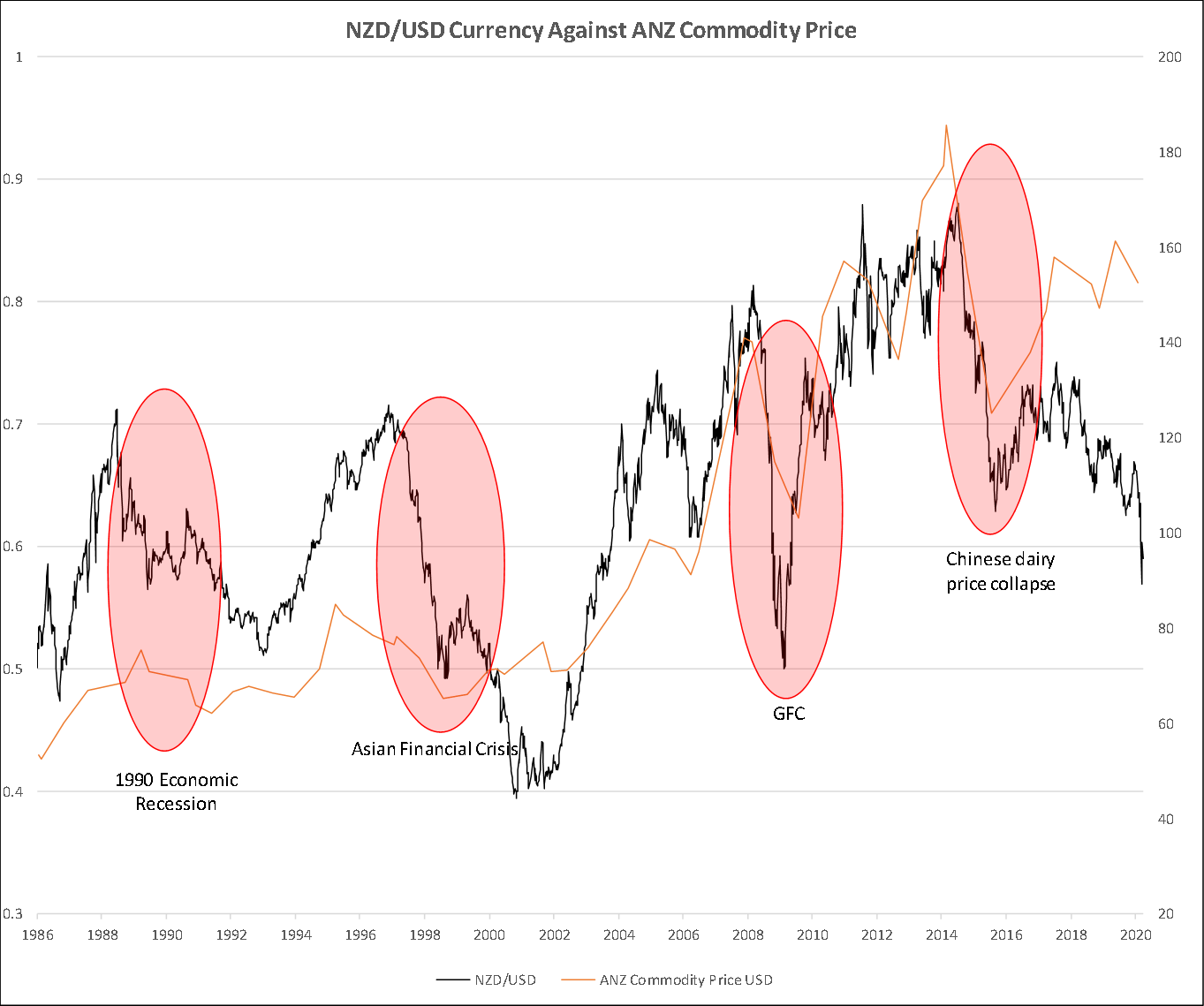
Whilst not so evident in recent times, the correlation between the NZ dollar and our export commodity prices has always been a very strong link. Over the last 35 years the four sudden and large decreases in the NZD value against the USD have been caused by the collapse of our commodity prices (refer to the pink bubbles in the chart below; 1990 Economic Recession, 1999 Asian Financial Crisis, 2009 GFC and 2015 Chinese dairy price collapse).
The current NZD depreciation has been caused by other factors. What results from a lower currency without a corresponding fall in our export commodity prices are booming export returns in NZD terms. Once we get past the current crisis, that economic positive will be much plainer for everyone to see.
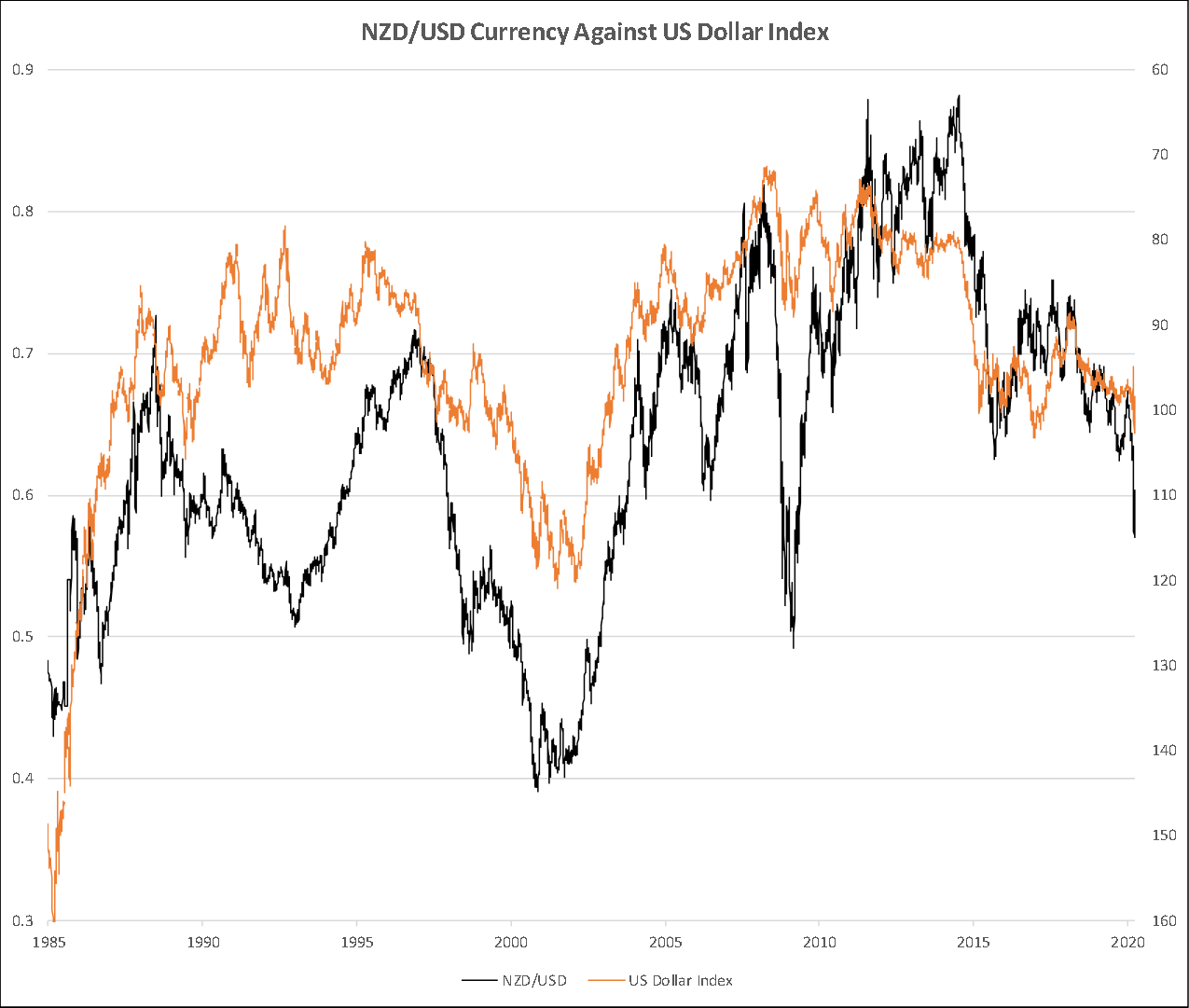
The second chart plots the NZD/USD movements against the USD Currency Index (Inverted Axis) over the same 35 year period. US dollar strength over recent years, moving up from 75.0 to 100.0, due to higher interest rates and good economic growth, justifies the NZD/USD rate being in the mid 0.6000’s, not 0.5500. Should a weaker USD value come about as the US economy suffers more than most from Covid-19, a USD Index back towards 90.0, would see a higher NZD/USD value.
Daily exchange rates
Select chart tabs
*Roger J Kerr is Executive Chairman of Barrington Treasury Services NZ Limited. He has written commentaries on the NZ dollar since 1981.
We welcome your comments below. If you are not already registered, please register to comment
Remember we welcome robust, respectful and insightful debate. We don't welcome abusive or defamatory comments and will de-register those repeatedly making such comments. Our current comment policy is here.