

By Gareth Vaughan
As the country's senior bankers drift back from their summer holidays they'll find little has changed since they called time on 2011 and left the office before Christmas.
The international financial and business news headlines are still dominated by the seemingly never ending European sovereign debt crisis. And with most of the bankers based in Auckland these days, it'll probably still be raining.
Here's a look, in no particular order, at five banking sector issues we'll probably hear plenty about in 2012.
1) Floating mortgage rates versus the Official Cash Rate.
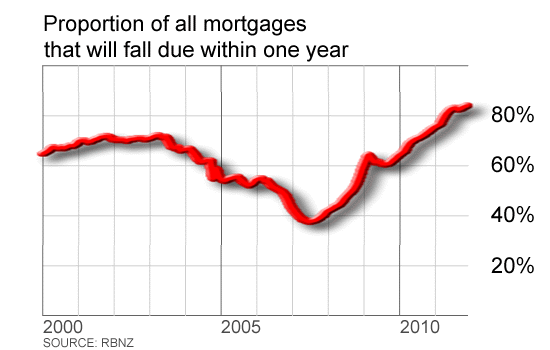
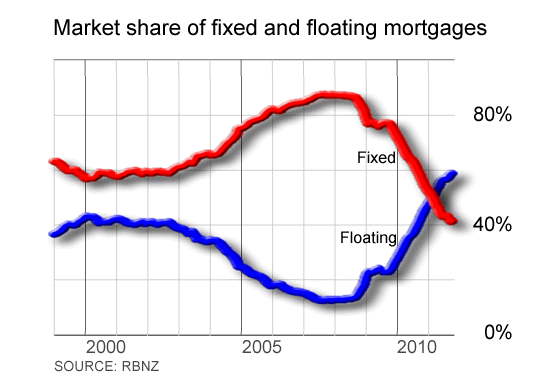
A key area of focus for anyone with a floating home loan or one fixed for less than a year. And there are plenty of us. Based on the latest Reserve Bank figures, NZ$143.053 billion, or 84%, of the country's total NZ$170.610 billion worth of mortgages are floating or fixed for terms of less than one year.
The main question here is, if the OCR remains at its record low of 2.5% late into 2012 as many economists predict, or even into mid-2013 as the New Zealand Institute of Economic Research suggests, will the major banks, usually rising funding costs as an excuse, hike floating mortgage rates anyway?
One CEO who has strongly hinted this will happen is the BNZ's Andrew Thorburn. Meanwhile, ANZ has made waves across the ditch by moving to monthly announcements on its interest rates independent of both the Reserve Bank of Australia and its competitors. ANZ New Zealand won't be doing the same. However, it and all the major New Zealand banks support ANZ's view that their funding costs aren't determined by the OCR, with Thorburn saying the two have always been "decoupled."
If the banks do hike their floating mortgage rates despite the Reserve Bank leaving the OCR unchanged, will our senior politicians follow in the footsteps of their Australian counterparts and publicly attack the banks?
2) Lending growth?
In a stubbornly weak domestic economy, where customer deleveraging has been a feature over the past couple of years, will the banks be able to grow their lending books? One bank CEO, SBS's Ross Smith, has suggested a flat lending book is viewed by many as growth these days.
The Reserve Bank's latest sector credit figures - for the year to November - show agriculture debt contracting by 0.9% to NZ$47.376 billion, business lending growing at 2.6% to NZ$73.470 billion and household debt, including housing and consumer loans, rising just 1% to NZ$184.666 billion.
And will recent trends of ANZ and ASB contracting their books and BNZ, Westpac and Kiwibank growing theirs continue?
3) Cost cutting, possibly featuring redundancies.
Cutting costs seems to be back in vogue with the country's biggest bank, ANZ, trimming operating expenses by NZ$44 million, or 10%, to NZ$384 million in the September quarter. The Reserve Bank warned banks in its November Financial Stability Report not to go too far. It said although it's appropriate to focus on cost containment during the current period of weak lending growth, they shouldn't cut costs to a level where they're exposed to "greater" operational risks.
Sydney-based UBS banking analysts suggest the days of staff cuts and branch closures could return at the big Australasian banks as they're now "structurally challenged" with the tailwinds of a leveraging economy driving strong balance sheet growth, readily available funding, fee hikes and rallying markets all having run their course.
4) Funding costs.
This is a topic we'll hear a lot about from the bank bosses. The European debt woes have put the heat on offshore wholesale funding markets where the big four banks - ANZ, ASB, BNZ and Westpac - get around a third of their funding.
Three of their Aussie parents have issue covered bonds, supposed to be a cheap source of funding for the banks, during the holiday season paying investors' interest rates that won't thrill the banks.
The ANZ Banking Group this week priced a €1 billion, ten-and-a-half year covered bond issue at 130 basis points over the swap rate. That's up from the 95 basis points over swap its NZ subsidiary got as recently as October when it sold €500 million worth of covered bonds and compares with just 62 basis points over swap in BNZ's €1 billion covered bond issue back in November 2010.
According to Bloomberg ASB's parent Commonwealth Bank of Australia and BNZ's parent National Australia Bank paid about 100 basis points more than premiums on senior unsecured debt issued mid-year when they sold a combined €2.5 billion worth of five-year covered bonds secured by home loans earlier this month. The Australian Financial Review reports that, after hedging the proceeds, CBA and NAB's costs all up were between 210 and 220 basis points over the Australian bank bill rate, or 6.6%. ANZ's were 240 basis points over the bank bill rate, or 6.85%.
In NZ just before Christmas the BNZ raised NZ$200 million in a seven-year bond issue, effectively priced at 246 basis points over swap (or 215 after hedging), up on rates of about 160-165 basis points over swap the banks could get three or four months ago.
Still, there are arguments the rise in funding costs is being over played by the banks. Deutsche Bank analysts argue none of the big four Australasian banks need to borrow more than A$12 billion (NZ$15.5 billion) from overseas wholesale money markets during their 2012 financial years, which should be manageable given their strong credit ratings and other borrowing options available including issuing domestic debt, commercial paper and raising retail deposits.
5) Profits & margins.
The four Australian owned banks have market dominance in New Zealand the like of which is seen in few other economies. They account for nearly 90% of the banking sector, or just over 70% of the financial system as a whole. In their last financial year they made a combined net profit after tax of NZ$2.778 billion. That's NZ$78 million, or 3%, higher than their combined profit in the boom year of 2007 when double digit lending growth was the norm. Both ANZ and ASB's 2011 financial year profit hit record highs of NZ$1.085 billion and NZ$568 million, respectively.
Driving this profit growth has been fattening margins on loans and tumbling impairment charges on bad loans. See more on this here.
The impairment charges can't keep falling forever but what will happen with margins? In their last financial year ANZ's net interest margins rose 11 basis points to 2.38%, Westpac's rose 22 basis points to 2.33%, BNZ's rose 14 basis points to 2.30%, and ASB's jumped 40 basis points to 2.08%.
You can keep tabs on the banks' margins here where the Reserve Bank monitors them.
This article was first published in our email for paid subscribers yesterday morning. See here for more details and to subscribe.
We welcome your comments below. If you are not already registered, please register to comment
Remember we welcome robust, respectful and insightful debate. We don't welcome abusive or defamatory comments and will de-register those repeatedly making such comments. Our current comment policy is here.