
There now seems an all-too-real possibility that the great all-night House Party of 2020-21 will give way to the Mother of All Mortgage Hangovers in 2022.
I fully expected mortgage interest rates to start increasing this year. But I've been blown away by how quickly they've risen.
To be clear from the outset, I don't see much chance that rising mortgage rates will get to the point that people will be forced from homes.
But I think there's an increasing chance that come probably the second quarter of next year there could be a fairly precipitous fall off in spending.
And that's going to have to be watched.
Yes, we know the economy has been stronger than any one expected. And the labour market has been as hot as a hot thing.
However, these things can swing around pretty quickly.
I remember commenting in May that the Reserve Bank had provided the 'Go' signal for financial markets to start pushing up interest rates. The RBNZ did that by something as simple as reinstating forward forecasts of the Official Cash Rate - and showing the OCR rising very meaningfully in the next three years.
The reaction was strong enough that by July I was fretting about the possibility of 'Stagflation'.
All this has happened with the RBNZ itself not having to physically do much. Remember, it had at time of writing done just one increase to the OCR, up to 0.5% from 0.25% (but with more presumably to come as of the Wednesday, November 24).
The markets though have just kept on running. With thanks to the ASB economists, here's their table on what the wholesale rates have been doing (as of Monday of this week):
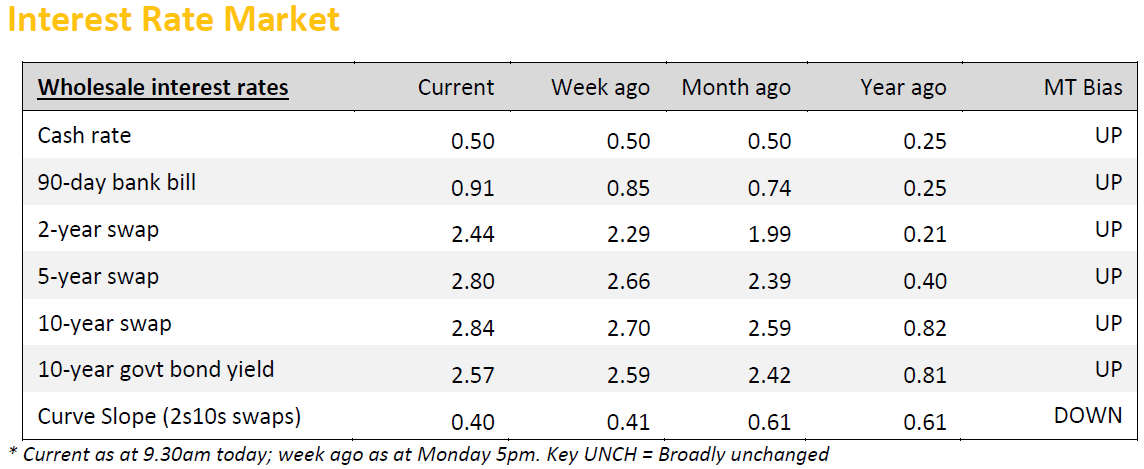
My word for the above is: "Wow."
The above figures in a nutshell are why we've seen mortgage rates screaming ahead. For example the popular two-year fixed 'special' rate has risen on average from around 2.5% in the middle of the year to 4.35%.
Apart from a couple of brief (quickly reversed) blips in 2010 and 2014 we haven't had a rising interest rate environment since the mid 2000s.
The interesting thing to note about that experience was the struggle the Reserve Bank had getting traction against homeowners with fixed mortgage rates.
During 2007 the RBNZ squeezed the OCR till it was blue in the face, pushing it up to a now-seemingly-unthinkable 8.25%.
But the interesting thing to note, via the RBNZ's now-discontinued 'S8' Mortgage Lending statistics, is that less than half, under 40% in fact, of the outstanding mortgage money at that time (using September 2007 as an example) was due to reset/reprice within a year. So, effectively nothing the RBNZ was doing could 'hurt' those paying the mortgage for at least 12 months. They were impervious.
This time it's very different.
The RBNZ's current 'S33' series showing the time till next repricing shows that as at September, the latest month available, over 70% of outstanding mortgage money (nearly $230 billion worth) was due to be repriced within 12 months. In fact over a quarter of the mortgage money (a bit under $90 billion) was due for resetting within THREE months - IE before the end of the year.
This means that any changes in mortgage rates made now get considerable 'bang' for their bucks very quickly. Change of rate today, pain tomorrow - or not that many days after anyway.
It's worth looking at a couple of examples to get some feel for what we are facing.
Let's use our old favourites, the first home buyers.
Two theoretical examples, one of the resetting of a two-year fixed mortgage (30-year term) taken out in November 2019 and the other of one-year fixed mortgage (again 30-year term) taken out in November 2020.
The RBNZ's lending by borrower type figures tell us that as of November 2019 the average-sized loan for the FHBs that month was $440,500. Based on the average of new special mortgage rates then, a two year fixed rate might have been 3.44%. Using the trusty interest.co.nz mortgage calculator gives monthly payments of $1963.
Fast forward two years and facing the new emerging two-year average rate of 4.35%, and let's take the somewhat charitable view that maybe $20,000 of principal has been paid off, leaving $420,500 outstanding, and the monthly payments will go up $130 (per month) to $2093.
The situation's a bit worse for the FHB from November 2020. The average-sized mortgage by this time was $498,000. The one-year fixed rate (average) was 2.53%. Now it's about 3.65%. Using the same calculations (and taking off $10,000 for principal repayment) gives our FHB monthly payments of $1975 as of November 2020, rising to $2232 as of this month - a $257 per month increase.
Now neither of those examples are going to break the bank, or more to the point, the FHB - but the increases are of a magnitude that will certainly be felt.
As anybody knows, you pay the bill for the roof over your head before you pay anything else. And if that roof is costing more to keep over your head then other things, discretionary things, miss out.
So, the obvious areas of spending that might start to go by the wayside are things like eating out, and 'impulse' buys. And it's this sort of drop off in spending that could really start to bite in the economy.
As I said at the start of this, the situation has got to be watched very closely.
Personally, I do not have a good feeling about this at all.
We welcome your comments below. If you are not already registered, please register to comment
Remember we welcome robust, respectful and insightful debate. We don't welcome abusive or defamatory comments and will de-register those repeatedly making such comments. Our current comment policy is here.