

Summary of key points:
- “Risk-off” equities sentiment hurts the Kiwi dollar
- Debunking the myths about the causes of our high inflation
“Risk-off” equities sentiment hurts the Kiwi dollar
The last week has been a right nightmare for Kiwi dollar bulls, the NZD/USD exchange rate falling sharply from above 0.6800 to 0.6630.
It started on Easter Monday with weaker than expected Chinese economic data sending both the Kiwi dollar and Aussie dollar down as slower Chinese demand is not good news for the two commodity currencies whose economies are heavily dependent on China for trade.
The week ended with global equity markets taken further fright to the growing economic uncertainties from high inflation, sharply higher interest rates and an escalation in the Russian/Ukraine war. US share markets fell 3% on Friday 22 April and they have dropped four weeks in a row as they reflect the growing “risk-off” uncertainties surrounding the outlook for the US economy. The Federal Reserve believe that the US economy is sufficiently robust to handle the higher interest rates now being implemented without tipping it into recession. However, consumer confidence crashing is one indicator pointing to more of a hard landing for the US economy than a soft one at this point.
We witnessed a similar rapid sell-off in US equities in the second half of January with the Dow Jones Index plunging 6% over a two week period. The “risk and commodity” currencies, the NZD and AUD were consequently punished with the Kiwi dollar depreciating from 0.6860 to a low of 0.6530 over that two week period. The impressive NZ dollar recovery that followed up to a high of 0.7030 on 5 April was due to commodity prices lifting after the Russian/Ukraine war commenced in February. The equity market sell-off risk for the Kiwi dollar is always present, however the risk goes both ways, with more favourable “risk-on” sentiment in equities generally pushing the Kiwi higher.
The near term direction of the NZD/USD exchange rate is once again in the hands of equity market sentiment and whether the US economy can handle the necessary aggressive monetary tightening from the Fed. Upcoming US data will need to prove that the economic activity levels are holding up and that there are signs of inflation increases peaking-out. A positive US GDP growth number for the March quarter on Friday 29 April and PCE inflation data on the same day have the opportunity to restore some equity investor faith on both counts. The following Friday, 6th May US employment figures for the month of April should again be another strong increase of over 400,000 new jobs.
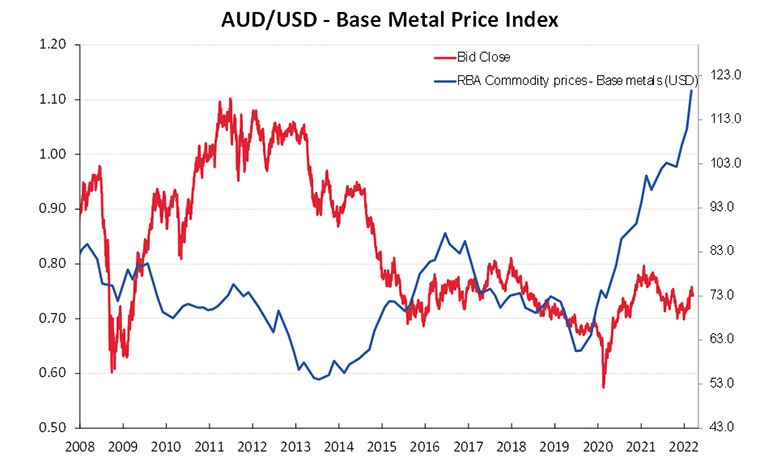
While the NZD/USD rate has broken below key technical/chart levels at 0.6700, the positive fundamentals of higher interest rates and higher commodity prices do not suggest continuing NZD selling. Off course, such a view is predicated on the investor risk sentiment in equity markets recovering from here. Global fund managers and hedge funds should be attracted back into equities at the lower values now available as the alternative investment asset class of bonds is a train-wreck of plummeting values. In this challenging investment environment it is understandable that hedge funds and investment banks are eyeing commodities as an alternative investment asset that will hold its value. Adding to the positive commodity story will be significant monetary and fiscal policy stimulus in China being just around the corner.
The dominating influence over the NZD/USD movements remains the daily direction of the AUD/USD exchange rate. Local Australian political risk factors ahead of the 21 May election date and the current investor “risk-off” sentiment has pulled the Aussie dollar back four cents from 0.7650 to 0.7250 over the last three weeks. The AUD selling is well over-done, in the author’s opinion, against the medium term and impressive Australian economic backdrop of 4.5% GDP growth this year and continuing massive external Current Account surpluses.
Perversely, NZ Finance Minister Grant Robertson’s budget on 19 May stands as another potential Kiwi dollar positive as he irresponsibly increases Government spending which will add to the already high inflation rate. The Robertson budget, in turn, prompting additional monetary tightening from the RBNZ as Robertson ignores Orr’s warnings that monetary policy needs fiscal policy as a friend, not a foe.
Debunking the myths about the causes of our high inflation
It has been very frustrating over recent weeks observing the shallow and superficial level of debate locally as to why New Zealand’s inflation rate is 6.9% and what can be done about it.
The analysis and understanding from the media, politicians, economists and various commentators has, in my humble view, failed to address the core crux of the matter i.e. the complete picture of the source of the high inflation. They have all made the same mistakes in attempting to identify the reasons for the sharply higher inflation rate at this time.
Mistake # 1: The high inflation is something very recent. Wrong! It is not new, the non-tradable, domestic inflation component of the CPI has been running at over 3.00% every year for the last 15 years. What everyone forgets about (not this column!) is that tradable inflation was low or negative from 2012 to 2020 due to imported deflation and this disguised the constant home-grown inflation. That Government policies will add to inflation over the next few years (as one prominent economist opined last week) is misleading, they have been causing the problem for 15 years!
Mistake # 2: It’s all the fault of profiteering supermarkets and oil companies. These sectors are very easy and visible targets for the lazy analyst. The facts are that both these retailers merely add a margin onto core product costs to distribute throughout the land. Commerce Commission investigations showed no evidence of increased profit margins or excessive returns on capital over recent times. These distributors are not the root-cause of our higher inflation.
Mistake # 3: It all comes from offshore, therefore not our fault. The Prime Minister likes to shift blame away from her Government for political purposes. However, successive Labour and National Governments over the last decade have allowed excessive regulatory and compliance costs to be imposed on the economy which households end up paying for. Local Government rates have increase on average 7% every year or 10 years, property maintenance is up 4.5% pa average and house rentals up 3% pa average.
Mistake # 4: It has nothing to do with Government. Wrong again. The public sector (including local government) is a reasonable chunk of the NZ economy and as they are forced to increase their costs to carry out Government policy on climate change, health and safety, water and carbon emissions they recoup the extra costs with increased prices to business and consumers. There is no market discipline of competition to control inflation coming out of the public sector.
Mistake # 5: NZ is a small/inefficient economy suffering from low “economies of scale”. That myth needs to be debunked as well. How can we have the most efficient grassland farmers in the world, however the most inefficient economy when it comes to distributing goods and services (particularly food). Unfortunately, we do have too many “middlemen” taking their cut in the NZ domestic economy. An old rugby mate of mine had a great business importing plastic clothes pegs from China and selling them to the supermarket chains. Who don’t the supermarkets buy direct and reduce their prices by the middleman’s profit margin?
Suggested solution: Rather than just identifying the problem and blaming the Government, opposition political parties should be coming up with solutions to reverse the out of control home-grown inflation of our own making. In 1995, our Finance Minister at the time Ruth Richardson sponsored the Fiscal Responsibility Act to hold all Governments to account on spending and budget deficits. Perhaps we need a “Public Sector Price Control Act” that requires every piece of Government legislation and regulation to first pass a test of whether it increases costs on average households. Such a “straw-man” test or reference household test would return some accountability and transparency to the public sector that has been absent for a long time.
Daily exchange rates
Select chart tabs
*Roger J Kerr is Executive Chairman of Barrington Treasury Services NZ Limited. He has written commentaries on the NZ dollar since 1981.

We welcome your comments below. If you are not already registered, please register to comment
Remember we welcome robust, respectful and insightful debate. We don't welcome abusive or defamatory comments and will de-register those repeatedly making such comments. Our current comment policy is here.