
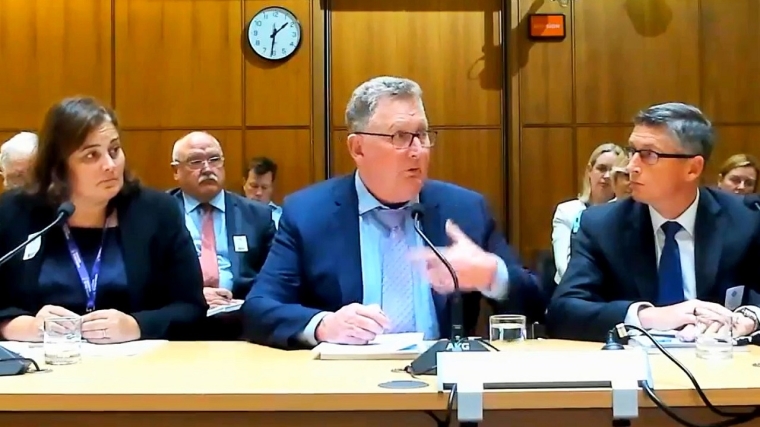
Reserve Bank Governor Adrian Orr says the country's banks are "up for" the task of supporting their customers through the strains of much higher interest rates that are now coming through.
Orr appeared before Parliament's Finance & Expenditure Committee (FEC) for the RBNZ's annual review on Wednesday, and he was asked by MPs about banks' high levels of profitability and what they were now doing to help out customers.
With the RBNZ firing up the Official Cash Rate in the past year from 0.25% in October 2021 to 4.25% now to counter 7.2% annual inflation, fixed rate mortgage borrowers are seeing their interest rates soaring from perhaps the 2%-3% range last year to somewhere around 6%-7% now.
Orr said banks need to be well capitalised - and the RBNZ has been working with them to make sure that is the case. And they need to have sound funding and be highly liquid.
"Banks need to be able to work with their customers through good times and bad," Orr said.
"And they need to take a long term view on their customer base because it is a lifetime of earnings they get off each customer.
"So, through the next period we are saying to them 'you need to be in touch with your customers'. They want to be in touch with them. The NZBA [banking industry body] are out there publicly saying they want to be helping and working with the customers.
"What are the practical things they can do? Awareness helps. Second one is around interest only. The other one's around deferrals. Other ones are around assistance in alternative forms of financing or activity etc. All of the things that you would expect a bank relationship to provide.
"And so the banks are well aware. They are telling us publicly they are up for it and so that's a great position to be in."
In his opening remarks before the FEC, Orr noted that New Zealand has a near record low unemployment rate of 3.3% and exceptionally high labour force participation rates.
Households have accumulated financial savings, with average household incomes rising in line with inflation. Nominal wage rates have risen, with incomes further bolstered as people moved jobs to earn more, worked longer hours, or gained promotions.
Average hourly earnings growth for the private sector was 8.6% in the year to September 2022, compared with Consumer Price Index inflation of 7.2% in the same period.
"As interest rates rise, we expect spending to slow and unemployment levels to increase as more people join the workforce over the coming year.
"Even with the expected slowdown in the period ahead, it is anticipated that the level of employment will remain high," Orr said.
He also commented on two much discussed initiatives the RBNZ launched in 2020 as the Covid pandemic took hold.
These were the Large Scale Asset Purchase programme (LSAP), through which the RBNZ originally bought $53 billion worth of Government bonds and the Funding for Lending programme (FLP), through which banks could borrow relatively cheap money priced at the OCR level. The latter programme was closed off on December 6 with about $19 billion borrowed by the banks.
Orr said the LSAP was highly effective in response to the liquidity crisis that emerged in early 2020 and in lowering longer-term interest rates.
The FLP also gave banks confidence that a stable and secure funding source was available during a period of heightened financial market uncertainty.
"Banks were able to continue their business of financial intermediation, avoiding a credit squeeze or worse.
"This lending programme needed a period of commitment from the Reserve Bank in order to provide banks the confidence to include the use of the facility in their forward plans. In hindsight, it could have been designed with more flexibility."
Orr reiterated that the interest rate charged for accessing funding under FLP rose in line with the OCR, "and the volume accessed accounted for only about 2% of bank funding".
"Our experience with both these tools has built our capability to respond to unexpected events in future."
Orr faced a number of questions from MPs over staff turnover.
He said the turnover rate for the central bank as at June 30, 2022 was 21.7%.
"This aligns with the overall public sector rate of 21.7% for the same period, but includes the necessary bank-wide re-organisation.
"Similar to other organisations we are experiencing higher than normal levels of staff turnover, in part promoted by the ongoing impact of Covid-19. We are however seeing strong demand in the marketplace for our roles and a high calibre of candidates coming on board."
We welcome your comments below. If you are not already registered, please register to comment
Remember we welcome robust, respectful and insightful debate. We don't welcome abusive or defamatory comments and will de-register those repeatedly making such comments. Our current comment policy is here.