

Well, that old spoilsport Grant Robertson 'showed us the money' in the past week but then displayed no immediate inclination to splash the cash in order to give the economy a lift.
In the meantime the business community is working itself into a gloomfest of epic proportions. The Reserve Bank is consequently going to be further leaned on to provide some support for the economy. Hence, therefore, the expectation that interest rates will be cut again by the central bank at its next review on November 13.
How much good that will do is open to speculation.
One thing I have touched on before in previous columns is the possibility (albeit seemingly remote just at the moment) of the housing market going into an upswing that will help support the economy. It's worth having a deeper dig, however.
Theoretically this could be a good time for the housing market. The ever-falling deposit interest rates are killing returns for term deposit investors. The falling lending interest rates are making borrowing money as cheap as chips. All things being equal, a lot of people you might imagine would turn to thoughts of owning an investment property and getting potentially a better yield from the rental return than would be available at the bank. But there's complications, which I go into further down this article.
So, the market may need a bit of a push. The RBNZ could actually help to do that - and help itself with its overall ambition of stimulating the economy into the bargain.
Some context: The Reserve Bank has two major functions - managing monetary policy and promoting financial stability.
To put that in easily recognisable terms, the Official Cash Rate is a monetary policy thing and the loan to value ratio (LVR) restrictions (one of the RBNZ's 'macro-prudential tools') are a financial stability thing. The RBNZ's next big 'financial stability' set-piece is the releasing of its Financial Stability Report on November 27.
Generally the monetary policy and financial stability roles don't overlap much - but one area of significant overlap of course is the housing market - it features prominently in the RBNZ's thinking in both the monetary policy and financial stability roles.
Lending a hand
And I think we are now in a situation where the RBNZ could use its financial stability weaponry to help out its monetary policy objectives.
There's no doubt this country hums along a lot better when the housing market is on an upswing. The 'wealth effect'. People feel like they have more money so they spend more and this turns the wheels of the economy around.
So, some rise in house prices and market activity now would arguably help stimulate the economy.
Okay, so, if we go back to 2013, the RBNZ introduced the LVRs in the face of a then raging housing market - particularly in Auckland.
I think it is often generally misunderstood that the RBNZ's actions were about controlling house prices. No. That's not the central bank's brief.
What the central bank does not want, however, is a lot of people getting into financial difficulty with their mortgages, banks reacting by pulling back sharply on credit availability, a subsequent big fall in the value of houses and resultant big risks to financial stability.
Back in 2013 the banks collectively were really ramping up the numbers and amounts of high loan to value ratio lending (lending of amounts above 80% of the value of the property) as they competed with each other for business. As the below graph from the RBNZ's September 2019 quarter 'Macro-prudential Chart Pack' shows, the LVRs have done a great job in reducing the numbers of high LVR mortgages outstanding.
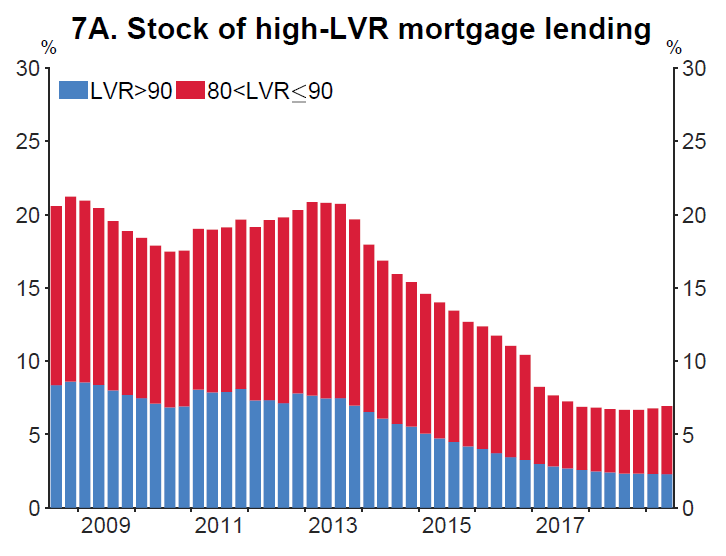
The big reduction in numbers of outstanding high LVR mortgages has given the RBNZ leeway to relax the LVR rules. And it has already done this. The LVRs were relaxed from both January 2018 and again in January of this year.
Under current LVR settings banks can advance up to 20% (originally 10% in 2013) of their new lending in mortgages of over 80% of the value of the property. That 20% figure is often described as the 'speed limit'.
In 2016 housing investors had punitive 40% deposit rules clamped on to them. These have subsequently been eased to 30% deposits. Banks in theory have some, but not much, discretion to lend more than 70% on the value of properties. The 'speed limit' on this category is just 5% - which is effectively zero really.
The RBNZ has been providing an excellent data series, mortgage lending by borrower type, since August 2014 and we can track what the impact of the LVRs has been on the various buyer groups.
Sharing the spoils
In August 2014 owner-occupiers borrowed 59.5% of the total mortgage money advanced. This dropped to 54.7% in August 2015, rose to 57.7% in August 2016, rose again to 62.3% in August 2017, dropped again to 60.2% in August 2018 and rose to 62.9% in August 2019. In the past three months the owner-occupiers' share of mortgage money has been steady in around the 62%-63% area.
First home buyers, as the RBNZ has subsequently conceded, were "disproportionately restricted" by the first iteration of the LVR restrictions in 2013. This fact, and the subsequent recovery of their participation in the market, is very clear from the RBNZ figures.
In August 2014 the FHB grouping took just 9.7% of the mortgage lending, then 10.5% in August 2015, 12.4% in August 2016,14.5% in August 2017, 15.4% in August 2018 and 17.1% in August 2019. The FHBs have accounted for over 17% of mortgage borrowing in each of the past three months.
And so to the investors. They are the key in many respects in all this.
In August 2014 investors accounted for 29% of the total borrowed, followed by 33.5% in August 2015 (and the share got higher than that in subsequent months - up to 35%), 28.8% in August 2016, 22% in August 2017, 23% in August 2018 and then just 19% in August 2019. In the past three months the investor total has been in an around the 19% mark or just below. A quick dollar for dollar comparison: In August 2019 the investors collectively borrowed $1.023 billion. Back in August 2015 they borrowed $1.989 billion. Not far off double the amount.
So, the stepping back from the market of the housing investors has on the one had been very helpful for would-be FHBs, but on the other has undoubtedly been a big contributor to the overall market going much more quiet. Any uptick of investor involvement would undoubtedly put some buoyancy into the housing market.
But how affordable is the market?
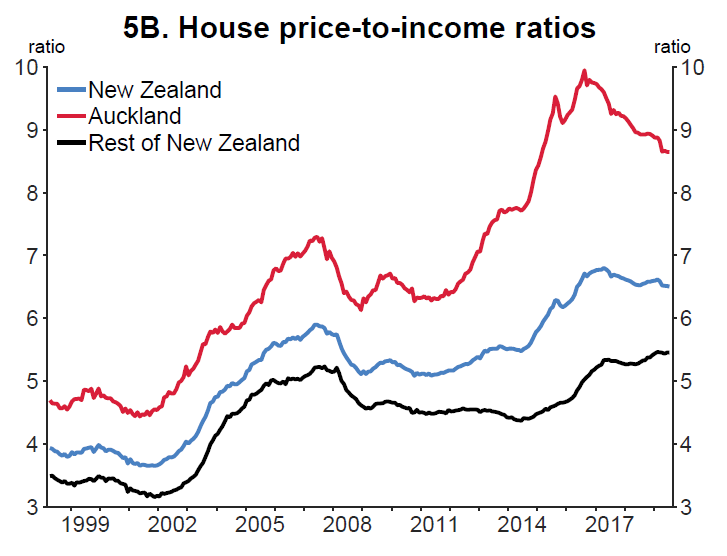
Affordability, as measured by price to incomes, is still high - particularly in Auckland. But it is coming down, as another graph from the RBNZ shows:
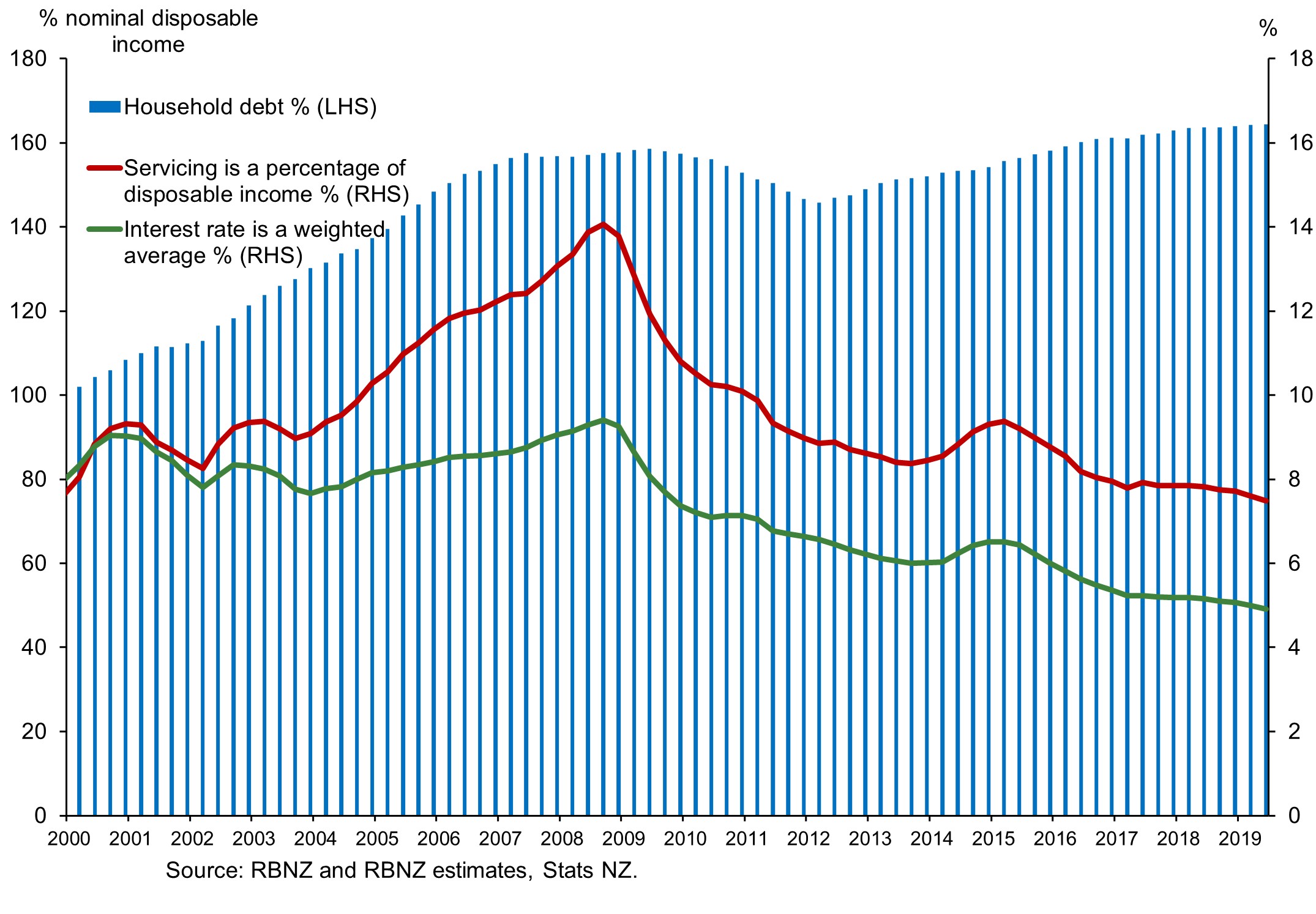
And more crucially still, as another RBNZ graph shows, while the size of loans has been getting bigger and bigger, the ability to service those loans is improving all the time - courtesy of the continually falling interest rates.
All of this says to me that the RBNZ can, and will, feel comfortable relaxing the LVRs further on November 27 - and just possibly giving itself a big hand up with providing some stimulus for the economy.
I honestly think the RBNZ may now feel sufficiently emboldened to 'switch off' the LVR settings for owner-occupiers, including first home buyers. Just to explain: We've already established that the LVRs will never now be 'removed' as such. But the RBNZ could just effectively 'switch them off' - meaning they are not binding for the banks any more. And if they are needed in future, they can be 'switched on' again. So, maybe there will be no official LVR restrictions for owner-occupiers and first home buyers, perhaps from the start of next year.
The bigger poser is probably what to do about the investors. It was the controls placed on the investors in 2016 that ultimately made the big difference to the housing market. Logic suggests that loosening up limits for the investors is therefore the key to allowing the housing market to heat up again. Would the RBNZ be bold enough to drop the deposit limit for investors down to 20%, in line with owner-occupiers and FHBs?
Well, it could do that, maybe. Of course another option might be to look at that 5% 'speed limit' referred to earlier. What say a 20% 'speed limit' for investors? That would mean banks able to advance up to 20% of the new mortgage money to investors for loans in excess of 70% of the value of the property. That would be a considerable loosening.
Surely such a loosening would get some would-be investors back into the market.
Would it be risky for the RBNZ to effectively allow the housing market the chance to heat up again?
Well, it would seem to me that an RBNZ seemingly struggling to get traction with its OCR cuts could do itself a favour by allowing the chance for the house market to heat a little.
And there's more...
There's another potential motivation here too.
In December the RBNZ is set to come out with its final proposals for banks to hold more capital. This issue has seemingly become more fractious as it has gone on.
We've seen dark suggestions about banks holding back on credit in the face of these new capital requirements.
Or that credit will be more expensive.
Or both.
If the RBNZ chooses to greatly free-up the bank's ability to lend on November 27, through a big relaxation of the LVR rules, this will remove one layer of excuses the banks might have why they shouldn't lend to someone. It would put public pressure back on them to keep lending - even if they might be more inclined to claim the new capital requirements are contstraining their ability to lend.
So, therefore, the RBNZ might find the idea of freeing up the LVRs doubly attractive, if indeed the final release of the capital proposals does turn out to be something of a battlefield.
It's therefore well worth keeping an eye on all this as it develops.
Look, maybe the Finance Minister will finally at some stage unveil some goodies through some new infrastructure projects to fire up the economy. Next year IS election year after all.
But in the meantime, the humble housing market could be used to help the RBNZ out a little.
*This article was first published in our email for paying subscribers early on Friday morning. See here for more details and how to subscribe.
We welcome your comments below. If you are not already registered, please register to comment
Remember we welcome robust, respectful and insightful debate. We don't welcome abusive or defamatory comments and will de-register those repeatedly making such comments. Our current comment policy is here.