

New Zealand's big four banks are on target for record annual combined profit this year.
Three of the four - ANZ NZ, ASB*, and Westpac NZ - have reported their annual financial results to date. BNZ follows on Tuesday, November 9.
The three who have reported so far have delivered combined annual net profit after tax of $4.171 billion. That's $957 million shy of the $5.128 billion the four, combined, reported in the record year of 2018.
BNZ's profit for the first nine months of its September 2021 year reached $978 million. It therefore appears on track to top its record annual profit of $1.038 billion made in 2015.
The four Aussie owned banks thus appear to be comfortably on target for combined record annual profit.
Whilst net interest margins and return on equity are perhaps worthier measures of bank profitability, the measure the average customer understands best is raw profit. And in a world dominated by the Covid-19 pandemic, the major banks have done mighty well on this front.
They have, of course, been assisted by government and Reserve Bank measures such as the wage subsidy scheme, mortgage deferral scheme, a record low Official Cash Rate encouraging record levels of housing borrowing, and removal last year of loan-to-value ratio restrictions on housing lending. This year's profits are also boosted by the banks writing back some of the loan loss provisions made last year in the early phase of the pandemic.
Back in August I reported that NZ's banking sector could post annual profit of $6 billion for the first time this year. Aside from the big four other banks including Kiwibank, TSB, SBS Bank and The Co-operative Bank have also posted strong profit this year, albeit off their more modest bases. Based on figures from KPMG's annual Financial Institutions Performance Survey, the banking sector's record annual net profit after tax to date was $5.77 billion in the year to September 30, 2018.
Reserve Bank Governor Adrian Orr called for banks to use their balance sheets to support households and businesses facing higher inflation and rising interest costs, firstly at last Thursday's virtual Institute of Financial Professionals NZ conference, and again when releasing the bi-annual Financial Stability Report on Wednesday. Effectively Orr is urging banks not to take the umbrellas away from customers when rain comes.
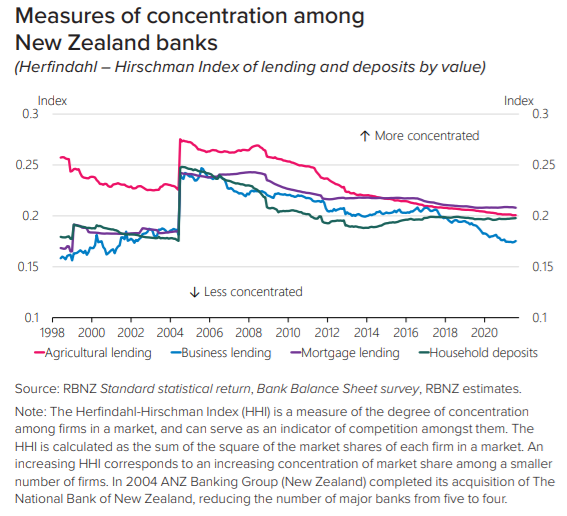
Meanwhile in its Financial Stability Report, the Reserve Bank argues that although the four Aussie owned banks continue to dominate NZ banking, their dominance isn't quite as complete as it has been.
"While New Zealand’s overall banking industry continues to be dominated by the four large Australian-owned institutions, measures of concentration across key bank lending and deposit markets point to gradually decreasing levels of market concentration since the last major change to the industry structure when ANZ acquired the National Bank [see the chart below]," the Reserve Bank says.
"Domestic-owned banks have grown their market shares in the residential mortgage lending and household deposit markets over the past two decades. In agricultural and business lending, strong competition from other foreign-owned banks has seen the market share of the Australian-owned banks decline, particularly over the past five years. In addition, differences in their long-term growth strategies for agricultural and business lending have seen the Australian-owned banks converge to now having more even market shares amongst themselves than was the case in the early 2000s."
Switching banks is a relatively easy, low friction process with the banks doing most of the work. The full list of NZ's registered banks is here.
*ASB's profit is for the June year. ANZ and Westpac's figures are for the September year. ASB's September quarter financial results won't be available until the Reserve Bank's Bank Financial Strength Dashboard is updated on November 26.
*This article was first published in our email for paying subscribers early on Friday morning. See here for more details and how to subscribe.
We welcome your comments below. If you are not already registered, please register to comment
Remember we welcome robust, respectful and insightful debate. We don't welcome abusive or defamatory comments and will de-register those repeatedly making such comments. Our current comment policy is here.