

Summary of key points: -
- Impossible to predict the unpredictable RBNZ
- Euro and Japanese Yen movements do not suggest a lower Kiwi dollar
- Who to blame for the electricity price crisis
- Kiwi dollar undervalued on the “Big Mac” currency index
Impossible to predict the unpredictable RBNZ
The NZD/USD exchange rate has returned to 0.6000 after another short-term dip to below 0.5900. Whether the Kiwi dollar can continue to make gains higher against a weaker US dollar in global FX markets over coming weeks and months will largely hinge on what the Reserve Bank of New Zealand (“RBNZ”) say and do this Wednesday 14th August. Over the last 12 months the RBNZ have proven to be as inconsistent and unpredictable as a struggling All Blacks rugby team this season under a new coach.
If the RBNZ deliver a monetary policy statement this week in line with what they messaged back on 22 May, the Kiwi dollar will respond by moving higher, as interest rates will need to stay higher for longer to bring down the stubborn/sticky non-tradable inflation that the RBNZ highlighted as problematic. Should the RBNZ adopt the tone of the 10 July OCR review statement, wherein they completely ignored their May inflation worries, the Kiwi dollar is likely to depreciate as the RBNZ would be signalling much earlier reductions in inflation and interest rates.
The likely outcome is that RBNZ Governor Adrian Orr will keep the markets guessing for a while longer and deliver a statement not consistent with either of their messages in May or July. It would be a major surprise if Adrian fully endorsed the current interest rate market pricing of eight x 0.25% =2.00% of cuts over the next nine months. To endorse that market pricing, the RBNZ would have to forecast tradable inflation plummeting further to -2.00% to offset the +4.00% permeant non-tradable inflation track. Such a further dramatic reduction in tradable inflation is improbable. Oil prices have reduced; however, the NZ dollar currency value has weakened overall which pushes tradable inflation higher, not lower.
On the other side, Governor Orr will not totally renounce the aggressive interest rate market pricing. He is more likely to indicate that inflation is progressively moving lower in line with their forecasts, however a too rapid reduction in interest rates runs the risk of igniting inflation again (particularly in the NZD/USD exchange rates depreciates in response).
It is recognised that the economy has continued to weaken through June and July, however that does not automatically transfer through to lower inflation. As we have demonstrated previously, the high 5.40% domestic/non-tradable inflation is immune and impervious to GDP and interest rate levels. The non-competitive parts of the economy and public sector continue to increase their prices and the RBNZ can do nothing about that. Therefore, they need to drive tradable inflation to well below zero to lower the overall inflation rate to the 2.00% target. The economy needs a higher NZD/USD exchange rate to achieve that, so it would be totally irresponsible to deliver a statement next Wednesday that sends the NZ dollar lower!
It would be refreshing indeed if Governor Orr was as clear-cut and straight forward as the Reserve Bank of Australia (“RBA”) Governor, Michele Bullock in respect to messaging to the market and the wider economy. Last week, the RBA Governor was upfront and honest with unambiguous messages of: -
- Inflation will take longer to decrease to our 2.50% target than previously forecast.
- The interest rate markets have gotten ahead of themselves with pricing-in interest rate cuts this year.
- The RBA will not be cutting interest rates before February 2025.
The RBA delivered a “hawkish hold”, the RBNZ are likely to deliver a “dovish hold” this Wednesday. However, the two countries’ inflation rates (both with high domestic/non-tradable inflation levels) are very similar. The RBA are not that confident of their inflation rate reducing over coming months. The RBNZ should not have confidence about our inflation rate reducing dramatically either with electricity prices soaring and local government rates ramped higher as well.
Whether the RBNZ wait for the September quarter’s CPI inflation data in mid-October and therefore make the first cut at their 27 November meeting or they cut at the earlier 9 October meeting remains to be seen. Either way, the cuts to New Zealand interest rates will come after the US Federal Reserve’s first cut on 18 September. The US do not have a 5.40% domestic inflation problem that New Zealand has, therefore over the next six to nine months the Fed will be reducing their interest rates at a more rapid pace than we will be.
Outside of the risk of Adrian completely ignoring the domestic inflation problem, the conclusion is that the NZD/USD exchange rate will move upwards on a more favourable interest rate differential for the NZD against the USD.
A surprise 0.25% cut this Wednesday would totally destroy any credibility the RBNZ have remaining, as it would mean cutting interest rates 12 months earlier than what they stated on 22 May (less than three months ago). The future track of inflation just does not change that much in the space of three months.
Euro and Japanese Yen movements do not suggest a lower Kiwi dollar
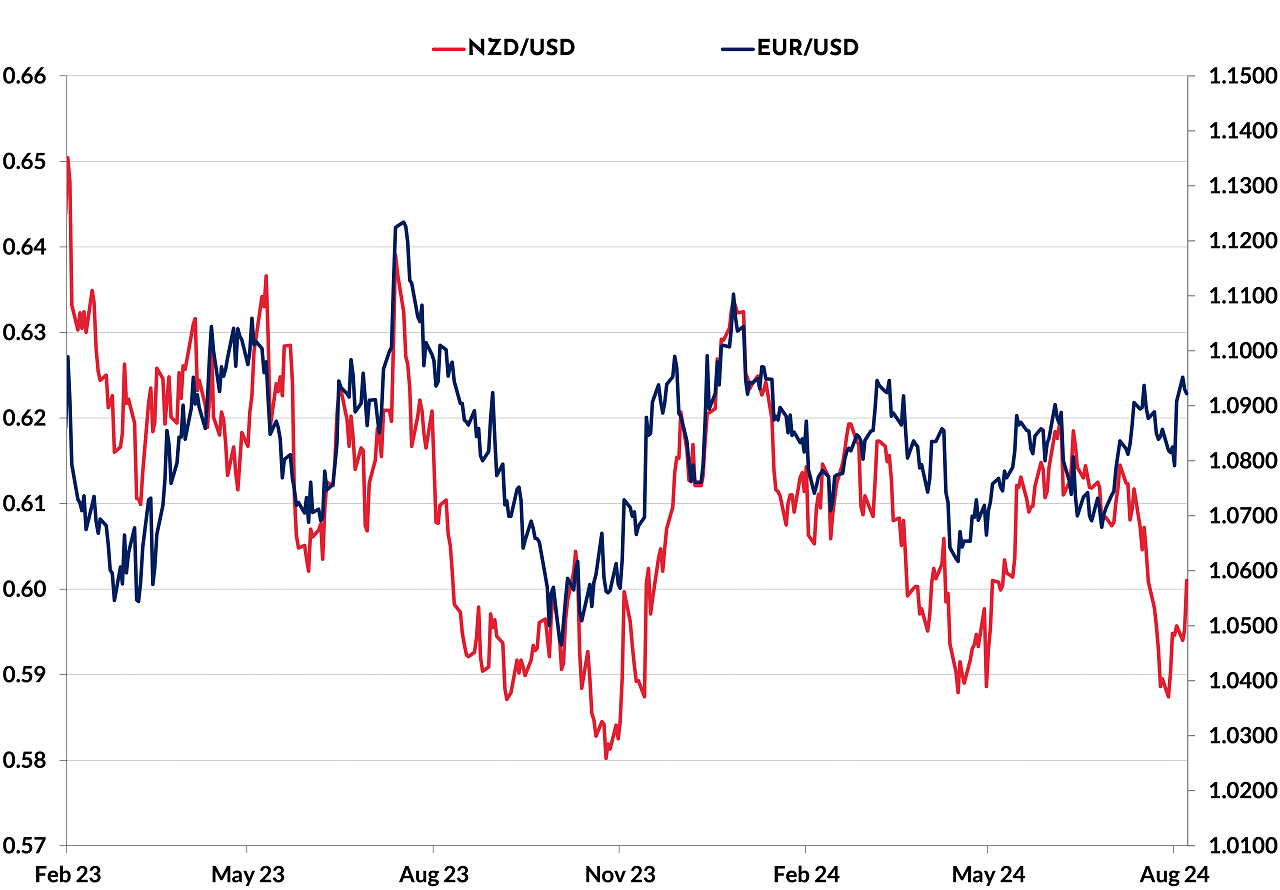
History tells us that the NZD/USD exchange rate is tightly correlated to EUR/USD movements, as what the US dollar does against all currencies remains the dominant determinant of NZD/USD direction. The chart below confirms that close correlation, however over recent weeks we have witnessed a significant divergence of the two rates. The NZ dollar was forced lower on the unwinding of Japanese Yen carry trades, independent and unrelated to a stable EUR/USD rate over that period. History also tells us that such divergence does not last for long. The NZD/USD exchange rate at the current 0.6000 level is arguably two cents undervalued and should be nearer 0.6200 based on the current EUR/USD level of $1.0920.
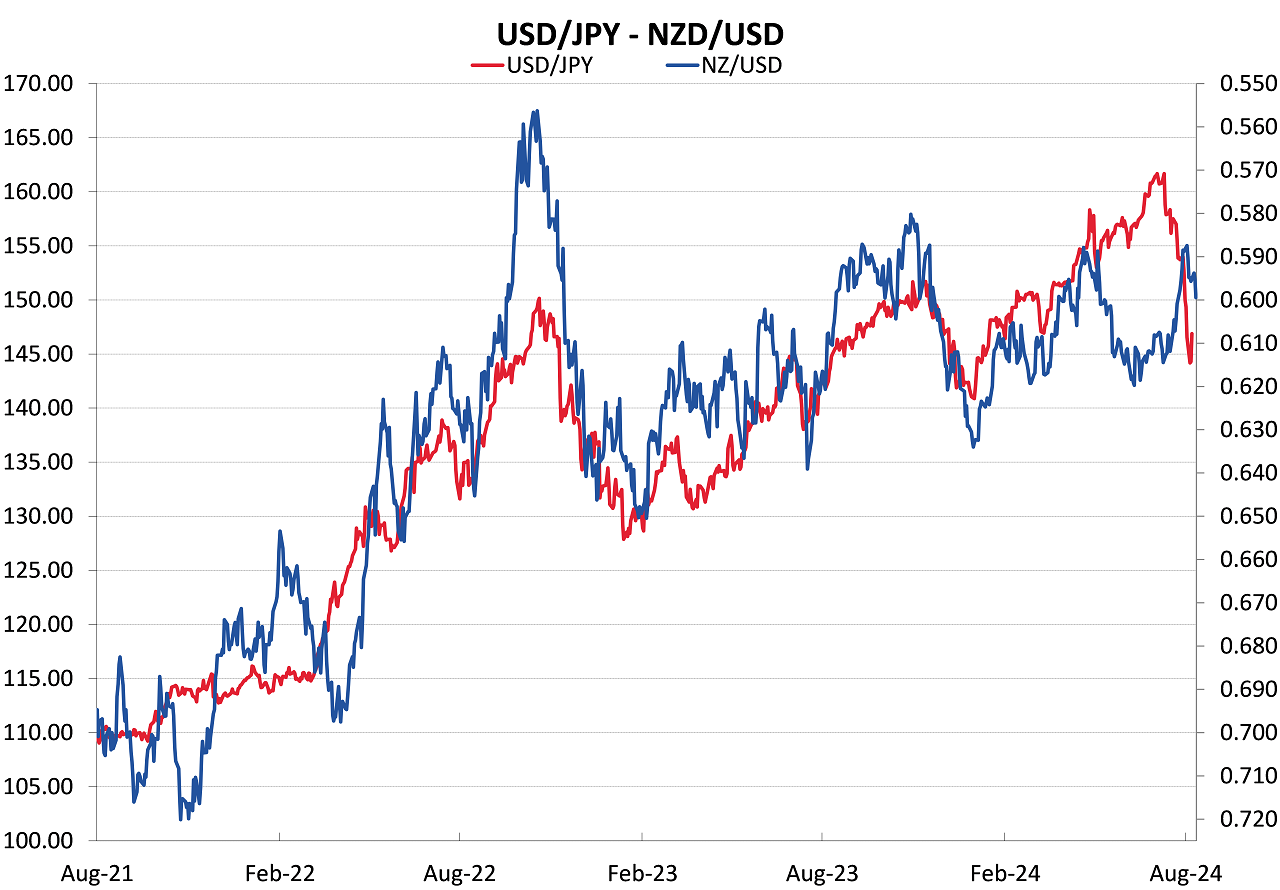
In our FX market report two weeks ago, we highlighted the connections between the Japanese Yen/USD exchange rate and other Asian currencies (including the NZD and AUD). The chart below depicts the Japanese Yen’s depreciation over the last three years against the USD (red line, left hand axis), the Yen weakening from 110 to 162 (now 145). The Kiwi dollar has not depreciated as much as the Yen in percentage terms; however, the directional relationship is close. The NZD/USD rate (blue line, inverted right hand axis) had weakened over recent weeks when the Yen strengthened on the unwinding of the carry-trades. However, over the medium term, the Kiwi does follow the Yen’s direction against the US dollar. It is estimated that the Yen carry-trades are now 75% unwound, so the intensity of Yen buying has somewhat abated.
Looking ahead, significantly lower US interest rates and higher Japanese interest rates suggests that the USD/JPY exchange rate still has a long way to go in its re-alignment i.e. continuing Yen strength to 130 (equivalent to 0.6500 NZD/USD) and 120 (equivalent to 0.6700 NZD/USD).
Who to blame for the electricity price crisis
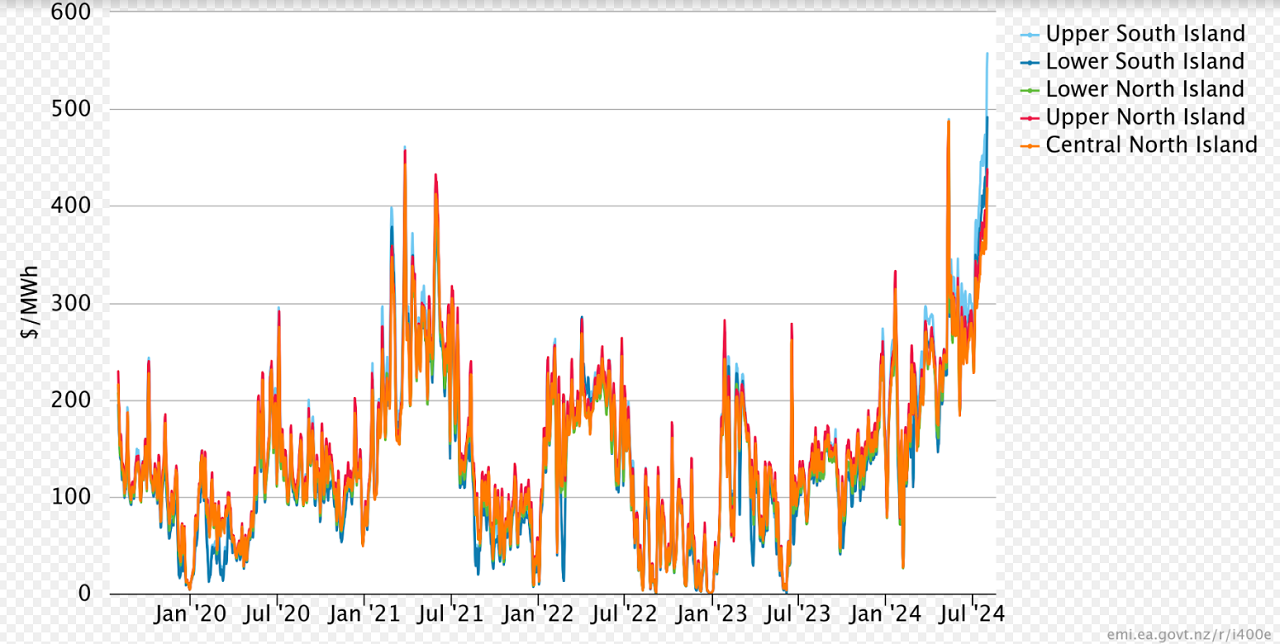
In typical Kiwi fashion, we like to point the finger and find someone to blame for things going wrong. The current electricity price crisis is a case in point. The “perfect storm” of a combination of factors of low hydro lake levels, low winds and higher winter demand has spiralled spot electricity prices higher. We cannot entirely blame climatic conditions, so we search for other scapegoats. The previous Ardern Labour Government has part culpability here as they stopped all new oil and gas exploration at a time when the existing offshore Taranaki gas fields were running out a lot faster than all forecasts. We now have a shortage of gas and are burning expensive imported Indonesian coal at the Huntly peaking generation plant. The Ardern Government also planned to build the massive Lake Onslow pumped hydro generation capacity, which stopped all other electricity generators from planning any new capacity. We fail help ourselves in this country!
Several pulp manufacturing facilities around the North Island are now threatening closure due to unaffordable electricity prices, they are all blaming the listed power generation companies for price gauging and profiteering. Pressure is mounting on the National Coalition Government to step in and intervene on electricity prices. The large industrial users are citing a failure of the electricity market and that someone should provide a subsidy to them so that they stay in business.
An examination of electricity spot market prices over recent years would suggest that the industrial users have had plenty of opportunity to buy forward fixed-price electricity contracts to hedge themselves against market price spikes, such as we are experiencing now. If they have not hedged their price risk under formalised risk management policies of minimum and maximum hedging limits over specified forward time periods, then they only have themselves to blame. Clearly, the overseas-owned pulp manufacturers have been playing the roulette wheel in the spot electricity market without prudent forward hedging protection. Managing electricity price risk is no different to hedging FX, interest rate and commodity price risk.
It is alarming that such large and sophisticated companies running pulp manufacturing plants in New Zealand adopt such high-risk business practices with one of their biggest operating costs.
NZ electricity spot prices (2020 to 204)
Kiwi dollar undervalued on the “Big Mac” currency index
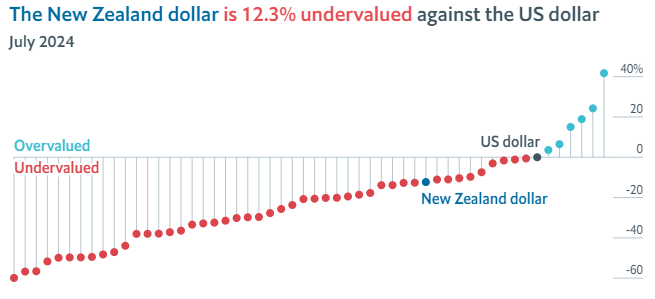
It is not the perfect method to measure one currency value against another, however there are not many products that are essentially exactly the same in all counties of the world. The Economist magazines “Big Mac Index” has been published for many years now, the latest measure has the Kiwi dollar 12.30% undervalued against the US dollar. A Big Mac costs NZD8.40 in New Zealand and USD5.69 in the US, an implied exchange rate of 0.6750. The Swiss Franc is 42% overvalued.
Daily exchange rates
Select chart tabs
*Roger J Kerr is Executive Chairman of Barrington Treasury Services NZ Limited. He has written commentaries on the NZ dollar since 1981.
We welcome your comments below. If you are not already registered, please register to comment
Remember we welcome robust, respectful and insightful debate. We don't welcome abusive or defamatory comments and will de-register those repeatedly making such comments. Our current comment policy is here.