
The Reserve Bank won’t be hiking the Official Cash Rate (OCR) until it sees more inflationary pressures and a stronger economy.
On Wednesday, the Reserve Bank’s Monetary Policy Committee left the OCR unchanged at 2.25%. This was expected but perhaps, less expected was a “dovish” view of the future.
It was also Anna Breman’s first OCR review, having come on board as Reserve Bank (RBNZ) Governor at the end of 2025.
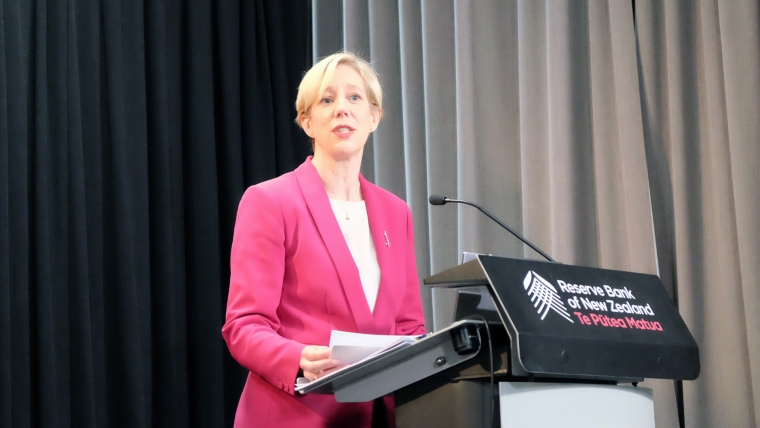
Speaking at a Monetary Policy Statement press conference, Breman told reporters that all the new data the RBNZ has, shows the economy is continuing to recover either at the end of this year or the beginning of next year.
“We do see that we are in the early stages of an economic recovery. But it’s true that many households will not feel this yet. They’re still feeling the high inflation that we had over the past few years. Many businesses are still struggling,” Breman said.
“But what we are seeing is that the data is showing us that we are at the early stages of a recovery and we want to keep the OCR on hold to support the recovery while ensuring that inflation falls back to target.”
Annual inflation, as measured by Statistics NZ's consumers price index (CPI), hit 3.1% in the December quarter, a touch over the top of the Reserve Bank’s 1% to 3% target range.
“We’re not planning on hiking the OCR until we see more inflationary pressures and a stronger economy. That’s the best projection we can do right now.”
RBNZ Assistant Governor Karen Silk, a member of the Monetary Policy Committee, added that monetary policy takes a while to transmit through to the economy.
“If we look at the two-year swap rate for example, that’s 270 basis points lower than it was at its peak and that takes time to transmit through to the economy. So we are still expecting to see transmission from prior cuts occurring through this year as well and that will continue to support the economy,” Silk said.
Flat house prices
In the forecasts contained in the February MPS, the RBNZ is now forecasting house prices won't move at all this year. In the MPS in November, the RBNZ forecast a 3.8% rise in the 2026 calendar year, but now the forecast is for 0.0%.
The RBNZ forecasts house prices will rise a modest 3.0% next year and then 4.6% in 2028.
Breman said the data they’ve seen shows households are being very cautious.
“We’ve seen that supply of new homes is relatively high. So we do expect to see house prices stabilise and go up over the medium term. But we don’t expect the same fast rise in house prices.”
RBNZ Chief Economist Paul Conway said this would be a big change for the New Zealand economy and that was why the committee was highlighting a downside risk to consumption or household spending.
“Without that kicker from the housing market, we think that household spending is going to become more dependent on what happens in the labour market rather than what happens in the housing market," Conway said.
“And given that we’ve got a pick up in the labour market, given lower interest rates, we think that is going to modestly increase house prices going forward.”
Breman said: “We’ve seen that historically house prices have been important for consumption growth in New Zealand. And now given that we see that we don’t expect house prices to increase that quickly going forward, labour market conditions [have become] relatively more important.”
Breman said they did see the labour market strengthening this year.
“So what would be good for household consumption is that more people will be employed and also that when inflation falls, then household purchasing power will be restored. So wages are still subdued, but with inflation falling, household purchasing power will be higher and that will support consumption growth.”
Compared to historical trends, she said, the committee thought this would be relatively more important.
Unemployment rate
New Zealand’s jobless rate rose to 5.4% in the December quarter, from 5.3% previously – with 165,000 people unemployed in the last three months of 2025.
The move upwards in the unemployment figure came as there was a meaningful rise in the 'participation rate', meaning people who make themselves available for work, to 70.5% from 70.3%.
This meant the number of people not regarded as being 'in the workforce' dropped by 6000 during the quarter. So, in other words 6000 more people actually made themselves available for work in the quarter, which will have had a significant impact on the unemployment figures.
Economists at the time said there was plenty of evidence to suggest the data was positive and the recovery in economic activity was starting to have a positive influence on that labour market.
Mortgage rates
When asked how comfortable she was with where mortgage rates were currently, Breman said; “we have discussed the fact that financial conditions have tightened, which is part of that, and wholesale interest rates have gone up and the mortgage rate has been following up”.
“We do think that might be causing some of the caution we see [with] household spending and also as Paul [Conway] discussed, more modest house price increases going forward. So we do see that is likely dampening demand a little bit currently.”
Asked about where she expected mortgage rates and term deposit rates to go within the next couple of months, Breman said the RBNZ saw market expectations as very much in line with Wednesday's OCR decision.
“We haven’t seen many more movements today in financial markets after the decision just came out … so we expect this to be approximately what the market was expecting.”
Silk said banks took a lot of factors into account when they are setting their mortgage rates.
“Obviously future expectations of where the OCR is heading is one of those critical aspects because that feeds into the wholesale rates. And in November, we did see a tightening in financial conditions as the market adjusted its view on where the next move in the OCR would be.”
Silk said the traditional measures they talked about as being where the average home lending rate is in terms of stock of mortgages, “we think that’s roughly at 5.1%”.
“It has the potential to move a little bit lower because we still see one and two-year rates certainly below those levels but it’s not the same magnitude that would have seen prior to the November statement. So still a wee way to go yet, but maybe 20 or 30 points at most.”
Silk said it was not the same magnitude because for the one and two-year rates, banks passed through that increase in wholesale rates into the mortgage rate. “So they lifted at least initially.”
Another reason, Silk said, was movement.
“So households moving out of six-month, for example, mortgage rates - moving much more out into that one and two-year which we definitely saw happen post the November statement.”
‘A little bit more exaggeration built into it’
When asked if the Reserve Bank regretted some of its commentary around the November Monetary Policy Statement, Silk said following that statement, financial markets did revise their perspective on where the next interest rate cut would come from.
“What we saw in terms of market movement went well beyond where the central scenario for the OCR tracks in terms of what the monetary policy had to say. So that was a market decision.
“It wasn’t reflective of what the Monetary Policy Committee was saying at that particular point in time. And that was held up at a higher level.”
Silk said part of that is because of the market’s own interpretation of what they think is happening in terms of economic conditions and what they then think their own positions need to be at that particular point in time.
“I would say, in terms of market participants, their job in part is to guess what the next move is. And so you will always see a little bit more exaggeration built into it.”
Silk said she did not think that was particularly reflective of the communication of the November MPS.
“The committee was very confident about its own position at that point in time, just as we are confident of our position at this point in time. And I’d note that the market track is still above our own position.”
An extra OCR review next year
When Breman was first announced as RBNZ Governor, in her first speech to reporters, she said: “The Reserve Bank lists high in international rankings of transparency, but I do believe that there is more work that needs to be done, so we will strive for transparency, accountability and clear communication within all the work that we do.”
When asked if there had been further discussions about transparency, Breman announced the committee is planning to move to eight monetary policy review meetings next year, up from seven. This is something she shared she was interested in changing in December.
She said the RBNZ would continue to communicate - she will be talking to businesses, attending and speaking at events, and so will other committee members
Asked about how her first policy meeting went, Breman said there were excellent discussions with good input from staff.
Compared to her time at the Riksbank in Sweden, Breman said it was similar and the process was similar.
“It’s the same commitment from the people working here to New Zealanders. People really care about the job they’re doing. They know it’s important and that’s very much the same, and that is the key of what we’re doing.”
‘Content to bide their time’
ASB senior economist Mark Smith said the RBNZ seems to have “sufficient comfort on the inflation outlook to be able to reduce monetary policy accommodation in measured and gradual steps”.
“The RBNZ appear content to bide their time.”
Smith said ASB continued to pencil in a 25 basis-point OCR hike in December.
“Nonetheless, we harbour concerns on the inflation outlook and see the risk of inflation outcomes hovering closer to 3% than 2% in 2026. This highlights the risk of a more frontloaded and protracted OCR tightening cycle."
ANZ chief economist Sharon Zollner said with only six weeks until the RBNZ’s next opportunity to express its views, “in that context, it is appropriate that the committee delivered what is essentially a placeholder statement”.
“Neither the housing market nor the labour market is looking like they will turn inflationary any time soon – and indeed the housing market data turned softer in January."
“The bounce in headline inflation is awkward, admittedly, and pricing intentions in our ANZ Business Outlook survey signal that the RBNZ needs to stay alert," Zollner said.
“But risks are not one-sided, and while a large and increasing majority of firms may say they intend to raise their prices, they may in practice find that very difficult in an economy where many are still cash constrained. No need to scare the horses. As you were.”
Westpac chief economist Kelly Eckhold said they continued to expect there would be no more policy easing this cycle, and believed the RBNZ would raise the OCR from the December meeting.
“The timing of the return of the OCR to higher, more neutral levels will depend on the pace of the eventual recovery and the evolution of inflation,” Eckhold said.
“The MPC (Monetary Policy Committee) seems to feel comfortable that they have time to assess, and the bar to justify OCR ‘lift-off’ remains high. Hence risks of a 2027 start are perhaps a bit higher than we thought before but what’s clear is that risks of a pre-election hike seem low as of now.”
“Much will depend on how economic activity and the labour market evolves over 2026,” Eckhold said.
We welcome your comments below. If you are not already registered, please register to comment
Remember we welcome robust, respectful and insightful debate. We don't welcome abusive or defamatory comments and will de-register those repeatedly making such comments. Our current comment policy is here.