
By Gareth Vaughan
The year was 1984. Bruce Springsteen was singing "Born in the USA" and Madonna "Like a Virgin." Mullet hairdos were in and the launch of TV series "Miami Vice" made it cool for men to wear pink and have stubble. The Cold War rumbled on whilst Ronald Reagan and Margaret Thatcher trumpeted their economic recipe of small government and free markets.
Here in New Zealand the cantankerous and divisive Robert Muldoon was both our prime minister and finance minister, as he had been for nine years. This was the era of the Bastion Point protest, Springbok tour, price and wage freezes and Think Big. In NZ the free market very much took a back-seat to Muldoon.
That all changed after an inebriated Muldoon called a snap election in June 1984 and lost it a month later to the Labour Party led by David Lange. Lange, and his finance minister Roger Douglas, inherited a weak economy, a NZ dollar whose value was fixed against a basket of other currencies, and rising government debt off the back of the Think Big projects, whose aim had been to gain NZ more energy independence and create jobs after the oil price shocks of the 1970s.
After his defeat Muldoon stayed on in Parliament. And as an opposition MP a few years later, he turned up as narrator in a stage version of the camp musical the Rocky Horror Show. One of the best known songs from the show is "Time Warp." Recently I've been reminded of both Muldoon and the Time Warp song by NZ politicians' attitudes towards government debt during our election campaign.
Because it feels to me as if their attitude towards government debt continues to be framed by a 1980s mindset, and that the ghost of Muldoon still looms large in their thinking. Relitigating the 1980s is not the right approach in 2020 because today we live in a very different, rapidly changing world. I'm going to set out why this is the case and why it matters. But first things first.
Treasury's recently issued Pre-Election Economic and Fiscal Update (PREFU) forecasts government debt will rise 249% over five years. I am comfortable with that but I anticipate many readers aren't. That's not surprising given the prevailing narrative from our politicians, business leaders and media pundits about government debt. Heck, the resurgent ACT, complete with apoplectic leader David Seymour, has even launched a debt destroyer website.
However, I'm going to argue here that our rising government debt is actually a good thing at the moment.
A 249% debt rise
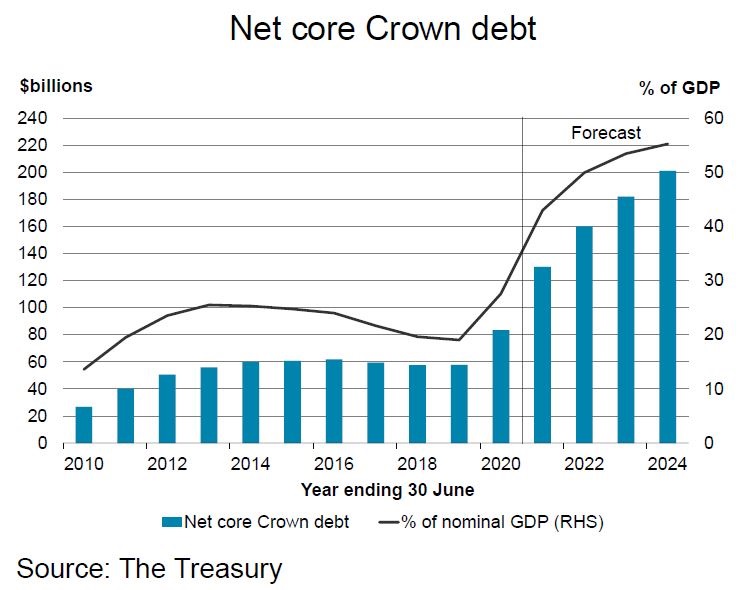
The PREFU has ongoing operating balance before gains and losses (OBEGAL) deficits peaking at $31.7 billion in 2020/21. Net core Crown debt is forecast to rise by $143.4 billion between June 2019 and June 2024 to $201.1 billion. Of course this is primarily related to the COVID-19 pandemic and the government response to it.
In May's Budget Treasury described COVID-19 as a once in a century public health shock causing major disruption to life and economic activity globally, and thus drastically altering the economic outlook both here and overseas. In terms of the impact COVID-19 is having globally that seems a reasonable statement. It also highlights that however the NZ government responded to COVID-19 we were going to have a recession this year.
So just what is our government debt?
Let's now take a look at what our government debt actually is. New Zealand Debt Management, a unit of Treasury, oversees government borrowing. NZDM issues debt via nominal bonds, inflation-indexed bonds, Treasury bills and Kiwi bonds. These interest paying securities are sold to investors and are all denominated in the NZ dollar. That's important because via the Reserve Bank, the NZ government is the monopoly issuer of the NZ dollar, a sovereign fiat currency.
Fiat money is government-issued currency that is not backed by or convertible into something our government could run out of such as a physical commodity like gold or another country's currency, but by the government that issues it. It's illegal for anyone else to issue the NZ dollar. This means we control our own money supply. And importantly the Labour government that ousted Muldoon floated the NZ dollar, against all currencies, in March 1985. Since then the Kiwi dollar's value has been set by the foreign exchange market.
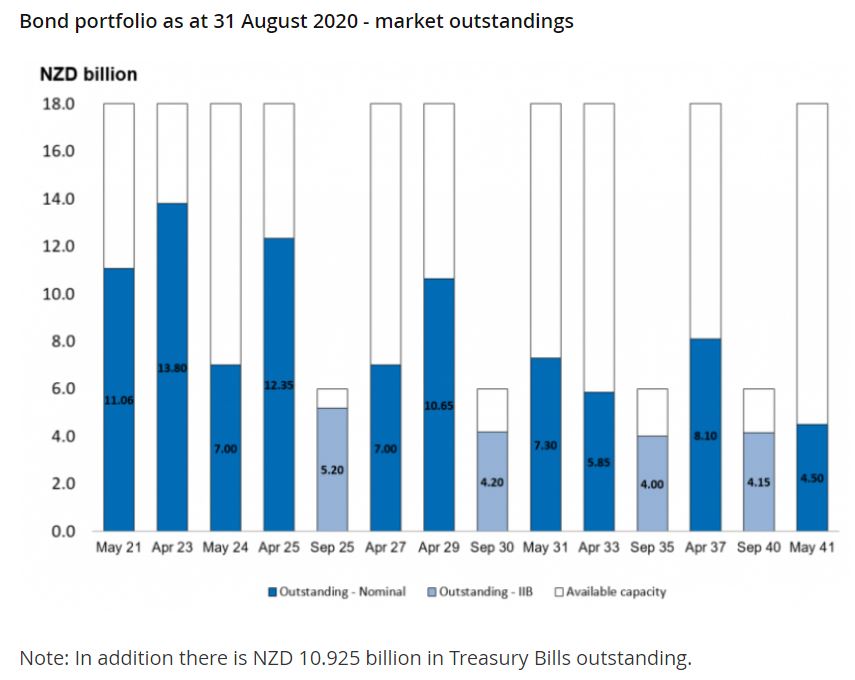
Treasury bills are wholesale fixed-term debt securities issued for terms of three months, six months and one year. Nominal bonds are wholesale fixed-term debt securities with an initial maturity of more than a year. The longest dated government bond on issue is not due to mature until 2041, that's 21 years from now. The government raised $4.5 billion through this bond issue in July, which is paying investors annual interest of 1.75%. Other countries, however, issue bonds for much longer terms. Austria, for example, recently issued a 100-year bond that's paying investors 0.88% interest.
NZDM also issues inflation-indexed bonds, which are wholesale fixed-term debt securities with an inflation-indexed component. These bonds have an initial maturity of one year or more. A bit like term deposits, Kiwi bonds are the main product offered to individual investors who must be NZ residents.
NZDM also has a euro-commercial paper programme, which issues a type of short term unsecured debt security maturing in less than a year. These can be issued in a range of currencies. The value of debt on issue through this programme is currently equivalent to NZ$1.130 billion.
Additionally NZDM has alternative funding mechanisms available to help meet any short-term Crown cash needs if, and when, they arise. These include an overdraft facility with the Reserve Bank, the Reserve Bank itself, and up-to-date legal documentation for a Euro Medium Term Note programme which is similar to the commercial paper programme, should this be required.
Temporary overdraft increase
The limit on the Crown overdraft facility was temporarily increased to $10 billion from $5 billion for a three month period to July 1 this year, and, according to the Reserve Bank, was utilised for a short period. This coincided with a $5.29 billion government bond maturity in April. Subsequently the account has been replenished following the issuance of additional bonds and Treasury bills. At the end of August the overdraft facility had a positive balance of $23.8 billion.
NZDM generally looks to buy back bonds prior to their maturity to smooth cash flows and to enable investors to recycle their money into new government bonds. Outstanding bonds are typically bought back within 18 months of maturing, with the Reserve Bank taking responsibility for buybacks during the final six month period before a bond matures to ensure overall financial system liquidity.
NZDM says the average weighted maturity of government bonds has increased to 7.9 years from 4.5 years in 2009. The Government has committed to maintaining government bonds on issue at not less than 20% of Gross Domestic Product (GDP) over time to support fiscal resilience and liquidity, and instil confidence in financial market intermediaries and investors.
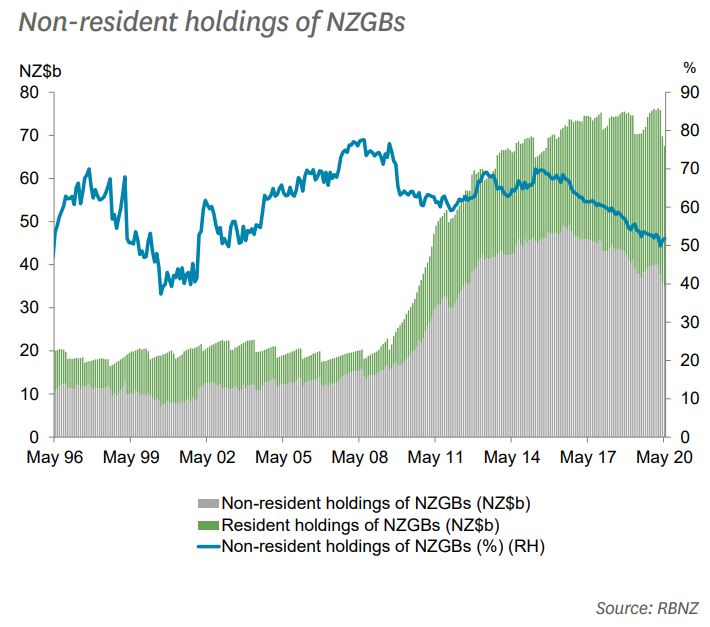
So who holds NZ government debt? Aside from Kiwi bonds, think banks, pension funds and fund managers, or professional investors, here and overseas holding it on behalf of clients. This includes KiwiSaver fund managers, and the likes of the NZ Super Fund and Accident Compensation Corporation. The percentage of NZ government bonds held by non-residents has been falling in recent years, as demonstrated by the chart below, and was at 51.8% at May 31.
Government securities pay investors periodic interest payments and are usually considered low-risk investments because the issuing government backs them. NZ currently has strong sovereign credit ratings from key international credit rating agencies. Credit ratings provide investors with an indication of the creditworthiness of an entity in which they are considering investing. NZ's sovereign rating is the highest possible Aaa from Moody's and the second highest possible AA+ from S&P and Fitch.
And what was government borrowing comprised of in Muldoon's day?
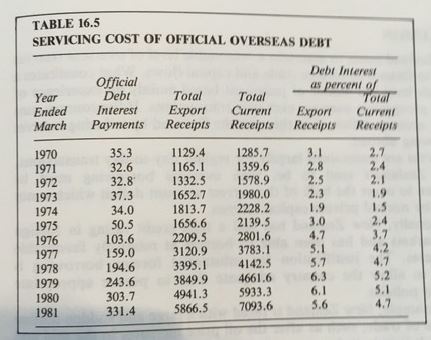
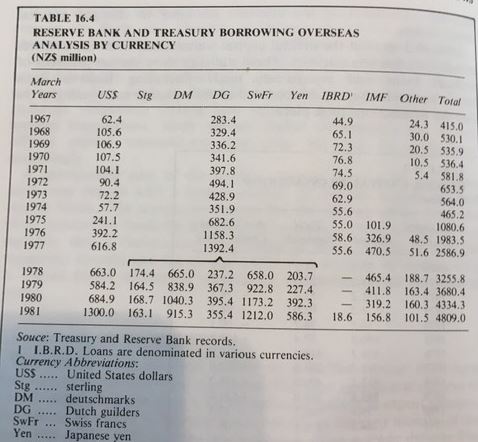
Government borrowing looked very different in Muldoon's day. Prior to the establishment of the NZDM in 1988, government borrowing was handled by a Treasury finance division with support from the High Commission in London, and the embassies in Washington and Tokyo. There was no domestic bond market, so extensive and complex overseas borrowing - where interest rates were typically lower in an era of high interest rates and high inflation following the 1970s oil shocks - was in vogue.
Types of borrowing included direct placements with investors, syndicated loans, private placements with investors and public bond issues. The investors were mostly fund managers and pension funds from a range of countries and the government borrowed in a smorgasbord of currencies including the pound sterling, Deutsche mark, Swiss and French francs, Dutch guilder and Japanese yen. The government also had syndicated standby credit facilities offering short term financing if needed with Lloyds Bank and Citibank.
Shortly after the 1984 election the NZ dollar was devalued by 20%. Given the government borrowing in a range of other currencies, the devaluation immediately increased the country's foreign debt. The average cost of borrowing when exchange rates were factored in ranged from 14% to 18% between 1965 and 1984.
The tables below, taken from the Reserve Bank 1981 book External Economic Structure and Policy, provide some details on NZ's overseas debt in that era.
What QE actually means
As part of its response to the COVID-19 crisis, the Reserve Bank in March launched its Large Scale Asset Programme, or Quantitative Easing (QE). Through this the central bank is buying NZ government bonds from market participants such as banks and pension funds in the secondary market. It's currently planning to buy up to $100 billion worth with new money by June 2022, and could ultimately own around 60% of the outstanding NZ government bonds on issue.
Thus the Reserve Bank is far and away the biggest player in the NZ government bond market. That should keep bond vigilantes, or investors keen to exert power by selling government bonds, or threatening to, and thereby making deficit-spending more expensive, at bay. And through QE the Reserve Bank is siphoning government debt out of the bond market. Sure it remains debt. And the PREFU forecasts the Government effectively buying back its own debt at a premium from banks and pension funds will cost $11.1 billion over three years. But it's debt issued by one arm of government being held by another arm of government.
How does the Reserve Bank exit its bond holdings? As a bond comes to maturity, for example a November 2020 bond issued 10 years ago, the Reserve Bank gets its money back from the Government in November and its holding decreases by the amount of the bond. The Reserve Bank is deliberately buying longer dated bonds, so it takes longer for them to roll off or mature. There has been some speculation the Government could simply write-off government bonds being held by the Reserve Bank. However, both Labour and National say they won't do this.
It's important to remember the key reason the Reserve Bank is undertaking QE is because it believes this will help meet its monetary policy remit. That is: Keep future annual inflation between 1% and 3% over the medium term, with a focus on keeping future inflation near the 2% mid-point, and to support maximum sustainable employment. QE is suppressing interest rates to make borrowing more attractive and encourage economic activity. That means low mortgages rates make housing look more attractive pushing up house prices, and very low bank deposit rates increase the appeal of the share market.
Thus concerns are being raised that, because it benefits asset owners, QE is increasing wealth inequality. In the US, where their experience of QE dates back a decade, a Columbia University report for the Department of the Treasury concludes QE more than likely mitigated income inequality in the US, but just as likely exacerbated wealth inequality and consumption inequality. However, I'll leave a fuller debate over the pros and cons of QE for another article.
What the politicians say
Let's now take a look at what our politicians are saying about government debt.
ACT's Seymour says "our current fiscal track is totally unsustainable." His deputy Brooke van Velden says new government borrowing is equivalent to "$28,000 for each and every New Zealander," and likened the impact of government borrowing on future generations to "fiscal child abuse."
National Party leader Judith Collins says "we cannot continue to have this line of economic morphine in our bloodstreams anymore." NZ First leader Winston Peters wants to "start to pay down debt so that our children are not saddled with the oppressive burden facing them."
Labour's Jacinda Ardern and Grant Robertson, whilst saying increasing government debt on their watch has been necessary to cushion the impact from COVID-19 on households and businesses, are keen to maintain small-c conservative credentials where government borrowing's concerned. Under pressure to implement a short extension to the Wage Subsidy when Auckland returned to COVID-19 Alert Level 3 in August, Ardern said this wasn't going to happen because every dollar borrowed has to be paid back. Post-PREFU Robertson was keen to note that because the Government’s cash position has improved since May's Budget, Treasury has reduced its borrowing programme over the next four years by $10 billion.
And Robertson gave short shrift to pleas for more government support from the struggling central Auckland hospitality sector, where restaurants, bars and cafes have been hard hit by COVID-19 restrictions and office workers working from home. Robertson also says Labour's fiscal plan leaves $12.1 billion of the $50 billion so-called COVID-19 Response and Recovery Fund "protected," which if not needed to combat the health and economic impacts of COVID-19, won't be spent.
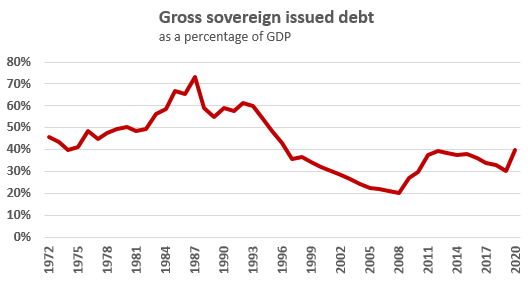
Treasury's PREFU has net core Crown debt-to-GDP at 55% by 2024. National wants to bring this down to 36% within 14 years. Either way, the target is an arbitrary one.
By and large business and media attitudes towards government debt are fearful and negative. For example, BusinessNZ says a survey it commissioned shows most businesspeople approve of the Government’s handling of the COVID-19 outbreak, but many are uncomfortable with the resultant debt. BusinessNZ says 60% of the 1,193 businesses surveyed are uncomfortable and 33% comfortable with NZ’s debt reaching 53% of GDP by 2023.
A recent NZ Herald article lumped government debt in with private sector housing, consumer, business and agricultural debt, plus local government debt, saying the combined amount owed is equivalent to about $120,000 for every man, woman and child. Unlike the central government, households, businesses and local government do not issue their own currency.
Argentina, Zimbabwe & Venezuela
Also appearing in a NZ Herald election series are articles by Richard Prebble, a key figure in the Labour government of the 1980s who subsequently became ACT's first leader. Prebble stated that if the Reserve Bank's up to $100 billion QE programme fails, "New Zealand will be another Argentina." And that both National and Labour "have adopted Zimbabwean economics."
"When we are able to travel again, we will find no one wants our money," Prebble claimed.
And Roger Partridge, chairman of think tank the NZ Initiative, reportedly said: "The road from central bank monetisation of government finance leads to Zimbabwe and Venezuela."
As demonstrated above in the explanation of what our government debt actually is, no one's going to come knocking on your door seeking $28,000, or any other sum, from you to pay back the Government's debt.
Virtually all NZ government borrowing is denominated in the NZ dollar today. Argentina defaulted on debt denominated in a currency it had no control over, the US dollar. Zimbabwe's hyperinflation earlier this century had a range of causes including land redistribution, declining economic output, price controls and increased money printing initially to finance a war in the Congo.
The oil dependent Venezuela was hard hit by the falling price of oil. President Nicolas Maduro increased money printing in response to this. Venezuela is now caught in a geopolitical power play, owing billions to China and Russia whilst being hard hit by US sanctions.
NZ's exports have been performing strongly this year. We had a record current account surplus in the June quarter, while the annual current account deficit for the June year fell to just 1.9% of GDP, the lowest for a June year since 2010.
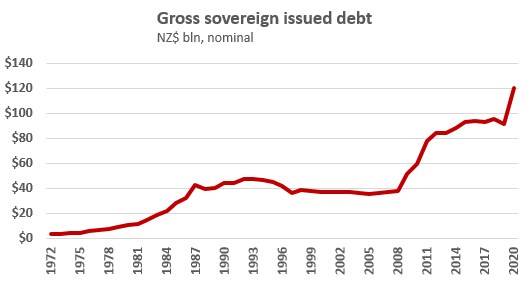
NZ Government debt
NZ Government debt as a percentage of GDP
A year when decades are happening
It was Vladimir Ilyich Lenin, the revolutionary who became the first leader of the Soviet Union, who said; “There are decades where nothing happens; and there are weeks where decades happen.” Lenin may have died 96 years ago but his "weeks where decades happen" reference could’ve easily been about 2020. COVID-19 and its monumental impacts have created the most uncertain world since World War Two. Heck, even the Olympic Games have been postponed for the first time since the Second World War. Literally no one knows when the virus will run its course, or if and exactly when reliable remedies such as anti-virals and vaccines will emerge. If battling COVID-19 itself is a marathon rather than a sprint, then combating the economic impact is likely to be a fully fledged ironman race.
A great example of the uncertainty it's causing is Treasury's PREFU forecast for unemployment to peak at 7.8% in the March 2022 quarter, which is a big shift from Treasury's previous forecast peak of 9.8% in the current September quarter. The reality is no one really knows what's around the corner, or the corner after that.
Tackling the impact of COVID-19 has ushered in the largest government interventions seen since the days of Muldoon. This has included border closures, quarantining people arriving from overseas, lockdowns and the Wage Subsidy Scheme. At its peak in May the Wage Subsidy was supporting more than 1.65 million jobs and by September 18 it had paid out $14 billion. Another example is the Small Business Cashflow Loan Scheme offering interest free loans administered by the Inland Revenue Department to help small businesses hard hit by the COVID crisis. It has seen $1.6 billion lent to small businesses to date. A third example is the COVID Income Relief Payment for people who have lost their job during the COVID crisis, which pays more money than the regular Jobseeker Support benefit.
But NZ, with its Labour-led government, is not alone in having taken such measures. For example, the UK, under a Tory government, has its Furlough Scheme, and Australia's Liberal government the JobKeeper Scheme.
Government debt is surging in other countries too, and in most cases from higher starting points. Credit rating agency Fitch recently forecast Australia's government debt to GDP ratio will hit 60.9% in 2022 up from 41.9% last year, with NZ's reaching 49.4% up from 26.8%. Fitch forecasts Japan's to rise from 232.9% last year to 260.6% in 2022!
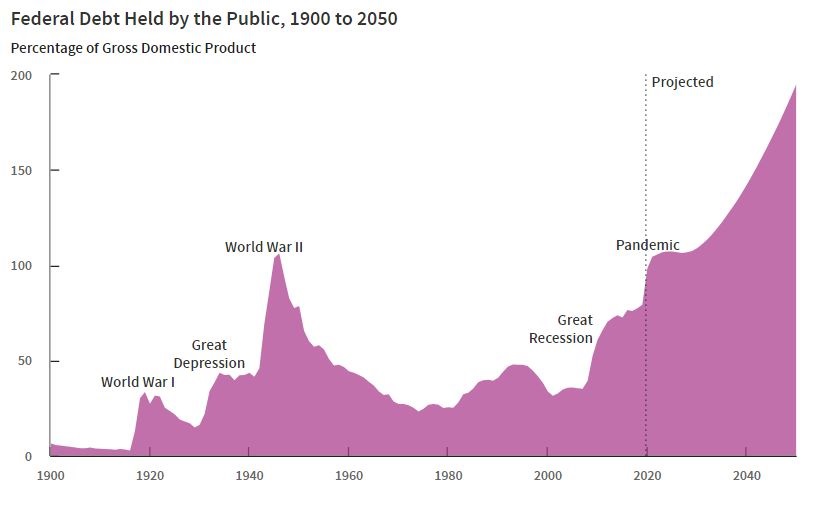
Meanwhile United States government debt will increase from 79% of GDP last year and 98% this year, to 107% of GDP by 2023, the highest in US history, according to the Congressional Budget Office.The previous high was 106% in 1946, right after World War Two. It's forecast to continue increasing, reaching 195% of GDP by 2050, (see chart below). And in the UK public sector net debt had reached 100.9% of GDP by the end of May, the first time it topped 100% since March 1963.
'A delightful moment in history'
Paul McCulley, an economist and the former managing director of high profile investment management firm PIMCO who coined the term "Minsky moment," recently cheered less obsessing over the US government deficit in a Bloomberg podcast , describing this as "a delightful moment in history."
"The budget deficit is quite big enough to take care of itself and needs to be bigger," McCulley told Bloomberg.
McCulley also hailed a sea change from a world where monetary policy has been the dominant, or even sole, economic lever for 40 years with fiscal policy, or government spending, now taking the lead. He spoke of the church and state separation of monetary and fiscal policy in the US in the 1980s, the decade when the same post-Muldoon divorce occurred in NZ with an inflation targeting Reserve Bank independent from government enshrined in law. McCulley said "robust fiscal relief" is required now because of the unique nature of the COVID-19 pandemic, and because monetary policy has largely run its course, having hit "the zero bound."
The US Fed Funds Rate, their equivalent of our Official Cash Rate (OCR) is at 0.00% to 0.25%. Here the OCR's at 0.25%, with the Reserve Bank expected to take it negative next year.
And as McCulley also pointed out, the multi-decade war to slay the inflation ogre "has been over won."
This point was hammered home late last month when US Federal Reserve chairman Jerome Powell announced that whilst the Fed's long-term goal continues to be an inflation rate of 2%, "following periods when inflation has been running below 2%, appropriate monetary policy will likely aim to achieve inflation moderately above 2% for some time."
To most of us that doesn't sound like a big concession. But in central banking it is. And remember the Fed is the world's most important central bank presiding over the biggest economy and the world's reserve currency.
The subtle sounding change means the Fed will be less likely to increase interest rates when the unemployment rate falls, as long as inflation doesn't rise too. Typically central bankers have felt low unemployment will lead to higher inflation, which they’ve preemptively acted against. This is good news in the US where tens of millions of jobs have been lost this year, and official unemployment figures have been as high as 14.7% with 23.1 million people out of work.
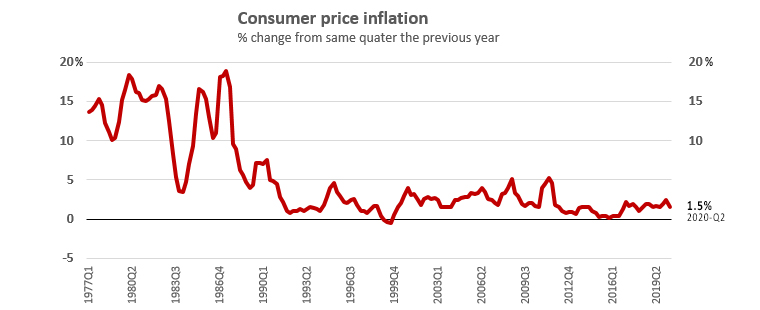
NZ CPI inflation since 1977
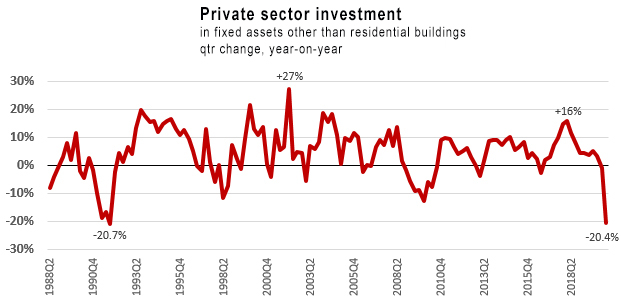
Picking up on McCulley's point about wanting a bigger deficit, private sector investment has fallen sharply in NZ this year (see chart below). This risk aversion hasn't been surprising given the challenging and uncertain world of COVID-19. But it means the private sector has pulled back from investing in the economy. At a time like this the Government is the obvious alternative.
'The expected increase in public debt is entirely manageable and is affordable'
On the theme of monetary policy's limitations when faced with COVID-19, Reserve Bank Governor Adrian Orr acknowledged: "We are first to admit that the front line economic support is fiscal policy." In a recent speech Orr also spoke of: "...the limitation of monetary policy in promoting economic activity when confronted with a pandemic. We can create the environment to spend and invest, but we can’t force it to happen. The outcome instead depends on confidence amongst households and businesses. This also highlights why fiscal policy has been at the forefront to economic support globally – governments are able to directly spend and invest, and ensure resources are mobilised."
Reserve Bank of Australia Governor Philip Lowe has gone further than Orr, specifically making the case for higher government debt in the wake of the global pandemic. Lowe told politicians that fiscal, rather than monetary, policy had provided much of the support to the Australian economy during the pandemic and this was a good thing.
"This is quite a change from how things have worked over recent decades and it is being accompanied by a significant increase in public borrowing as governments work to limit the hit to people's incomes. This shift in fiscal policy is quite a shock for a country that has got used to low budget deficits and low levels of public debt," Lowe said.
He went on to say that by borrowing today to support the economy Australia was avoiding an even bigger loss of output and jobs that would damage its economy and society for years to come, putting an ongoing strain on the budget. Australia's public finances, like NZ's, are in strong shape and public debt is lower than in most other countries, and thanks to staggeringly low interest rates, government financing costs have never been lower.
"This all means that the expected increase in public debt is entirely manageable and is affordable. It is the right thing to do to borrow today to help people, keep them in jobs and boost public investment at a time when private investment is very weak," said Lowe.
In Canada's recent Speech from the Throne Governor General Julie Payette outlined the direction and goals of prime minister Justin Trudeau's government.
"This COVID-19 emergency has had huge costs. But Canada would have had a deeper recession and a bigger long-term deficit if the Government had done less," Payette said.
"With interest rates so low, central banks can only do so much to help. There is a global consensus that governments must do more. Government can do so while also locking in the low cost of borrowing for decades to come. This Government will preserve Canada’s fiscal advantage and continue to be guided by values of sustainability and prudence." (Canada's government debt to GDP ratio was 53.3% in March. Fitch forecasts it will top 120% in 2022).
Turning Japanese as the cost of capital falls to zero
Rather than scaremongering over Argentina, Zimbabwe and Venezuela, Prebble & Co would do better to look to Japan. Rising government debt, low inflation and weak economic growth have been features there since Japan's finance and real estate bubbles burst. Japan's government debt has been steadily climbing since 1990. Its government debt to GDP ratio pushed through 100% in the late 1990s, breached 200% in 2010 just before the massive earthquake and tsunami of 2011, and has continued rising since. After more than two decades of low interest rates, Japan's debt-servicing cost is approximately zero with the Bank of Japan buying up Japanese Government Bonds by the bucket load.
Raf Manji, a strategy and risk consultant and former Christchurch City Councillor, told me in May of his experiences trading the yen and Japanese government bonds (JGBs) in a previous life. Holding a short position in JGBs led to a big losing trade for him. The Japanese were "printing money like crazy" and Manji expected JGBs to go down when they just kept going up. Manji was one of many traders who lost by betting against Japanese sovereign debt in what became known as the widow maker trade.
With little inflation or growth, Manji describes Japan as a highly advanced but post-consumer society. This may not be an ideal scenario, but nor is it a worst case one.
Someone else I've interviewed this year is the Hong Kong-based Macquarie strategist and author Viktor Shvets. He argues that technological disruption and financialization started creating a new world in the 1970s, and the COVID-19 pandemic is a dislocation that's accelerating change. The financialization began when US President Richard Nixon ended the post-World War Two collective international currency exchange regime, or Bretton Woods Agreement, in 1971. This had seen other currencies pegged to the US dollar, which was itself pegged to the price of gold. Shvets argues Nixon's move ushered in an era of leverage and strong asset price inflation.
In this world the role of capital and labour are different to how they're traditionally viewed in capitalism. Rather than being scarce and allocated carefully, capital is now abundant. In fact in a world of QE we're drowning in it, Shvets says, although it's not evenly or fairly distributed. And as technology develops in this information age, led by artificial intelligence, human labour is becoming less relevant.
Thus generating more capital than we need is required to support asset prices, which have become the backbone of the economy. And as we generate more capital than we need, the cost of capital, or the cost of a company's funding, falls to zero. The lower the cost of capital gets, the faster technology proliferates, Shvets argues, because with the cost of capital so cheap, almost any idea can be funded.
Probability that #Automation will lead to job losses in next decade or two. pic.twitter.com/Ii9coIlns2
— HumanVSMachine (@HumanVsMachine) September 20, 2020
An inflation comeback?
The Shvets thesis is that capitalism as we know it is irreparably broken and will be replaced by something else in coming years. But of course there are other views.
There are pundits who believe the scale of the global monetary and fiscal stimulus being splashed around to combat COVID-19 could lead to rising inflation after three decades of deflation. Such a situation could see a sharp spike in interest rates. Chetan Ahya, Morgan Stanley's chief economist and global head of economics, is one of them. Ahya argues the monetary and fiscal policy easing underway around the world is essential to get out of the low-growth, low-inflation loop of recent years, and will disrupt the three key deflationary forces of the past three decades, being technology advances, trade rules and corporate titans.
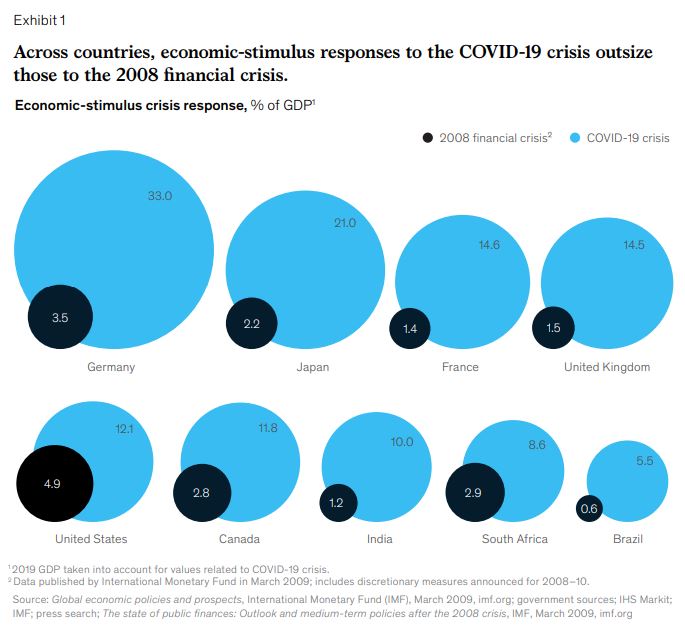
Ahya says inflation may emerges from 2022 onwards, and overshoot central banks’ targets. Bernstein analysts also suggest the public policy response to the COVID-19 pandemic will be inflationary because of its scale, the social impact of the pandemic highlighted by high unemployment, and government debt among OECD countries in line with levels reached at the end of World War Two. The diagram below from McKinsey and Company shows the scale of COVID-related economic stimulus from several countries. Note, this dates from June.
But right now central banks are worried about deflation, not inflation. In its August Monetary Policy Statement the Reserve Bank forecast consumer price inflation of just 0.4% next year, 0.8% in 2022 and 1.5% in 2023. If the inflation ogre does re-emerge surely we will know what to do, we can draw on our experience of the past 30 plus years.
In the meantime NZ government bonds were recently issued with a negative yield for the first time. That means an investor receives less money when the bond matures than what they originally paid for the bond. And as I recently pointed out, despite NZ government bond issuance surging since COVID-19's emergence, the interest bill on the debt isn't following suit. In fact despite having borrowed almost four times as much money via bond issues this year to date as in all of 2018, the government's interest bill is $21 million lower.
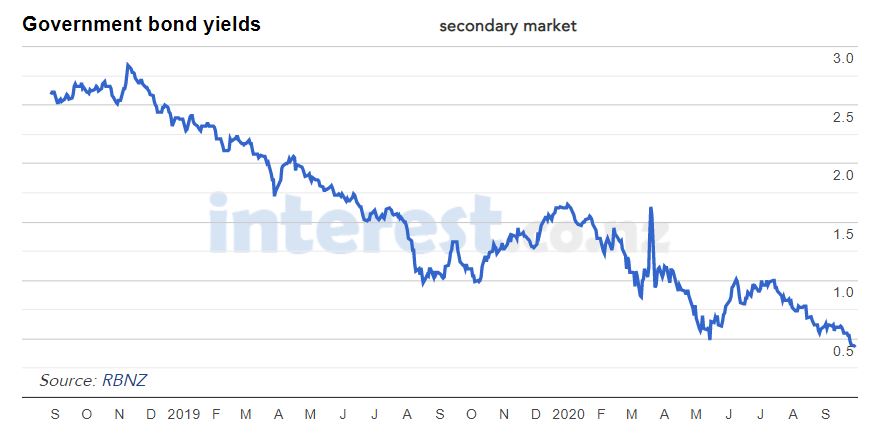
In the tweet below Martin Whetton, head of fixed income and foreign exchange strategy at ASB's parent Commonwealth Bank of Australia, points out a significant volume of the NZ government bond market is now in negative yield land.
A good chunk of the NZGB market is now in negative yielding territory. pic.twitter.com/pTCOLsSXW7
— Martin Whetton (@martin_whetton) September 21, 2020
Post-Muldoon Parliament passed the Public Finance Act in 1989. It sets out principles of responsible fiscal management.
Under the Act, the Government must reduce total debt to prudent levels. This is to provide a buffer against anything that might impact adversely on the level of total debt in the future by ensuring that, until those levels have been achieved, total operating expenses in each financial year are less than total operating revenues in the same financial year. Additionally once prudent levels of total debt have been achieved, they must be maintained by ensuring that, on average, over a reasonable period of time, total operating expenses don't exceed total operating revenues.
The Act also says when formulating fiscal strategy the Government should have regard to its likely impact on present and future generations. There is some wriggle room, however. The Government may depart from the principles of responsible fiscal management temporarily, if the Minister of Finance states the reasons for the departure from those principles, the approach the Government plans to take to return to those principles, and the period of time the Government expects to take to return to those principles.
At risk of being burnt at the stake as a heretic, in the world Shvets describes would the principles of responsible fiscal management in the Public Finance Act still be relevant?
Awash with debt
According to the Institute of International Finance, global debt to GDP reached a new record high in the first quarter of 2020 at US$258 trillion, or 331% of GDP.
If the inflation hawks are right and inflation makes a comeback with interest rates rising significantly in this debt sodden world, how many borrowers holding a slice of that US$258 trillion will simply not be able to continue servicing their debts, or pay back the principal borrowed? How many of NZ's home owners with mortgages would face severe financial stress, especially if unemployment was also high?
In this scenario is it against the realms of possibility that something will simply have to give? Could it be some sort of debt jubilee, or debt forgiveness, as proposed by Australian economist Steve Keen, or the Great Reset that US pundit John Mauldin talks about? Or will the days of fiat currencies come to an end, with a return to something like the Gold Standard, or perhaps something completely different?
I don't have the answers to that. But what I do know is that in a 2020 world I'm not going to lose any sleep over our government debt-to-GDP ratio whether it's 35%, 55% or 75%.
And that $12.1 billion that Robertson's keen not to spend? Couldn't we actually put some of it to good use?
At the onset of the COVID-19 health crisis NZ wasn't as well prepared as it could have been despite warnings stretching back at least as far as SARS in 2003 that a major global pandemic was on the cards. The Global Health Security Index, issued last November, ranked us 35th out of 195 countries with a score of 54 out of 100. In contrast Australia came in fourth with a score of 75.5. Writing at the time the University of Otago's Matt Boyd, Michael Baker and Nick Wilson said: "This poor result suggests that the NZ Government needs to act promptly to upgrade the country’s defences against pandemic threats."
What about building some proper quarantine facilities outside our cities so we're better prepared for the next pandemic? In normal times they could be used for the likes of school camps and conferences. Meanwhile, the Government is tipping $180 million into the Canterbury District Health Board basically to keep the lights on after a decade featuring earthquakes and a terrorist attack on the city's mosques. That's even though Treasury acknowledges underfunding is one reason for the DHB' s deficit. Wouldn't a bigger contribution help bolster core services?
Then there's education. An RNZ story last week highlighted Auckland's five year-old Ormiston Primary School, which is converting its boardroom, staff room, principal's office and library into classrooms as a school designed for 700 students sees its roll approach 1000.
Our politicians passed the Zero Carbon Act last year, with the support of all parties in Parliament except ACT. Under the Act, the Government must strive to meet the target of zero net carbon emissions by 2050, with the Climate Change Commission established to advise and monitor the Government. Climate Change Commissioner Rod Carr told me that electrification is a significant opportunity for NZ to reduce its emissions, as long as the electrification is powered by renewable energy sources.
Achieving this is a major undertaking, requiring significant investment in increasing renewable energy production, upgrading how we move energy from where it's produced to where it's used, and incentivising the uptake of electric vehicles. Carr also says we need a national energy plan for the next 30 years.
Then there's the tourism industry, hit by the loss of overseas tourists. In a report last December Simon Upton, Parliamentary Commissioner for the Environment, noted international visitor numbers were approaching four million and could rise as high as 13 million annually by 2050. The sheer numbers of people are eroding the sense of isolation, tranquillity and access to nature that many overseas tourists seek when visiting NZ, Upton added, questioning whether we were in danger of killing the goose that laid the golden egg. Thus surely now is the perfect time to work out a preferred post-COVID approach to tourism for NZ.
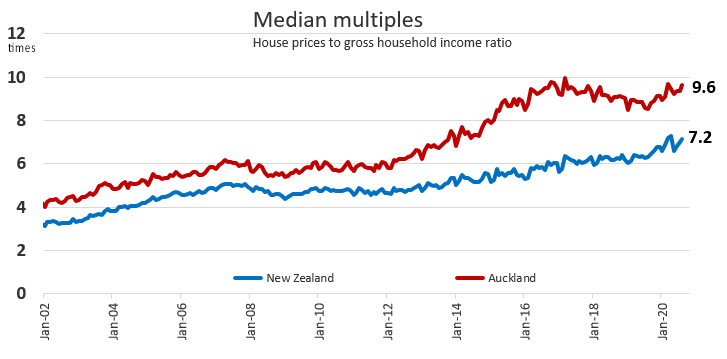
I am a parent. Leaving government debt for my kids and grandchildren is not something that worries me. There are many other issues I would prefer to see us focus on. These include what sort of housing is going to be affordable and available for them. Just look at the house price to income multiples in the chart below. Additionally will they be able to find fulfilling work, what state will the planet be in, what state will our infrastructure be in, how fractured along social media bubble lines and haves and have nots might society be, and what type of world leaders and regimes will be ruling the roost?
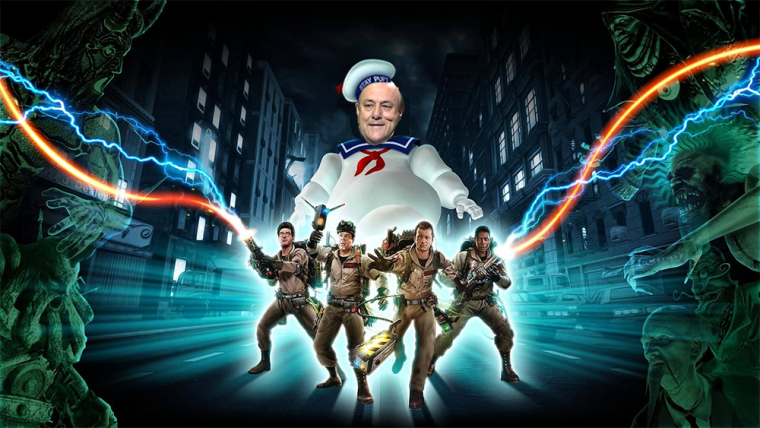
Muldoon's ghost as the marshmallow man
The original "Ghostbusters" film, about a group of ghost catchers in New York City, came out in 1984, the year of Muldoon's electoral Waterloo. There's a famous scene in the film where the heroes successfully battle a giant ghost marshmallow man. Muldoon's political demise ushered in a sea change, ultimately right across NZ society. But our understanding of government debt has not evolved. In NZ's fiscal version of "Ghostbusters," Muldoon is the marshmallow man. Now, 36 years after his political demise and against the backdrop of COVID-19, the time is again ripe for some major changes. Moving on from 1980s style thinking about government debt, and focusing on issues that really matter for New Zealand, would be a good start.
(This article is part of Interest.co.nz's Election Series).
*This article was first published in our email for paying subscribers. See here for more details and how to subscribe.
We welcome your comments below. If you are not already registered, please register to comment
Remember we welcome robust, respectful and insightful debate. We don't welcome abusive or defamatory comments and will de-register those repeatedly making such comments. Our current comment policy is here.